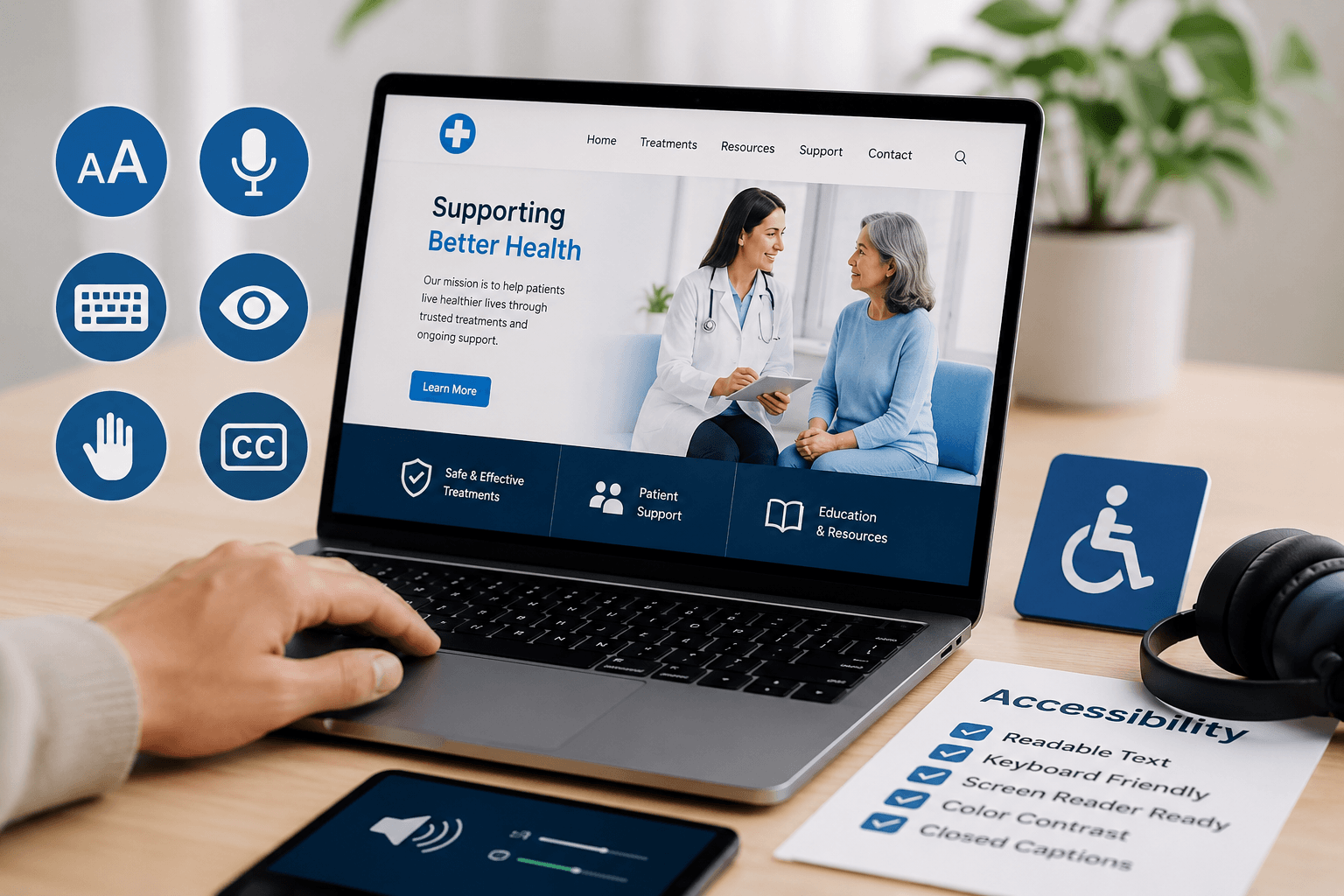
It’s easy to treat pharma website accessibility as little more than a technical checklist. Yet for patients, the questions are much more basic: Can I read this? Can I hear it? Can I navigate it? Can I understand what I should do next? A pharmaceutical website may have strong creative, useful educational content, and a carefully planned media strategy. However, if patients with visual, auditory, motor, or cognitive disabilities cannot use it, part of the intended audience may never receive the message. So, rather than viewing accessibility only as a compliance issue, pharma marketers should also see it as a way to improve audience reach and the patient experience.
Table of Contents
- Why accessibility is a pharma marketing issue
- Where patients encounter digital barriers
- Making safety information accessible
- Building accessibility into the customer experience
- Conclusion
- Frequently Asked Questions
Website Accessibility Is an Audience-Reach Issue for Pharma
Pharmaceutical marketers invest heavily in reaching the right patients at the right moment. However, reaching someone with an advertisement does not mean that person can successfully use the destination website. Accessibility barriers can interrupt the journey after a patient clicks, searches, or scans a QR code.
This matters because the audience affected is broader than many marketers assume. The W3C Web Accessibility Initiative notes that age-related changes in vision, hearing, dexterity, and cognitive ability can affect how older adults use websites. Those needs often overlap with the needs of people with disabilities. As a result, accessible design can make digital experiences easier for a much wider patient population.
Consider a patient who has difficulty seeing low-contrast text. Another patient may rely on a keyboard rather than a mouse. Meanwhile, someone watching a treatment video may need captions to understand it. Each person arrived because the content was relevant, but a design decision could determine whether the journey continues.
Consequently, website accessibility should be part of a pharma brand’s audience strategy from the start. Every inaccessible interaction can become a point of friction between awareness and action. For marketers, that means accessibility can directly affect engagement and the overall patient experience.
Accessible Pharma Content Removes Patient Barriers
Many accessibility problems are surprisingly ordinary. Small text, weak color contrast, unlabeled buttons, missing alternative text, and confusing page structures can all make a website harder to use. Likewise, videos without captions can exclude people who cannot reliably hear the audio.
Screen-reader compatibility is another important consideration. A page may look perfectly organized to a sighted visitor but become confusing when headings, links, forms, or images lack meaningful structure. Therefore, semantic headings, descriptive links, useful image descriptions, and properly labeled forms should be considered part of content quality.
Keyboard navigation also matters. W3C accessibility guidance addresses the ability to operate website functionality using a keyboard and emphasizes visible keyboard focus. In practical terms, patients should be able to move through menus, forms, buttons, and other interactive elements without relying on precise mouse movements.
Mobile usability adds another layer. Patients may encounter a pharmaceutical brand while sitting in a waiting room, commuting, or researching health information at home. Consequently, readable type, clear buttons, logical navigation, and content that works when enlarged can improve the experience across devices.
Making a pharma website more accessible does not mean making every page visually plain. Instead, it asks creative and development teams to remove unnecessary barriers. Better accessibility and better user experience often point in the same direction: clearer choices, easier navigation, and content people can understand.
Readable Safety Information Matters Too
Accessibility becomes especially important when a website communicates drug benefits and risks. A beautiful treatment page loses value if important safety information is difficult for a patient to perceive or navigate.
The U.S. Food and Drug Administration requires prescription drug advertising to present an appropriate balance between effectiveness and risk information. Its guidance also makes clear that presentation can matter. Typography, layout, contrast, headlines, paragraphing, and white space can affect whether risk information receives appropriate prominence and readability. Pharma marketers can review the FDA’s Office of Prescription Drug Promotion FAQs for additional information.
That connection should get marketers’ attention. Accessibility is not simply about whether safety language exists somewhere on a page. Teams should also consider whether patients can find, read, navigate, and understand that information.
For example, low-contrast Important Safety Information can create problems for people with reduced vision. Dense blocks of small text may be difficult for older users or people with cognitive limitations. Similarly, inaccessible expandable sections can make critical information harder to reach for someone navigating by keyboard or assistive technology.
FDA research has also examined how the location of risk information on branded prescription drug websites can affect consumers’ risk knowledge. Therefore, accessibility and information architecture should be considered together rather than handled as separate tasks.
Build Accessibility Into the Pharma Digital Experience
The strongest approach is to build accessibility into the pharma website workflow rather than trying to fix problems immediately before launch. Strategy, UX, creative, content, development, legal, regulatory, and media teams all have a role.
Start by asking how different patients will experience each important journey. Can someone using a screen reader understand the page hierarchy? Can a keyboard-only visitor reach every interactive feature? Are videos captioned? Is essential information communicated through more than color alone? Can text be enlarged without breaking the experience?
Next, test real tasks rather than focusing only on individual pages. For instance, evaluate whether a patient can move from a campaign landing page to treatment information, locate safety content, find support resources, and complete a form. This approach connects digital accessibility directly to marketing outcomes.
Accessibility testing should also continue after launch. New campaign modules, videos, forms, consent tools, and website updates can introduce barriers over time. Therefore, regular reviews can help preserve an accessible patient experience as digital properties evolve.
For pharmaceutical marketers, this creates a useful shift in thinking. The question is no longer simply, “Does the website meet accessibility requirements?” A better question is, “How much of our intended audience can successfully receive and act on our message?”
For more perspectives on pharmaceutical marketing and digital engagement, explore Pharma Marketing Network. Brands looking at accessibility as part of their broader digital advertising strategy should also consider how inclusive experiences can support effective healthcare digital marketing across the patient journey.
Conclusion
An accessible pharma website can determine who gets to participate in a brand’s digital experience. Screen-reader support, captions, keyboard navigation, strong color contrast, readable safety information, and mobile usability are not minor technical details. Together, they shape whether patients can find and understand important information.
Moreover, accessible design can benefit older adults, people with disabilities, and many other users facing temporary or situational barriers. As pharmaceutical brands compete for attention and trust, removing digital friction can make their communication more useful and inclusive.
Ultimately, the most important accessibility question may be the simplest one: After investing in reaching patients, can every patient actually use the experience you created?
Frequently Asked Questions
What does website accessibility mean for pharma brands?
Website accessibility means designing pharmaceutical sites so people with different visual, hearing, motor, and cognitive abilities can use the content effectively. That includes making information easier to perceive, navigate, understand, and interact with.
Why should pharmaceutical marketers care about accessibility?
Accessibility can affect audience reach, engagement, and customer experience. If patients cannot navigate a landing page, watch a video, read safety information, or complete an action, marketing performance can suffer.
What are common accessibility problems on pharma websites?
Common barriers include low color contrast, missing video captions, poor keyboard navigation, unclear link labels, inaccessible forms, weak heading structures, small text, and images without useful alternative text.
Does accessibility matter for Important Safety Information?
Yes. Patients need to be able to perceive and navigate important risk information. FDA materials also emphasize the prominence and readability of risk information in prescription drug promotion, including factors such as typography, layout, contrast, and white space.
How can pharma brands improve website accessibility?
Brands can incorporate accessibility into content, UX, design, development, and testing from the beginning. Teams should also test important patient journeys with assistive technologies and review digital properties as content changes.
This content is not medical advice. For any health issues, always consult a healthcare professional. In an emergency, call 911 or your local emergency services.