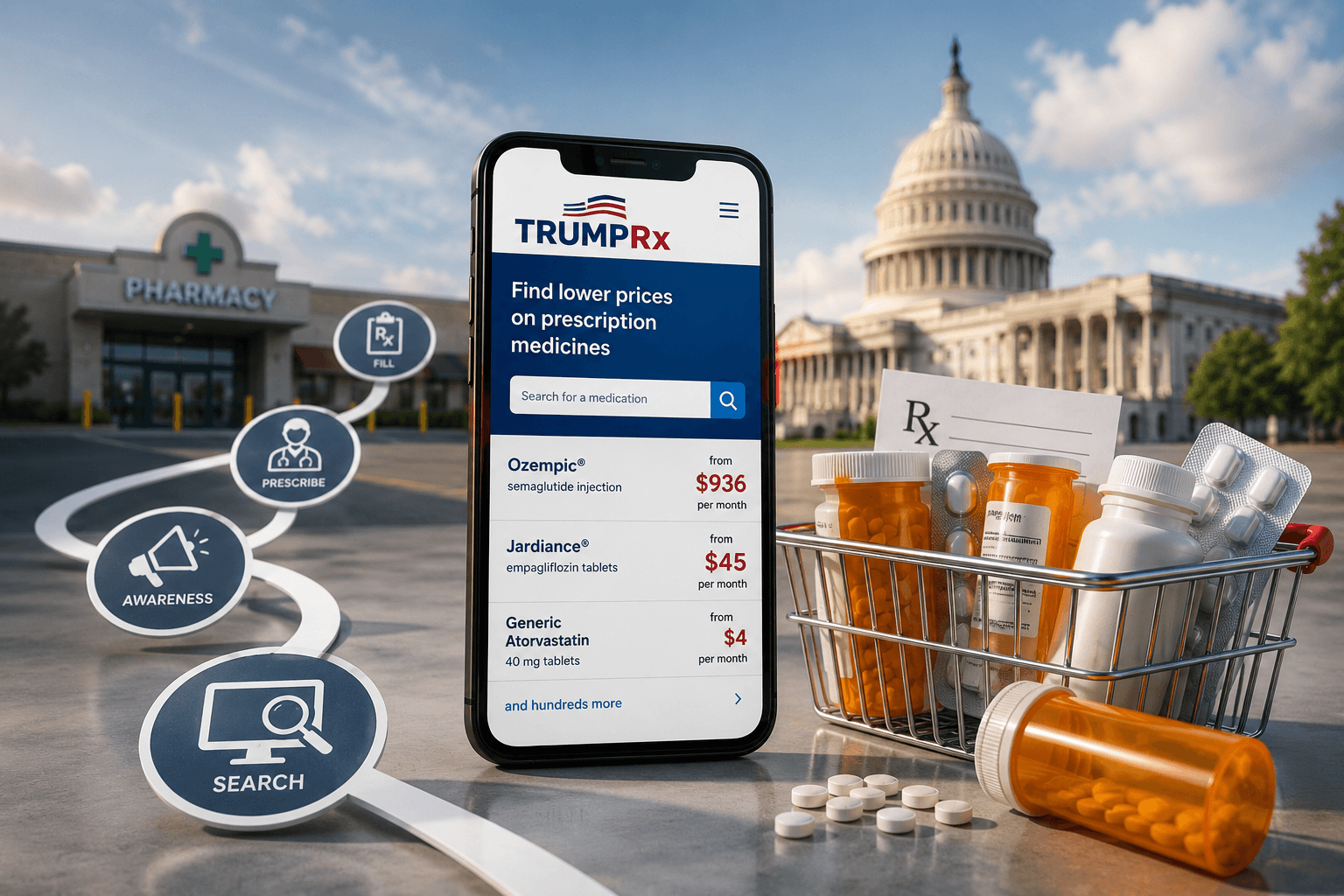
For decades, pharmaceutical marketers have worked with a fairly familiar customer journey. A patient sees an ad, searches for a condition or branded drug, visits a manufacturer website, talks with a healthcare professional, and eventually reaches a pharmacy. TrumpRx adds something unusual to that path: the federal government.
The implications of this shift go beyond drug pricing. For pharma marketers assessing TrumpRx, the bigger question is whether a government platform can become a meaningful discovery and conversion point between pharmaceutical brands and patients.
Table of Contents
- TrumpRx changes the prescription drug discovery journey
- What TrumpRx could mean for branded search and DTC marketing
- Affordability becomes part of patient acquisition
- How pharma marketers can adapt
- Conclusion
- FAQs
TrumpRx Changes the Prescription Drug Discovery Journey
TrumpRx is no longer simply a policy concept. The federal platform lets consumers search prescription medicines and explore pricing options. Its catalog includes branded offers as well as hundreds of generic medications. Some listings guide patients toward coupons or other ways to obtain lower self-pay prices through the TrumpRx platform.
That matters because discovery is one of the most valuable parts of the pharmaceutical customer journey. Traditionally, manufacturers have invested heavily in search, television, social media, patient education, and disease-awareness campaigns to generate that discovery.
Now, a patient motivated primarily by price may begin somewhere else.
For example, someone searching for a lower-cost medication can use TrumpRx to browse medicines and investigate available offers. Individual listings may also direct consumers toward additional pricing or fulfillment information. Meanwhile, branded drug information can put affordability in front of a patient before that person ever reaches a manufacturer’s traditional digital experience.
As a result, pharma marketing strategies may need to account for TrumpRx as a new patient touchpoint rather than simply another prescription pricing website.
Importantly, this does not eliminate the physician, pharmacy, manufacturer, or payer. Instead, it potentially inserts another influential step into an already complicated patient journey. That change matters because the organization controlling a discovery touchpoint can influence what information patients encounter next.
Branded Search and DTC Marketing Face a New Intermediary
Search has long connected direct-to-consumer advertising with deeper brand engagement. A patient sees an advertisement for a medicine, searches the brand name, and then chooses among manufacturer pages, healthcare publishers, pharmacy sites, telehealth providers, and other results.
TrumpRx creates another possible destination.
The platform can give consumers access to pricing and savings information that may be especially compelling for people concerned about out-of-pocket costs. Therefore, marketers may need to reconsider what a branded search conversion actually means.
The goal cannot always be to move every consumer directly from a paid or organic search result to a manufacturer-controlled page. Instead, pharmaceutical companies increasingly operate within an ecosystem where patients move between government resources, manufacturer websites, pharmacies, healthcare publishers, prescribers, and other healthcare platforms.
That creates an attribution challenge. A television or digital campaign might generate awareness, Google could capture intent, TrumpRx might help answer the affordability question, and a manufacturer program or pharmacy could ultimately help the patient obtain the medication.
Consequently, measuring the final click alone may reveal very little about what actually persuaded the patient.
For pharmaceutical marketing, the customer journey increasingly looks less like a simple funnel and more like a network of connected decision points. Marketers need to understand how those points work together instead of treating each channel as an isolated interaction.
Affordability Messaging Becomes Part of Patient Acquisition
Price has always mattered to patients. However, affordability information can now appear much earlier in the discovery process. That changes the competitive environment for pharmaceutical brands.
TrumpRx brings prescription pricing and potential savings into a consumer-facing environment. At the same time, manufacturer savings programs, cash-price platforms, pharmacies, and other services already compete for patients searching for ways to reduce medication costs.
Therefore, TrumpRx raises an important issue for pharmaceutical marketers: affordability information can also influence patient acquisition.
Patients do not necessarily separate “marketing” from “access” as neatly as industry teams often do. Someone asking, “Can I afford this medicine?” is also deciding whether to continue exploring that brand, discuss it with a healthcare professional, or consider another treatment option.
Consequently, manufacturer websites may need to make pricing support easier to understand and find. Patient assistance, savings programs, insurance guidance, and fulfillment instructions should not sit several clicks away from the main brand experience.
At the same time, marketers should avoid treating price as the entire brand proposition. Clinical information, appropriate patient education, safety information, and conversations with healthcare professionals remain essential.
The opportunity is to connect those pieces more effectively. A patient who understands both the potential role of a medicine and the available access options is better equipped to have an informed conversation with a healthcare professional.
How Pharma Marketers Can Adapt to the TrumpRx Era
The first response should be journey mapping. Brand teams can identify where TrumpRx, manufacturer direct-to-consumer programs, pharmacies, search engines, healthcare publishers, and telehealth services now intersect with patient intent.
Next, teams should examine branded search behavior. If consumers increasingly search combinations such as a drug name plus “price,” “coupon,” “TrumpRx,” “savings,” or “cash price,” those queries reveal a different type of intent from traditional disease-education searches.
Content strategy should reflect that difference.
Additionally, pharmaceutical marketers should strengthen the connection between awareness and access. A campaign that creates strong demand but leaves consumers confused about price may lose momentum precisely when patient intent is highest.
Manufacturer websites also have a new reason to become more useful. Rather than merely repeating campaign messages, they can answer practical questions about eligibility, insurance, savings, prescriptions, pharmacy fulfillment, and next steps.
Furthermore, TrumpRx could make cross-channel attribution more complicated for pharma marketers because an influential patient touchpoint may now sit outside a manufacturer’s owned media environment. Marketers should therefore evaluate search trends, qualified site visits, access-program engagement, prescription signals, and other indicators together.
Finally, marketers should monitor how TrumpRx develops. New manufacturer participation, additional medications, changes to pricing programs, and evolving consumer behavior could all influence its role in the prescription drug customer journey.
The strategic mistake would be assuming today’s customer journey will remain static.
Conclusion
TrumpRx introduces a participant that pharmaceutical marketers rarely had to consider as a consumer-facing discovery channel: the federal government.
Its long-term significance will depend on consumer adoption, manufacturer participation, pricing, and how the platform evolves. Nevertheless, the direction is important. Patients have another place to search for medicines, investigate affordability, and decide what to do next.
For pharma marketers responding to TrumpRx, that means brand strategy cannot stop at awareness. Search, affordability, patient education, manufacturer websites, access programs, and fulfillment increasingly belong to the same connected experience.
The brands that respond effectively will not simply buy more media. Instead, they will make the journey from interest to access easier to understand.
In that sense, TrumpRx poses a bigger question for pharma marketers: if patients have a new intermediary between advertising exposure and prescription fulfillment, how will brands earn their way into the next step?
FAQs
What is TrumpRx?
TrumpRx is a federal prescription drug platform designed to help consumers search for medications and explore available pricing options. Its role in drug discovery makes it relevant not only to healthcare policy but also to marketers studying the patient journey.
How could TrumpRx affect pharmaceutical marketing?
It could add another touchpoint between advertising, branded search, manufacturer websites, affordability programs, and prescription fulfillment. As a result, marketers may need to rethink patient acquisition and cross-channel attribution.
Could TrumpRx affect branded drug searches?
Yes. Patients who search for a brand alongside terms such as “price,” “discount,” “savings,” or “coupon” may encounter TrumpRx or related affordability resources as additional destinations. Marketers should consider this price-oriented search intent as part of the broader customer journey.
Does TrumpRx replace manufacturer websites?
No. Manufacturer websites still play an important role in product information, safety information, support programs, and brand engagement. However, those websites increasingly operate alongside external affordability and drug-discovery resources.
What should pharma marketers do first?
Start by mapping the updated patient journey. Identify where advertising, search, TrumpRx, manufacturer resources, healthcare professionals, pharmacies, and affordability programs intersect. Then measure those touchpoints as a connected experience rather than as isolated channels.
This content is not medical advice. For any health issues, always consult a healthcare professional. In an emergency, call 911 or your local emergency services.