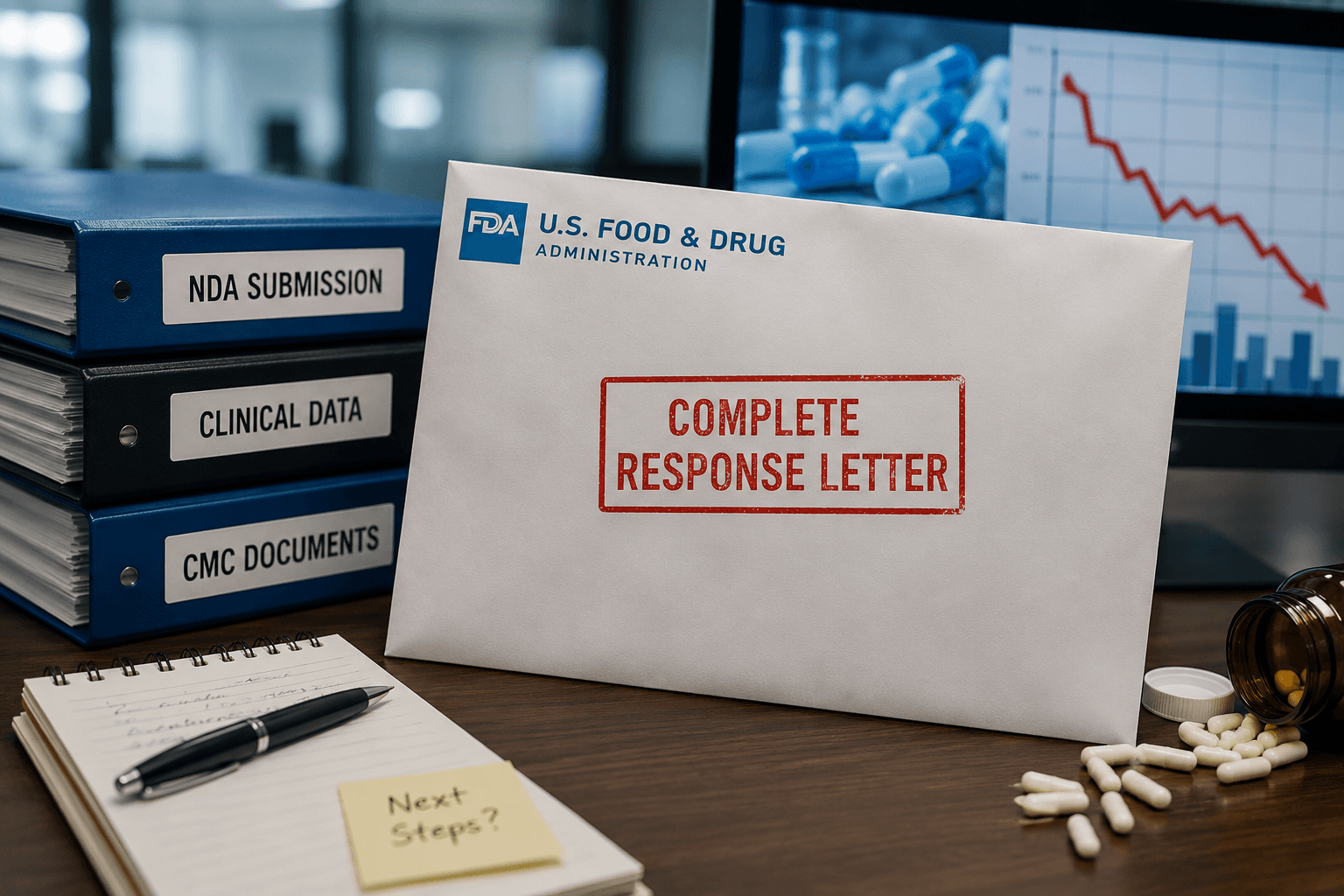
The communications playbook for a failed drug approval has changed. Complete Response Letters, or CRLs, once remained largely between the FDA and drug sponsors. A company could announce a setback, summarize the FDA’s concerns, and control much of the public narrative. Now, that information can become far easier for outsiders to examine. In September 2025, the FDA announced that future Complete Response Letters would be released promptly after being issued, with confidential commercial information, trade secrets, and private information redacted.
For pharmaceutical marketers, communications teams, and agency partners, this creates a new reality. An unsuccessful approval decision is no longer simply a regulatory event. It can quickly become an investor-relations issue, a media story, a competitive intelligence opportunity, and a test of brand credibility.
Table of Contents
- What FDA Complete Response Letters reveal
- Why CRL transparency changes pharma communications
- How public CRLs affect competitors and stakeholders
- Building a pre-launch CRL contingency plan
- Conclusion
- FAQ
What FDA Complete Response Letters Reveal to the Public
A Complete Response Letter is issued when the FDA finishes reviewing an application but determines that it cannot approve it in its current form. Importantly, a CRL is not necessarily the end of a drug’s path to approval. Instead, the letter identifies deficiencies that the sponsor may need to address before the agency can approve the application.
Those deficiencies can be significant. According to the FDA, CRLs may address safety and effectiveness concerns, manufacturing deficiencies, bioequivalence problems, or other issues uncovered during review. They may also describe steps a sponsor can take to address the agency’s concerns.
Historically, the public often received a much narrower version of that story from the drug developer. However, the FDA’s transparency initiative makes it possible to compare corporate messaging with the agency’s own explanation.
The change began accelerating in July 2025, when the FDA released more than 200 CRLs connected with drug and biologic applications submitted between 2020 and 2024. Then, in September, the agency announced that it would promptly publish newly issued CRLs while continuing to release older letters.
Today, the FDA maintains a centralized, searchable Complete Response Letters resource through openFDA. The database includes CRLs associated with approved and unapproved NDAs and BLAs, giving stakeholders a growing window into regulatory decision-making.
Why CRL Transparency Changes Pharma Communications
For years, companies had substantial discretion over how much detail to disclose after receiving a Complete Response Letter from the FDA. A press release might mention that the agency requested “additional information” or needed concerns resolved before approval. Those descriptions could be accurate while still leaving important context unexplained.
The FDA itself highlighted this problem when launching its transparency initiative. It cited a 2015 analysis by agency researchers finding that sponsors did not mention 85% of FDA safety and efficacy concerns when publicly announcing that an application had not been approved. Furthermore, when the FDA requested a new clinical trial for safety or efficacy reasons, that information was not publicly disclosed about 40% of the time.
Public CRLs dramatically narrow that information gap.
As a result, marketers should assume that statements about a regulatory setback may eventually be compared with the FDA’s letter. Journalists can do it. Investors can do it. Competitors can do it, and healthcare professionals or patient advocates can do it as well.
That means communications teams should resist overly optimistic descriptions that may look incomplete once the CRL becomes available. Instead, messaging should explain what happened accurately while providing appropriate context about the company’s next steps.
The goal is not to communicate every technical detail immediately. Rather, the goal is to avoid creating a credibility problem on top of a regulatory problem.
Public CRLs Reshape Pre-Launch and Competitive Strategy
The impact extends well beyond the press release announcing a setback. Pharmaceutical brands often spend months building disease awareness, engaging HCPs, educating patient communities, and preparing stakeholders before an expected approval.
A CRL can disrupt that momentum overnight.
Therefore, marketers need to consider how disease-awareness content, unbranded campaigns, conference activity, media outreach, and other pre-launch programs should respond if approval does not arrive as expected. Teams working with pharmaceutical and healthcare audiences should also evaluate their broader digital healthcare marketing strategies against this more transparent regulatory environment.
Publicly available CRLs also create a valuable source of competitive intelligence. Competitors can study the agency’s concerns about clinical evidence, manufacturing, safety, efficacy, and other regulatory deficiencies. Moreover, those lessons may influence development programs and communications strategies across an entire therapeutic category.
The FDA identifies this knowledge-sharing effect as a benefit of disclosure. According to the agency, greater transparency may help drug developers avoid common mistakes, improve predictability, and potentially reduce wasted development time and resources.
Consequently, CRL monitoring should not belong only to regulatory affairs. Competitive intelligence, communications, brand strategy, medical affairs, and agency teams all have reasons to watch the FDA’s growing database.
Build the CRL Communications Plan Before Approval Day
The worst time to create a crisis communications strategy is after a CRL arrives.
Instead, companies should develop an approval-day decision tree well before the PDUFA date. The plan should cover approval, delay, labeling surprises, and a Complete Response Letter. Each outcome needs clear responsibilities and an agreed communications process.
First, identify which claims can safely be made if approval is unsuccessful. Regulatory, legal, medical, investor relations, and communications teams should align before the decision date rather than negotiating language during a crisis.
Next, prepare stakeholder-specific responses. Investors may focus on timelines and additional development costs. Journalists may focus on why the FDA did not approve the application. HCPs may want to understand the clinical implications, while patients may simply want to know whether the treatment could still become available.
Companies should also prepare for the CRL itself to become searchable. The FDA’s openFDA database supports searches using fields including company name, application number, letter date, and letter text. That accessibility means discrepancies between the FDA’s language and a sponsor’s public explanation can be discovered quickly.
Finally, marketers should monitor the narrative after disclosure. Search results, trade media coverage, social conversations, analyst commentary, and competitor messaging may all shape perceptions of the setback.
In this environment, transparency is not merely a regulatory principle. It is part of reputation management.
Conclusion
Complete Response Letters are becoming a much more visible part of the pharmaceutical information landscape. What once functioned primarily as correspondence between the regulator and sponsor can now become source material for investors, journalists, healthcare professionals, patients, and competitors.
For marketers, the lesson is straightforward: plan for the possibility of a public CRL before approval day arrives. Communications should be accurate enough to withstand comparison with the FDA’s eventual disclosure, while pre-launch programs need contingency plans that can respond quickly to an unexpected outcome.
Greater CRL transparency does not prevent a company from shaping its story. However, it changes what good storytelling requires. In the new environment, context matters, speed matters, and credibility matters most.
FAQ
What are FDA Complete Response Letters?
A Complete Response Letter is an FDA communication stating that an application cannot be approved in its current form. The letter generally identifies deficiencies the sponsor must address before approval may be possible.
Are FDA Complete Response Letters public?
The FDA announced in September 2025 that it would promptly release newly issued CRLs and continue publishing additional historical letters. Published letters are redacted to protect confidential commercial information, trade secrets, and private information.
Where can marketers find published CRLs?
The FDA provides a centralized CRL resource through openFDA. Users can search published Complete Response Letters and review information about FDA regulatory decisions.
Why do public CRLs matter for pharmaceutical marketing?
They give journalists, investors, competitors, HCPs, and other stakeholders direct access to more information about why an application was not approved. Therefore, companies need public statements and communications plans that remain credible when compared with the FDA’s account.
How should pharma marketers prepare for a CRL?
Teams should build a contingency communications plan before the anticipated approval date. That plan should align regulatory, legal, medical, investor relations, brand, and communications teams while preparing messages for different stakeholders and potential public disclosure.
This content is not medical advice. For any health issues, always consult a healthcare professional. In an emergency, call 911 or your local emergency services.