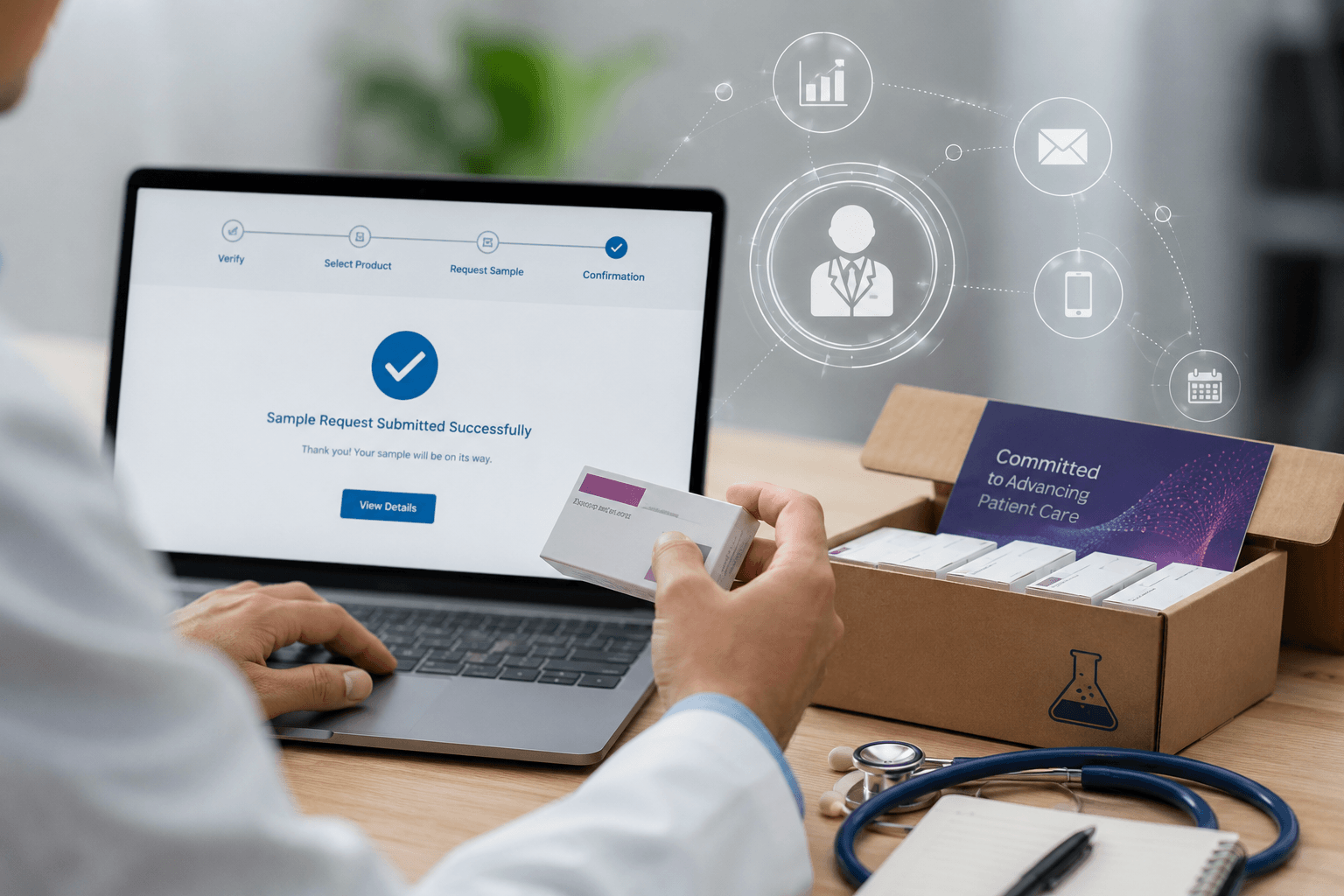
For years, pharmaceutical sampling was largely viewed as a rep-driven transaction. A healthcare professional asked for a product sample, the request was processed, and the sample was delivered. Today, pharma e-sampling is changing how that exchange happens and what marketers can learn from it. When an authenticated HCP actively requests a sample online, the action can reveal more intent than an email open, ad impression, or routine website visit. As a result, marketers have an opportunity to view digital sampling not only as fulfillment, but also as a meaningful signal within the broader HCP journey.
Table of Contents
- Why a digital sample request creates a different HCP signal
- Connecting e-sampling with omnichannel HCP marketing
- Using sample requests to inform what happens next
- Coordinating digital sampling and field engagement
- Conclusion
- Frequently Asked Questions
Why a Digital Sample Request Creates a Different HCP Signal
Not every digital interaction carries the same meaning. An HCP may see a display ad without actively engaging with it. Likewise, an email open can indicate interest, but it does not necessarily show intent. A visit to a product page offers another useful signal, yet the reason behind that visit may still be unclear.
A sample request is different because the HCP takes a deliberate action. In many digital sampling programs, the HCP must authenticate, select a product, provide the required information, and complete the request. That added effort can make the interaction particularly useful when viewed alongside other engagement data.
Importantly, a request should not automatically be treated as proof of prescribing intent. However, it can indicate that a product has become relevant enough for the HCP to take another step. Therefore, marketers can consider the request in context with prior and subsequent interactions.
The regulatory framework also makes sample requests distinct from many common marketing engagements. FDA requirements specify information that must accompany written requests for prescription drug samples delivered by mail or common carrier, including practitioner information, product identity, quantity, and date. Marketers can review the applicable prescription drug sample requirements for additional context.
Because of this structure, an authenticated sample request can create a clearly defined interaction rather than another anonymous digital touchpoint. The real opportunity comes from understanding how that interaction fits into the HCP’s broader journey.
Connecting E-Sampling With Omnichannel HCP Marketing
Pharmaceutical marketers have invested heavily in omnichannel strategies designed to connect email, websites, digital media, virtual engagement, and field activity. However, these channels can still operate in separate workflows. Digital sampling becomes more valuable when sample-request activity is considered within that connected ecosystem.
For example, imagine an authenticated HCP who reads clinical content and later requests a sample. That sequence may tell marketers more than either interaction alone. Similarly, an HCP who requests a sample after receiving a rep visit presents a different journey from someone who reaches the request independently through digital media.
Consequently, marketers can look beyond the sample request itself and examine the events surrounding it. Which content did the HCP engage with beforehand? Which channel led to the request? Did the HCP return for additional clinical information afterward? Did another meaningful interaction occur later?
These questions can help teams develop a richer picture of engagement without assuming that one action tells the entire story. In that sense, pharma e-sampling can become one useful piece of a much larger HCP engagement picture.
This approach also supports a broader shift in pharmaceutical marketing toward coordinated customer experiences. Instead of measuring channels only by isolated clicks, visits, or requests, teams can evaluate how interactions work together across the HCP journey.
Using Sample Requests to Inform What Happens Next
The value of an online sample request does not have to end when fulfillment begins. Instead, a completed request can become one input for determining an appropriate next interaction, subject to brand rules, permissions, privacy requirements, and regulatory review.
For instance, an HCP who has recently requested a sample may benefit from relevant educational content about the product or patient population. Meanwhile, another HCP may be better served by a field interaction. The key is not to create an automatic marketing response to every request. Rather, the goal is to use the signal intelligently alongside other available information.
Timing matters as well. If sample-request data remains isolated inside a fulfillment platform for weeks, its usefulness to an omnichannel program may decline. However, when appropriate data can flow into approved customer engagement systems, marketers may gain a more current view of HCP activity.
That creates an opportunity to rethink journey orchestration. Instead of relying mainly on broad segments, marketers can use meaningful behaviors to help shape subsequent experiences. A digital sample request may become one of several signals used to understand where an HCP appears to be in the engagement journey.
At the same time, governance remains essential. Prescription drug sample programs operate within specific regulatory requirements. FDA rules address electronic records, security, authentication, accessibility, and retention requirements related to drug sample records. The relevant electronic recordkeeping requirements provide further detail. Additionally, manufacturers and authorized distributors have reporting obligations involving requested and distributed samples under Section 6004 of the Affordable Care Act.
Therefore, marketing use cases should be developed with compliance, legal, privacy, IT, and sampling operations involved from the beginning.
Coordinating Digital Sampling and Field Engagement
Digital sampling does not have to compete with the sales force. In fact, e-sampling can become more useful when digital and field teams share a coordinated view of HCP engagement.
Consider an HCP who independently requests a sample between rep interactions. Where permitted and appropriate, awareness of that activity could help make the next field conversation more relevant. Instead of beginning without context, the representative may have a clearer understanding of recent engagement.
The reverse can also happen. A rep interaction may create awareness, while a later digital sample request gives the HCP a convenient way to act when the timing is right. In this case, digital sampling extends the experience rather than replacing personal engagement.
Furthermore, marketers can analyze aggregated journey patterns to understand how channels work together. Do sample requests tend to follow certain educational experiences? Are particular digital pathways associated with higher request completion? What commonly happens after an HCP requests a sample?
Those insights may help teams improve media planning, content sequencing, channel coordination, and field strategy. They can also encourage marketers to move beyond simplistic last-touch attribution.
Ultimately, a sample request should not be treated as a guaranteed outcome or a stand-alone measure of success. However, when evaluated responsibly within a wider engagement framework, it can become a valuable behavioral signal.
Conclusion
Digital sampling is expanding the role that product samples can play in the HCP journey. The operational need remains important: qualified HCPs must be able to request and receive appropriate samples through compliant processes. Yet the digital interaction can provide additional context about HCP engagement.
For marketers, the opportunity is to connect that signal with the broader journey. When sample activity is considered alongside content engagement, digital media, website behavior, and field interactions, teams can gain a more complete view of how HCPs engage with a brand.
A sample request is still a sample request. Increasingly, though, it can also help marketers understand what happened before the request and make better-informed decisions about what should happen next.
Frequently Asked Questions
What is pharma e-sampling?
E-sampling gives eligible healthcare professionals a digital way to request pharmaceutical product samples. Depending on the program, the process may include HCP authentication, electronic signatures, fulfillment, and required recordkeeping.
Why is a digital sample request a useful HCP engagement signal?
A request requires an HCP to take a deliberate action. Therefore, it may indicate a different level of engagement than passive activities such as viewing an advertisement. However, marketers should interpret the request alongside other HCP interactions rather than assume prescribing intent.
How can digital sampling support omnichannel HCP marketing?
Digital sample activity can add another behavioral signal to an HCP journey. When appropriately connected with other approved engagement data, it may help marketers understand channel sequences and create more relevant follow-up experiences.
Can e-sampling replace pharmaceutical sales representatives?
Not necessarily. Digital sampling can complement field engagement by giving HCPs another convenient way to request samples. Coordinating digital and rep interactions can create a more connected experience.
What should marketers consider before using sample-request data?
Teams should consider privacy, consent, data governance, regulatory requirements, system integration, and internal policies. Compliance and legal stakeholders should be involved when determining how sampling data can appropriately support marketing or field activities.
This content is not medical advice. For any health issues, always consult a healthcare professional. In an emergency, call 911 or your local emergency services.