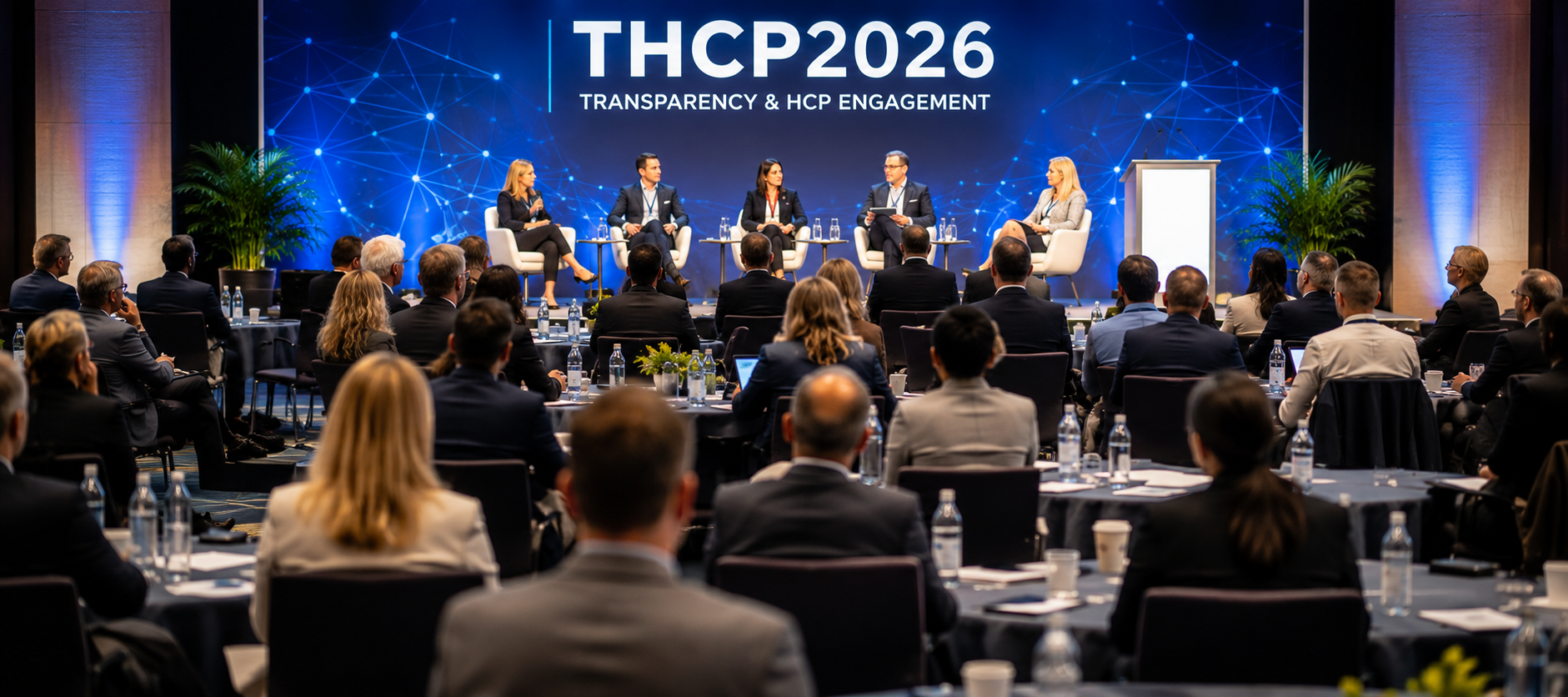
Pharma and life sciences companies are navigating an increasingly complex challenge: engaging healthcare professionals in ways that deliver genuine educational and clinical value while meeting growing expectations around transparency, documentation, data privacy and compliance.
Hosted by Informa Connect, Transparency & HCP Engagement 2026 brought together professionals from across pharma, biotech and medtech to explore HCP engagement, aggregate spend reporting, compliance monitoring, data governance and the technologies increasingly supporting those functions.
Across the sessions covered by Pharma Marketing Network, one message surfaced repeatedly: strong compliance is increasingly about designing the right processes from the beginning, rather than addressing requirements only at the end.
From documenting the educational rationale behind speaker programs to establishing governance around artificial intelligence, the conversations at THCP2026 demonstrated the value of bringing compliance, commercial, legal, finance and technology stakeholders together earlier in the process.
Transparency Starts Long Before Reporting
For companies subject to federal transparency requirements, reporting payments and transfers of value to healthcare providers may be the final deliverable, but producing an accurate report requires work throughout the year.
During “A Foundation of Transparency & HCP Engagement — A Beginner’s Guide to Doing It Right,” Mary Ann Mobley, Senior Manager, Compliance at LEO Pharma, and Brenda Crabtree, Senior Director, Commercial Legal & Compliance at Kura Oncology, presented a practical framework for building a Sunshine Act reporting program.
Their approach centered on four foundational steps: assembling the appropriate cross-functional team, identifying and mapping relevant data sources, designing the collection process, and executing and validating reporting.
That cross-functional component is critical. Transparency data can originate across travel and expense systems, accounts payable, CRM and reprint platforms, third-party vendors and other areas of an organization. No single department necessarily controls the entire picture.
The speakers emphasized that documentation should therefore begin on day one rather than when an annual reporting deadline approaches. Data sources, assumptions, processes and submissions all need to be tracked continuously.
The takeaway: reporting quality is largely determined upstream. Establishing strong processes early can make transparency reporting more accurate, efficient and manageable.
Building HCP Engagement Systems With Compliance at the Foundation
Technology can help address many of those operational challenges when the underlying workflow is thoughtfully designed.
Dawn DiPierro, Director of Global Compliance Operations at Insmed, provided a real-world example during “Modern HCP Engagement Systems — A Real-World Case Study in Implementation and Redesign.”
DiPierro walked attendees through Insmed’s experience rebuilding its HCP engagement system, including workflow gaps that prompted the redesign and opportunities to use automation to reduce manual work.
Importantly, the implementation wasn’t solely a technology project. Cross-functional alignment, documentation, process changes, stakeholder training and usability all played roles in the rollout.
Those upstream improvements ultimately strengthened downstream transparency reporting and data accuracy while creating greater operational efficiency.
The broader lesson for organizations investing in HCP engagement technology: build a strong compliance foundation while leaving enough flexibility for systems and processes to evolve as engagement programs mature.
Speaker Programs and the Importance of Demonstrating Educational Value
Few areas illustrate the intersection of commercial objectives and compliance responsibilities as clearly as pharmaceutical speaker programs.
Micah Ackerman, Director, Compliance Business Partner at Boehringer Ingelheim, explored that balance during “Reimagining Speaker Programs — Design High-Value, High-Impact Engagements.”
A central theme was the importance of demonstrating legitimate educational need. Speaker programs should provide identifiable value to HCPs and ultimately patients, and organizations need to be able to document why an engagement was appropriate.
That requirement extends into speaker selection.
Sales teams may play a role in identifying potential speakers, but the session emphasized the importance of maintaining appropriate separation in the ultimate selection process. Speakers should have the right credentials and experience, with selection decisions supported by clear documentation.
The same attention applies to program attendees and execution. Maintaining a genuinely educational focus helps ensure programs serve their intended purpose.
Even logistical considerations such as venue and alcohol policies can factor into how organizations design their programs. Approaches vary: some companies prohibit alcohol at educational programs, while others allow HCPs to purchase it independently.
One of the broader messages from the session was that compliance is ultimately about thoughtful risk management. Strong programs benefit when compliance and sales leadership work as partners, establishing shared expectations from the top and helping managers reinforce those standards with their teams.
Keeping Governance in Step With AI Adoption
Artificial intelligence is creating a new set of considerations as organizations incorporate emerging technologies into healthcare, compliance and engagement workflows.
During “Data Privacy and Access Controls in AI Adoption,” Ericka Watson, former Chief Privacy Officer at Regeneron, AbbVie and Abbott and founder of MyDataMyDolla, and Nereida Parks, Regional AI, HIPAA and Privacy Officer at Olympus, examined how governance frameworks can keep pace with rapid AI adoption.
The panel characterized the challenge memorably: institutions operate at “governance speed,” while AI moves at “light speed.”
As organizations adopt AI, questions around access controls, sensitive information, vendor relationships, existing agreements and organizational responsibility become increasingly important.
Legacy approvals deserve particular attention. An agreement or workflow established before today’s AI capabilities existed may need to be revisited as technology and its applications evolve.
The speakers also discussed the increasingly complex U.S. regulatory environment, with states developing their own approaches to AI and privacy. Similar underlying obligations can carry different requirements and scopes depending on jurisdiction.
For healthcare applications, patient transparency adds another consideration. Organizations benefit from clear workflows establishing who communicates about AI use, what information is communicated and when.
The session reinforced the value of involving legal, privacy and compliance stakeholders early in AI initiatives. Establishing governance alongside adoption can help organizations embrace new capabilities while maintaining appropriate safeguards and accountability.
Turning Field Monitoring Into Organizational Insight
Even the strongest policies and systems ultimately need to work effectively in real-world field environments.
Jamie Lutz, Associate Director, U.S. Compliance Monitoring at Gilead Sciences, and Björn Dupre, Executive Director of Compliance Monitoring & Investigations at Bayer, offered a practical look at that process during “Monitoring Field Interactions — Strengthening Accuracy, Documentation and Issue Detection.”
Compliance teams may conduct unannounced monitoring visits to speaker programs and other HCP engagements, comparing activity in the field with attendee and program records.
Both speakers stressed the importance of trust between field representatives and compliance teams. When representatives understand the monitoring process and view compliance as a partner, interactions can operate more effectively.
That standard remains consistent when monitoring is outsourced. Third-party monitors should be held to the same expectations as internal team members.
Documentation again emerged as a major theme. Sign-in sheets remain valuable for reconciling attendance and resolving discrepancies. Bayer has also experimented with QR codes as an alternative, illustrating how organizations are exploring new ways to streamline processes while maintaining accurate records.
The discussion highlighted another opportunity for innovation: reducing the time sales representatives spend on manual expense documentation. Better tools and automation could help alleviate that administrative burden while continuing to provide compliance teams with the accuracy they require.
Because only a portion of field programs can realistically be monitored directly, information gathered through monitoring can also reveal broader patterns and trends that help inform leadership and future compliance strategy.
The conversation extended to KOL development as well. Bayer trains speakers on compliance expectations, recognizing that clinical expertise and effective, compliant presentation skills don’t necessarily develop in tandem. The company is also evaluating geographic gaps in its KOL network to identify areas for additional development.
The result is a broader view of monitoring: it can serve not only as an oversight function, but also as a source of organizational insight that informs training, systems, speaker development and HCP engagement strategy.
The Common Thread: Building Compliance Into the Process
Taken together, the sessions at Transparency & HCP Engagement 2026 pointed toward an increasingly proactive approach to compliance across the life sciences industry.
Organizations are thinking about data quality well before an Open Payments submission is due. They’re considering educational rationale while designing speaker programs. And they’re establishing privacy, legal and governance frameworks alongside emerging AI initiatives.
In other words, compliance is moving upstream.
That means mapping data before reporting it, documenting decisions as they’re made, incorporating compliance into technology implementations, establishing AI governance early and strengthening relationships between compliance and commercial teams.
For pharma marketers and other commercial stakeholders, that evolution is particularly relevant.
Rather than viewing compliance solely as a function that reviews commercial activity after strategies have been developed, the discussions at THCP2026 highlighted the benefits of involving compliance early enough to help shape programs that meet both business objectives and industry expectations.
As HCP engagement becomes more data-driven, technology-enabled and interconnected, that collaboration will only become more important.
Transparency & HCP Engagement 2026 offered a valuable look at how companies across the industry are navigating that evolution—and how thoughtful processes, stronger cross-functional collaboration and well-designed technology can help organizations build more effective HCP engagement programs for the future.