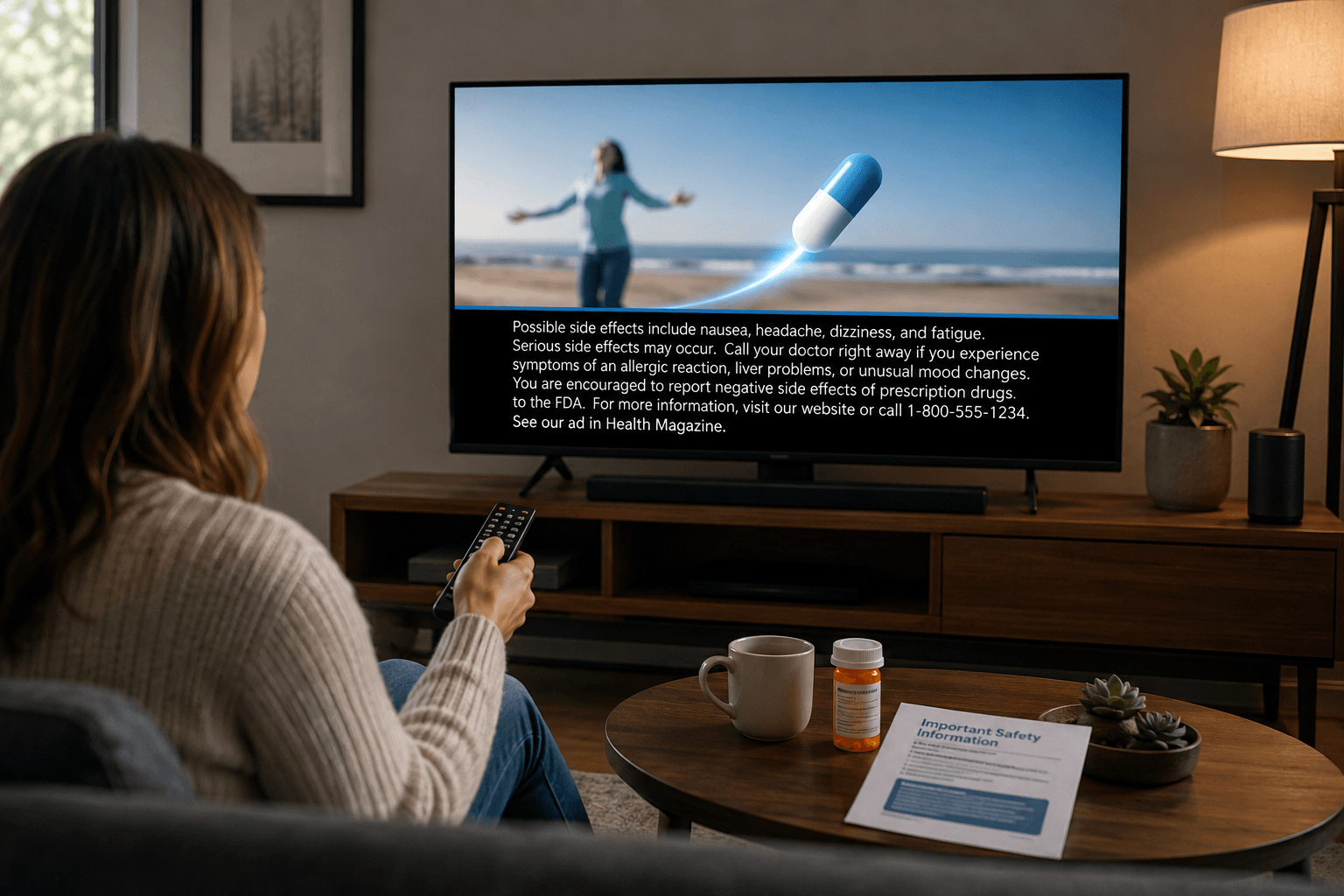
Pharma TV advertising has long depended on a practical compromise: explain the most important risks on screen, then direct viewers elsewhere for fuller prescribing information. Now, that model could face a major test. A proposed FDA change to the regulatory framework behind “adequate provision” could require much more safety and risk information to appear within the broadcast advertisement itself.
For pharmaceutical marketers, this is more than a compliance issue. It could change the economics, creative structure, and even the role of television in the media mix. If the fine print can no longer live somewhere else, what happens to the traditional drug commercial?
Table of Contents
- How adequate provision shaped pharma TV advertising
- Why longer disclosures could change TV economics
- How CTV and digital channels could gain ground
- Why unbranded education may become more valuable
- Conclusion
- FAQs
How Adequate Provision Shaped Pharma TV Advertising
The current broadcast model did not emerge by accident. FDA guidance describes an approach under which consumer-directed broadcast ads can present a major statement of important risks while making “adequate provision” for consumers to access the FDA-approved labeling elsewhere. Those additional sources can include websites and toll-free telephone numbers.
That framework helped make branded prescription drug television advertising practical. Instead of trying to squeeze extensive labeling into a commercial, marketers could balance benefit messaging with the major risk statement and routes to additional information.
The Pharma Marketing Network glossary reflects how deeply adequate provision became embedded in DTC advertising practice. However, the FDA has raised concerns about relying on other sources to communicate information that consumers may need when viewing the advertisement itself.
Under the proposed approach, broadcast DTC ads could need to provide more relevant safety, contraindication, and other risk information within the advertisement rather than relying on an external destination for fuller disclosure.
Consequently, pharmaceutical TV ads could face a serious time constraint. There are only so many seconds available, and every additional second of disclosure has a cost.
Why More Disclosure Could Change the Economics of Pharma TV Advertising
Consider a familiar 60-second prescription drug commercial. The opening establishes a patient problem. Next comes the branded treatment, followed by benefits, lifestyle imagery, and a substantial risk statement. Even today, marketers compete for every second.
If disclosure requirements expand significantly, that equation becomes harder. Brands may need longer commercials, less benefit messaging, faster creative transitions, or entirely different formats.
Longer spots also mean higher media costs. Meanwhile, shortening the persuasive portion of the commercial could reduce the value of the impression. Therefore, brands may find themselves paying more for an advertisement with less room to tell the story that justified the investment.
Creative flexibility could suffer as well. A campaign designed around emotional storytelling becomes harder to execute when regulatory content consumes a larger share of the runtime.
That pressure arrives when traditional television is already competing with a growing range of digital channels. Pharmaceutical marketers increasingly have access to streaming video, connected TV, programmatic media, search, and other formats that can support more targeted patient journeys.
As a result, stricter disclosure rules may not end prescription drug advertising on TV. Instead, they could accelerate a shift that was already underway.
Connected TV and Digital Could Gain More Strategic Weight
Connected TV offers many of television’s strengths without requiring marketers to think only in terms of a traditional linear commercial. It provides premium video, large-screen viewing, audience targeting, measurement, and greater campaign flexibility.
That combination is increasingly attractive to pharmaceutical marketers. However, moving to streaming does not make FDA requirements disappear. Brands still need compliant messaging wherever prescription drug promotion occurs. The advantage is strategic flexibility.
For example, marketers can coordinate video with search, display, patient education, contextual placements, and other digital touchpoints. Rather than asking one commercial to carry the entire communication burden, brands can build a broader information journey.
The Pharma Marketing Network’s coverage of programmatic advertising trends also highlights the growing importance of connected TV and other digital channels for pharmaceutical marketing teams.
Moreover, digital environments can provide marketers with more opportunities to measure and optimize campaigns. Teams can adjust targeting, frequency, media placement, and creative based on performance rather than relying as heavily on fixed linear television schedules.
For pharmaceutical marketers building those campaigns, healthcare-focused digital advertising partners such as eHealthcare Solutions may become increasingly relevant as budgets move toward targeted digital environments.
Unbranded Education May Become a Bigger Part of the Mix
There is another possible consequence: marketers may reconsider when they need to lead with the drug brand at all.
Unbranded disease education can help patients understand symptoms, risk factors, treatment categories, and questions to discuss with healthcare professionals. Therefore, it can create awareness without forcing every initial interaction into the structure of a traditional branded product-claim commercial.
That does not mean unbranded campaigns are a loophole or replacement for compliant branded communication. Rather, they may become a more important first stage of the patient journey.
A television or digital video campaign might introduce the condition. Search, publisher content, patient resources, and healthcare professional conversations can then provide greater depth. Finally, branded information can appear when the consumer is more prepared to evaluate benefits and risks.
This approach also reflects changing patient behavior. People increasingly move between television, search engines, streaming platforms, websites, social content, and healthcare resources while looking for information.
For consumers who have questions about symptoms, treatments, or prescription medicines, professional medical guidance remains essential. Resources such as Healthcare.pro can help people find healthcare information and support.
In that environment, the future of pharmaceutical advertising on TV may be less about creating the perfect standalone commercial and more about television’s role in a connected patient journey.
Conclusion
The proposed FDA change to adequate provision could force pharmaceutical marketers to rethink one of DTC advertising’s longest-standing assumptions: that fuller risk information can live somewhere beyond the television screen.
If more disclosure must fit inside the advertisement, traditional branded spots may become longer, more expensive, and less creatively flexible. At the same time, CTV, digital video, programmatic media, and unbranded education could gain additional strategic importance.
TV advertising will not necessarily disappear from pharmaceutical marketing. Its reach remains valuable, particularly for major launches and broad disease categories. However, its job may change.
The winning strategy may no longer be to make TV carry the entire message. Instead, marketers will need to design campaigns in which every channel has a clear role, and enough room, to communicate responsibly.
FAQs
What is adequate provision in pharmaceutical advertising?
Adequate provision is the regulatory approach that allows qualifying broadcast prescription drug ads to provide major risk information while directing consumers to other sources for FDA-approved labeling and additional information.
Is the FDA banning pharma TV advertising?
No. The proposed regulatory change is not a ban on direct-to-consumer television advertising. Instead, it could change how required risk and safety information must be presented in broadcast advertisements.
Could pharma TV commercials become longer?
Potentially. If substantially more information must appear within the commercial, marketers may need longer formats or may have to reduce the time devoted to benefit messaging and creative storytelling.
Will connected TV replace linear pharma advertising?
Not necessarily. However, CTV and digital video offer targeting, measurement, and media flexibility that could make them increasingly important parts of the pharmaceutical advertising mix.
Why could unbranded education become more important?
Unbranded campaigns can educate audiences about diseases and treatment conversations without making a specific branded product claim. As branded advertising becomes more complex, disease education may play a larger role earlier in the patient journey.
This content is not medical advice. For any health issues, always consult a healthcare professional. In an emergency, call 911 or your local emergency services.