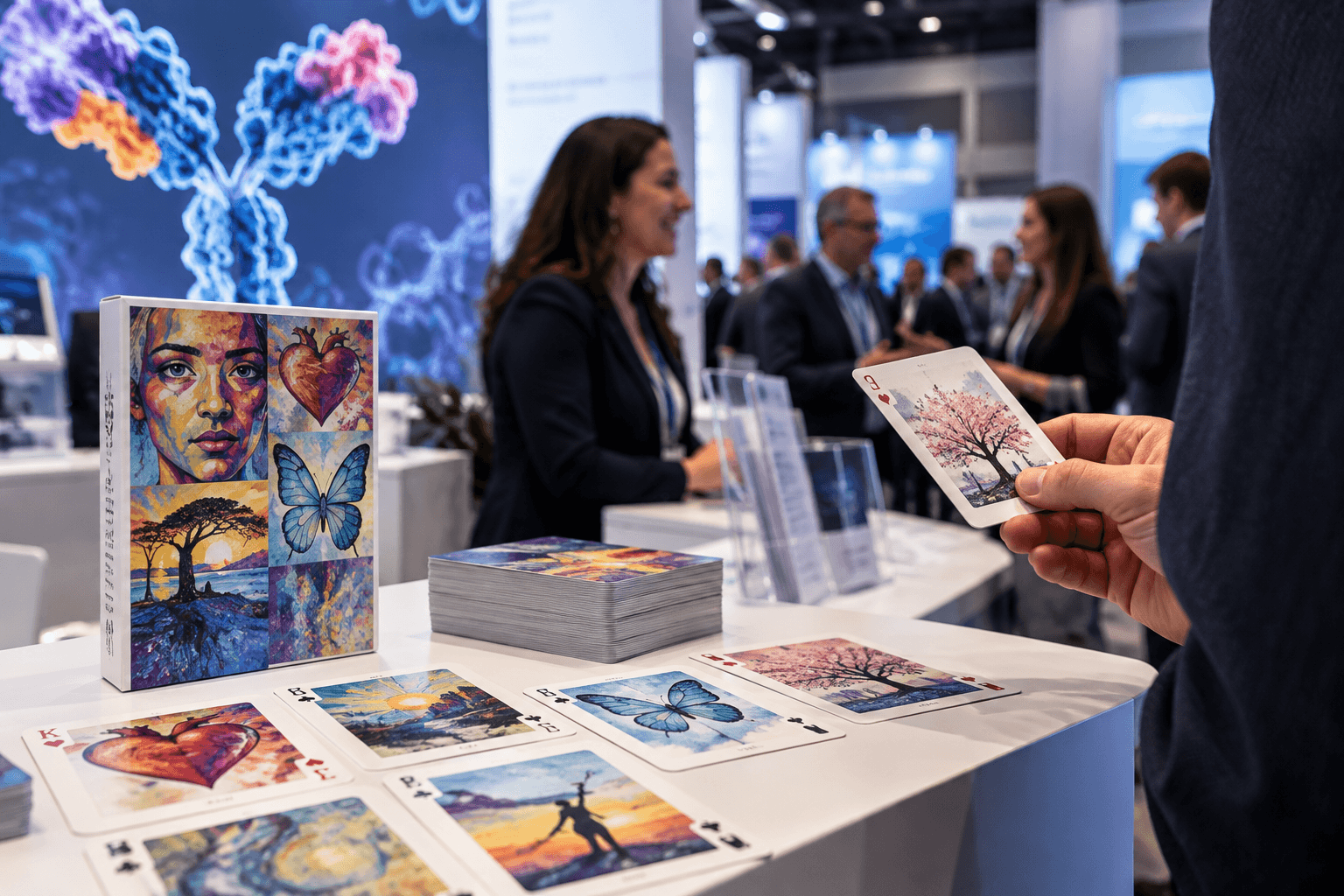
B2B life sciences marketing often revolves around scientific data, technical capabilities, and potential partnerships. However, Invenra brought something unexpected to the 2026 World ADC Conference in San Diego: a deck of playing cards featuring artwork created by people affected by cancer. The initiative, called 52 Views of Cancer, raises an interesting question. Can human stories make highly technical pharmaceutical marketing more meaningful without weakening its scientific credibility?
Invenra believes they can. Its approach offers a fresh perspective on how biotechnology companies connect with researchers, executives, and potential development partners.
Table of Contents
- Why Invenra Brought Patient Art to World ADC
- How Human Stories Make Biotech Marketing More Meaningful
- Balancing Scientific Credibility With Emotional Connection
- What Pharma Marketers Can Learn From Invenra
- Conclusion
- Frequently Asked Questions
Why Invenra Brought Patient Art to World ADC
The World ADC Conference is a major gathering for companies developing antibody-drug conjugates, or ADCs. These targeted cancer therapies combine antibodies with powerful drugs designed to attack cancer cells.
At the October 2026 event, Invenra introduced its multispecific ADC discovery capabilities alongside an unusual creative project.
Its 52 Views of Cancer initiative features original artwork from cancer patients, survivors, and immediate family members. Each card represents a different experience with the disease.
Rather than distributing another conventional promotional brochure, Invenra offered conference attendees something personal and memorable.
The idea originated with Invenra CEO Roland Green, whose daughter was diagnosed with ovarian cancer. After seeing her artwork, he envisioned a collection that could inspire scientists working on cancer treatments.
The company subsequently developed a deck featuring 52 artistic perspectives, giving individuals affected by cancer a visible presence at scientific meetings.
Importantly, the project accompanied a genuine business initiative. Invenra was introducing expanded ADC discovery services based on its B-Body bispecific and T-Body trispecific antibody platforms.
According to Fierce Pharma’s coverage of the initiative, the project also supports Invenra’s efforts to attract biopharmaceutical partners.
That combination makes the campaign particularly interesting. Scientific capabilities explain what Invenra can deliver, while patient artwork reminds attendees why those capabilities matter.
How Human Stories Make Biotech Marketing More Meaningful
Biotechnology partnership decisions involve complex evaluations. Companies examine research quality, manufacturing feasibility, intellectual property, development risks, and commercial opportunities.
Consequently, marketing often emphasizes technical evidence and competitive advantages.
Yet business decisions are still made by people.
Researchers, executives, and business development professionals bring personal experiences, values, and motivations into their work. Many have also been affected by serious illness within their families or communities.
Patient storytelling can create a connection that traditional technical marketing materials rarely achieve.
Invenra’s playing cards demonstrate this possibility without requiring lengthy presentations or emotional advertising campaigns.
Instead, the artwork creates a natural opening for conversation.
A scientist might notice an image, read its accompanying story, and reflect on the people who could eventually benefit from successful research.
That moment does not replace scientific evaluation. However, it can make a company’s mission easier to remember.
For biotechnology companies, the lesson is clear: connecting with people emotionally doesn’t have to come at the expense of scientific credibility.
Thoughtful conference marketing should generate meaningful engagement beyond the exhibition floor. Invenra’s initiative illustrates how memorable content can potentially support those longer conversations.
Balancing Scientific Credibility With Emotional Connection
Emotion alone cannot establish confidence in a biotechnology partnership.
Potential partners still need convincing evidence that a company’s technology addresses meaningful scientific problems.
Invenra appears to recognize that distinction.
During World ADC 2026, the company presented preclinical research involving trispecific ADC programs designed to improve tumor targeting and drug delivery.
Its October 13 scientific presentation examined approaches involving HER2, HER3, EGFR, and VEGF, highlighting possible advantages of multispecific antibody designs.
These findings remain preclinical and do not establish improved outcomes in patients. Nevertheless, they provide technical substance for interested partners to evaluate.
Meanwhile, the patient-art initiative gives that scientific discussion a broader human context.
Together, these elements create two complementary messages. The research communicates technical potential, while the artwork expresses the purpose behind cancer drug development.
However, marketers must approach this combination carefully.
Patient stories should never imply that an experimental treatment is proven effective. Personal experiences must also be represented accurately, with appropriate consent and respect.
Invenra has stated that selected artists retain rights to their work and receive compensation for participating.
These considerations matter because trust is central to pharmaceutical communications.
Ultimately, effective pharmaceutical marketing should build trust in the science rather than distract from it.
What Pharma Marketers Can Learn From Invenra
Invenra’s approach offers several useful lessons for biotechnology companies, contract research organizations, and pharmaceutical service providers.
First, companies can make complex scientific offerings more approachable by connecting them with recognizable human experiences.
A technical platform may be difficult to understand immediately. However, an authentic patient story can communicate its broader purpose.
Second, conference materials should offer value beyond a logo or sales message.
The playing-card format gives attendees an object they may keep, share, or discuss after the event.
Third, thoughtful storytelling can help differentiate brands competing for attention in crowded scientific markets.
Nevertheless, differentiation should serve a meaningful message rather than become a marketing gimmick.
Fourth, patient participation must be authentic. Creative contributions deserve proper recognition, fair treatment, and clear communication about how their work will appear.
Finally, marketers should measure whether emotional engagement produces useful business outcomes.
Relevant indicators include qualified partnership discussions, follow-up meetings, content engagement, and sustained relationships.
A memorable campaign is valuable, but memorability alone does not prove commercial success.
Companies seeking professional support with pharmaceutical campaigns can also explore specialized services through eHealthcare Solutions.
For teams working in B2B life sciences marketing, Invenra shows how scientific storytelling can be both professional and deeply human.
Conclusion
Invenra’s 52 Views of Cancer initiative challenges the assumption that pharmaceutical business marketing must remain entirely technical.
By introducing patient artwork at World ADC 2026, the company connected its ADC discovery capabilities with the experiences of people affected by cancer.
The approach does not eliminate the need for rigorous scientific evidence. Instead, it suggests that human context can make technical conversations more memorable and meaningful.
Whether the initiative ultimately generates additional partnerships remains to be seen. Still, it offers an important reminder: behind every promising scientific platform are people hoping that research will improve lives.
Frequently Asked Questions
1. What is B2B life sciences marketing?
B2B life sciences marketing involves promoting products, technologies, and services to pharmaceutical companies, biotechnology firms, researchers, and healthcare organizations rather than directly to consumers.
2. Why did Invenra bring patient artwork to World ADC 2026?
Invenra introduced its 52 Views of Cancer playing-card deck to share the perspectives of people affected by cancer while presenting its ADC discovery capabilities to potential partners.
3. Can emotional storytelling improve biotechnology marketing?
Emotional storytelling may increase audience engagement and brand recall. However, companies must still support their marketing messages with credible scientific evidence.
4. How can pharmaceutical companies use patient stories responsibly?
Companies should obtain appropriate permission, represent experiences accurately, respect patient privacy, and avoid suggesting that personal stories prove treatment effectiveness.
5. What makes a successful B2B pharmaceutical conference campaign?
Effective campaigns combine clear scientific information, meaningful audience engagement, credible differentiation, and measurable follow-up opportunities with potential business partners.
This content is not medical advice. For any health issues, always consult a healthcare professional. In an emergency, call 911 or your local emergency services.