Healthcare advertising has spent decades trying to make serious diseases feel urgent. Genentech is experimenting with a different question: What if making people laugh could make them more willing to pay attention?
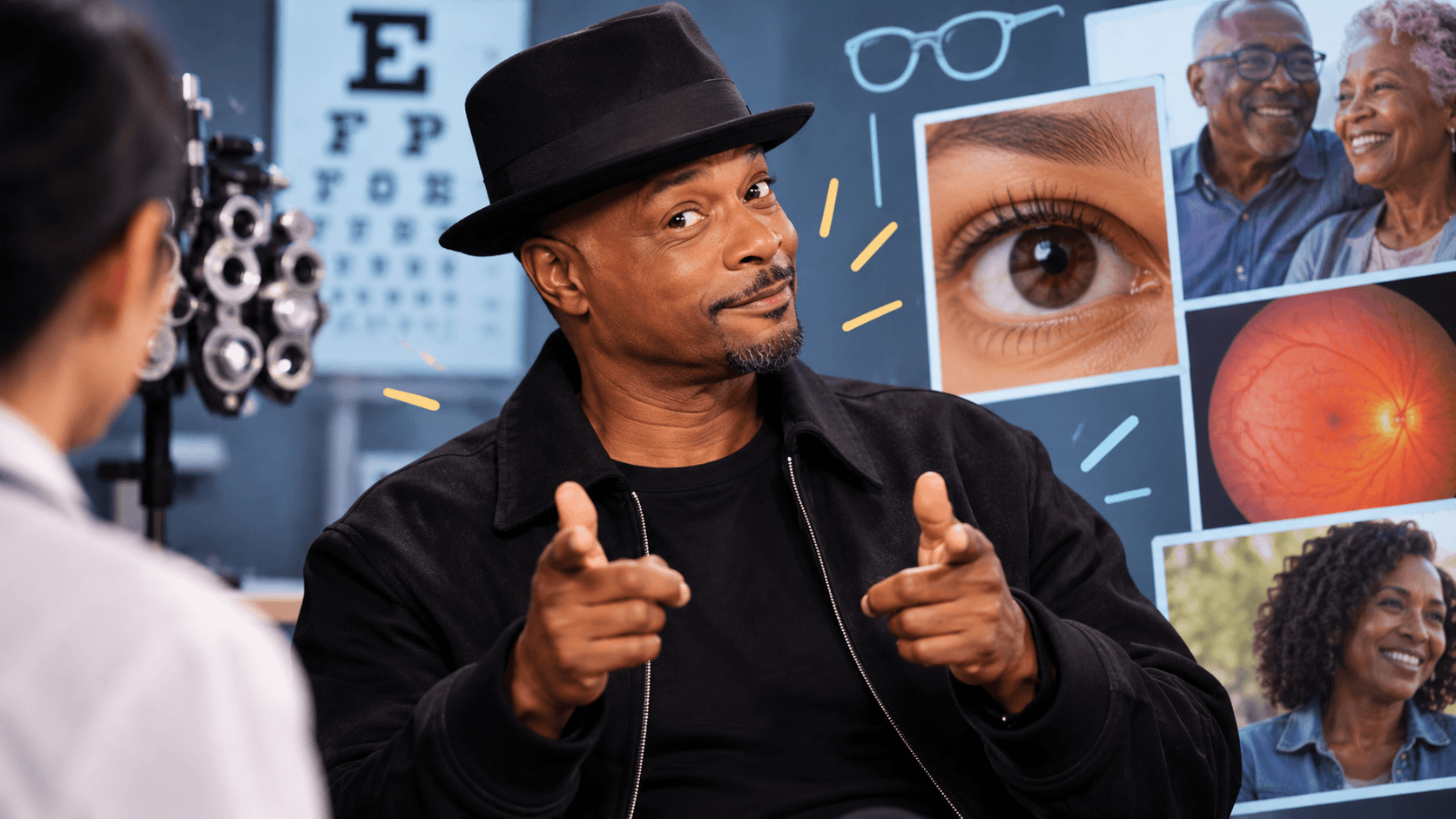
Its All Eyes on DME campaign, developed with diabetes advocacy organization diaTribe, features comedian Damon Wayans discussing diabetic macular edema (DME), a diabetes-related eye condition that can lead to vision loss. Wayans, who lives with type 2 diabetes himself, brings humor alongside his own experience with the disease.
It is an interesting test of how humor can work in pharma marketing because the subject is anything but light. DME affects hundreds of thousands of people in the United States, and many people with diabetes do not receive recommended annual eye exams.
That creates a difficult creative challenge. The campaign needs to communicate real risk without making people so anxious, uncomfortable, or defensive that they stop listening.
Humor may provide a way through.
Table of Contents
- Humor Can Lower the Cost of Paying Attention
- The Joke Should Not Be the Disease
- Why Damon Wayans Changes the Equation
- Seriousness and Approachability Are Not Opposites
- Where Healthcare Humor Can Go Wrong
- The Better Question for Marketers
- Frequently Asked Questions
Humor Can Lower the Cost of Paying Attention
Many health campaigns start from a reasonable assumption: If the medical consequence is serious, the communication surrounding it should feel serious too.
But seriousness does not always create engagement.
Fear, shame, embarrassment, fatigue, and simple avoidance can all interfere with health communication. Someone who has already spent years managing diabetes may not be eager to hear about yet another possible complication. Another warning can become another message to tune out.
That is where humor potentially earns its place.
Research on humorous health messages suggests that comedy can influence attitudes, improve engagement, and reduce some of the emotional resistance surrounding difficult topics. At the same time, humor requires particular care when it is used around severe conditions, vulnerable populations, or high-risk health situations.
In other words, comedy is not automatically effective—or appropriate—simply because it captures attention.
The more useful question is what the humor is doing once it has that attention.
In All Eyes on DME, the goal is to use laughter to help people discuss diabetes-related vision health more openly. The campaign combines Wayans’ personal story with educational resources, patient perspectives, information about DME symptoms and risks, and tools for talking with healthcare professionals.
The humor is therefore functioning as an entrance to the conversation rather than as the conversation itself.
That distinction matters.
The Joke Should Not Be the Disease
There is an enormous difference between making a serious subject easier to discuss and making the seriousness itself the punchline.
The safer territory for humorous healthcare messaging is often the human experience surrounding a condition: awkward conversations, avoidance, misconceptions, everyday frustrations, or the absurd ways people sometimes behave when faced with something uncomfortable.
The dangerous territory is the patient’s suffering.
If audiences feel that a brand is laughing at symptoms, disability, fear, mortality, or the people living with a condition, humor can quickly turn from approachable to insensitive.
That provides a practical creative principle for pharma marketers:
The joke can relieve tension around the health conversation without diminishing the health consequence.
Wayans has made essentially that distinction when discussing the campaign. Humor can make difficult conversations easier, but jokes obviously do not treat DME. His own experience with type 2 diabetes and the effect diabetes has had on his family gives the campaign’s humor a different texture.
He is not an outsider being inserted into a disease campaign solely because audiences recognize him.
He is someone who shares part of the health experience the campaign is addressing.
Why Damon Wayans Changes the Equation
Celebrity campaigns frequently borrow attention.
The better ones borrow credibility as well.
Wayans brings both, but his role is especially useful because there is alignment between his public identity and the campaign’s creative mechanism.
If humor is central to the creative strategy, casting a comedian makes intuitive sense. If that comedian also lives with the disease at the center of the campaign, the humor becomes easier to position as lived experience rather than commentary from the sidelines.
Genentech identifies Wayans as a paid spokesperson, and the campaign features his own diabetes journey alongside stories from other people living with diabetes.
That does not automatically make every joke appropriate. But it does illustrate why casting becomes especially important when pharma brands experiment with tonal boundaries.
The messenger helps determine how the message is interpreted.
A joke from an anonymous corporate voice can feel very different from similar humor coming from someone who can credibly say, in effect, “I live with this too.”
For marketers, that suggests celebrity selection should go deeper than reach, familiarity, or demographic fit. When creative depends on vulnerability, humor, or taboo-breaking, lived connection to the issue can become part of the strategy itself.
Seriousness and Approachability Are Not Opposites
Pharma marketing sometimes treats tone as a binary choice.
Either a campaign is sober enough to demonstrate that a disease matters, or it is entertaining enough to compete for attention.
But those goals do not necessarily conflict.
A campaign can acknowledge the severity of vision loss while making the first few seconds of engagement feel less clinical. It can use entertainment to get someone through the door and then provide meaningful education once they arrive.
That sequence may be especially relevant for conditions where the primary communications problem is not lack of information but avoidance.
DME provides a good example. The condition may cause blurry vision, dark spots, and, in severe cases, vision loss, yet eye health can receive less attention amid the many other demands of diabetes management.
Making another alarming ad is one option.
Making the subject easier to bring up is another.
For pharma marketers using humor, the distinction suggests a useful framework: creative does not necessarily have to make the disease feel lighter. It can make engaging with the disease feel easier.
Those are very different objectives.
Where Healthcare Humor Can Go Wrong
None of this means pharma should suddenly start adding comedians to every disease-awareness campaign.
Humorous healthcare advertising introduces risks that more conventional educational creative may avoid.
First, tone is highly audience-dependent. What feels warm or disarming to one community may feel dismissive to another. Disease severity, age, cultural context, personal experience, and the stage of a patient’s journey can all change how the same joke lands.
Second, memorable creative can overshadow the health message. People may remember the celebrity, the punchline, or the commercial but fail to remember what action they were supposed to take.
Third, humor can accidentally reduce perceived urgency. If the emotional release is too complete, marketers may solve the discomfort problem while creating a new one: audiences no longer feel that the condition requires attention.
And fourth, healthcare carries a constraint that most consumer categories do not. The audience may be frightened, newly diagnosed, experiencing symptoms, or caring for someone whose health is deteriorating. What looks playful in a creative review can feel remarkably different to someone encountering the message during a vulnerable moment.
That is why the right evaluation question is probably not, “Is this funny?”
It is, “What does the humor make easier?”
Does it make a screening conversation easier?
Does it make someone more willing to learn about a symptom?
Does it reduce embarrassment enough for a patient to talk to a doctor?
Does it help people remember an important behavior?
Or does it simply make the advertising more entertaining?
The first four possibilities have a health-communication rationale. The last one may not be enough.
The Better Question for Marketers
The All Eyes on DME campaign arrives as pharma marketers continue pushing beyond the traditional visual language of disease advertising.
Brands increasingly compete in the same fragmented attention economy as every other advertiser. Patients do not temporarily stop being consumers when they encounter healthcare content. They still scroll, skip, and tune out.
That creates understandable pressure to be culturally relevant, entertaining, and human.
But healthcare creative cannot abandon the gravity of its subject merely to win attention.
The opportunity is to separate gravity from gloom.
A serious disease does not require every communication about it to feel solemn. Sometimes fear is precisely the barrier preventing someone from engaging with the subject. Humor can create enough emotional distance for a difficult conversation to begin.
The line is crossed when the campaign reduces the perceived importance of the condition rather than reducing the discomfort associated with discussing it.
That may be the most important lesson from Genentech’s experiment.
Pharma does not necessarily need permission to be funny about health.
It needs a clear reason for why the joke is there.
When laughter opens the door to education, screening, treatment conversations, or greater openness, it can serve the communication strategy.
When laughter becomes the objective itself, the disease—and the people living with it—risk becoming secondary to the creative idea.
For healthcare marketers, that is a line worth watching carefully.
Frequently Asked Questions
What is humor in pharma marketing?
Humor in pharma marketing is the use of comedy, wit, or lighthearted creative devices in pharmaceutical and healthcare communications. It can be used to attract attention, reduce discomfort, challenge stigma, or make difficult health subjects easier to discuss.
Why is Genentech using Damon Wayans in the All Eyes on DME campaign?
Genentech and diaTribe launched All Eyes on DME to increase awareness of diabetic macular edema and diabetes-related vision health. Wayans is a comedian who also lives with type 2 diabetes, allowing the campaign to combine humor with a personal connection to the broader health issue.
Can humor make health campaigns more effective?
Research suggests humor can improve some health-message outcomes and may reduce emotional resistance or increase engagement in certain circumstances. Its effectiveness varies by audience, topic, and execution, and extra care is warranted when humor is used around severe or high-risk conditions.
When can healthcare humor become inappropriate?
Humor becomes risky when it appears to mock patients, minimize symptoms, reduce the perceived seriousness of a disease, or prioritize entertainment over useful health information. Marketers also need to consider cultural differences and the emotional state of the audience receiving the message.
What can pharma marketers learn from All Eyes on DME?
One lesson is that humor does not have to make a disease itself seem funny. It can instead make an uncomfortable health conversation feel easier to start. Connecting the humor to an authentic spokesperson, clear educational information, and a meaningful next action can help keep the medical purpose visible.