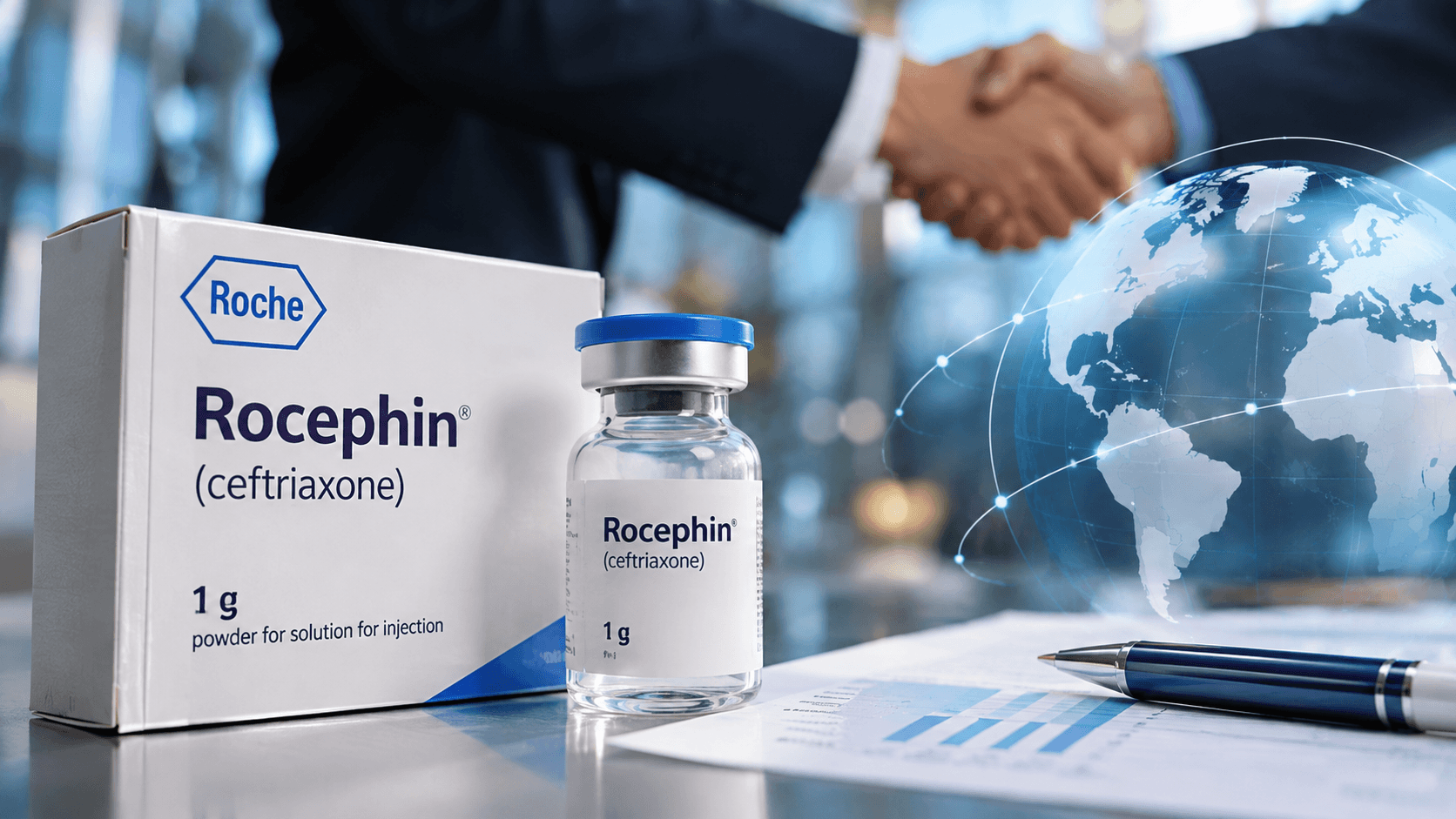
Roche spent decades building Rocephin into a recognizable antibiotic brand. Now, DKSH has acquired commercial rights across more than 80 markets. The change in commercial ownership raises a question that goes beyond the transaction: What happens when a pharmaceutical brand changes hands, but physicians still associate it with its original developer?
For DKSH, the challenge is not creating awareness from scratch. Instead, it is preserving trust, maintaining supply, and building a future for a medicine whose reputation already exists.
Table of Contents
- Inside the Roche and DKSH Rocephin Deal
- Why Established Pharmaceutical Brand Equity Matters
- How DKSH Can Manage Rocephin’s Next Chapter
- What Pharmaceutical Marketers Can Learn
- Conclusion
- Frequently Asked Questions
Inside the Roche and DKSH Rocephin Deal
On October 28, 2026, DKSH announced that it had acquired rights to Rocephin (ceftriaxone) from Roche across more than 80 markets. The territories span Asia Pacific, Europe, Africa, the Middle East, and Latin America.
According to the official DKSH announcement, Rocephin generated approximately CHF 61 million in net sales during 2025.
The medicine is a third-generation cephalosporin antibiotic developed by Roche. Its active ingredient, ceftriaxone, appears on the World Health Organization’s Model List of Essential Medicines.
For DKSH, the acquisition strengthens its Healthcare Own Brands portfolio. Furthermore, it follows the company’s July 2026 announcement concerning its acquisition of Meliane from Bayer.
However, this is more than a portfolio expansion story. Rocephin has decades of recognition among healthcare professionals, giving DKSH an established commercial identity to manage.
The announcement describes acquired rights across specified markets. It does not establish that every global trademark, regulatory authorization, or manufacturing responsibility has transferred.
That distinction matters because pharmaceutical brand ownership involves commercial, legal, and regulatory responsibilities that can differ across countries.
Why Established Pharmaceutical Brand Equity Matters
In pharmaceutical marketing, brand equity represents the familiarity, confidence, and associations built around a medicine over time.
Unlike newly launched treatments, established drugs often enter clinical conversations with considerable history. Physicians may recognize their names, understand their use, and associate them with previous treatment experience.
Consequently, when an established pharmaceutical brand changes hands, the transition brings both opportunities and risks.
DKSH inherits recognition that would take years to build organically. However, that recognition comes with expectations about product quality, reliability, and professional communication.
A sudden visual redesign or dramatic repositioning could create confusion without improving the brand’s value. Similarly, messaging that treats Rocephin as a breakthrough launch would ignore its established clinical history.
The stronger approach is to distinguish between brand elements that still serve customers and those that need improvement.
For example, educational resources, digital access to approved product information, and healthcare professional support may benefit from modernization. Meanwhile, familiar brand identifiers and evidence-based positioning may deserve continuity.
Ultimately, inherited pharmaceutical brand equity should be treated as an asset requiring careful stewardship rather than an invitation to start over.
How DKSH Can Manage Rocephin’s Next Chapter
The next chapter of Rocephin will depend on how effectively DKSH combines commercial execution with the brand’s established reputation.
Preserve Trust Before Refreshing the Brand
First, DKSH should prioritize a smooth transition for healthcare professionals, hospitals, distributors, and other partners.
Clear communication about responsible commercial contacts, approved product information, and distribution arrangements can reduce uncertainty. Moreover, maintaining consistent quality and product availability matters more than introducing a new marketing identity.
DKSH already served as a commercialization partner for Rocephin in certain markets before the acquisition. Therefore, its existing experience may help support continuity in those territories.
However, different countries may require different transition plans because local regulations, market access conditions, and healthcare systems vary.
A successful transition starts with understanding what healthcare professionals already value about the brand. Only then should marketers decide where changes would make a meaningful difference.
Modernize Communication Without Overpromoting Antibiotics
Digital marketing offers opportunities to make established medicine information easier for healthcare professionals to access.
For instance, DKSH could review professional education materials, approved product websites, and communication channels to improve clarity and consistency.
Nevertheless, antibiotic marketing carries special responsibilities. Ceftriaxone is classified in the World Health Organization’s Watch antibiotic group, highlighting the importance of appropriate prescribing and antimicrobial stewardship.
The WHO AWaRe framework supports responsible antibiotic use and efforts to limit antimicrobial resistance.
Therefore, Rocephin’s future marketing should emphasize accurate information, approved indications, and responsible clinical use rather than simply increasing prescription volume.
Professional pharmaceutical communication strategies, including those discussed by Pharma Marketing, should recognize this balance between commercial performance and public health.
What Pharmaceutical Marketers Can Learn
The Roche and DKSH agreement offers broader lessons for companies acquiring established pharmaceutical brands.
First, commercial rights do not automatically create new brand equity. Instead, the incoming company inherits perceptions shaped by years of medical experience and previous commercial decisions.
Second, the value of an established medicine often depends on reliable execution. Product availability, clear communication, and regulatory compliance may influence confidence more than advertising campaigns.
Third, transferring ownership of a pharmaceutical brand across multiple markets requires a deep understanding of local conditions. A strategy that works in one country may need adjustments elsewhere because prescribing practices, reimbursement rules, and promotion requirements differ.
Furthermore, marketing teams should establish practical measures of transition success. These could include supply continuity, healthcare professional inquiries, corrected information gaps, and customer satisfaction.
Rather than viewing an acquisition as a traditional product launch, companies should approach it as a brand transition.
This distinction also matters for digital marketing agencies such as eHealthcare Solutions, where relevant, compliant communication can help healthcare brands reach professional audiences.
The best outcome is not necessarily greater visibility. It is a stronger commercial foundation that preserves the medicine’s established value.
Conclusion
Roche built Rocephin’s reputation over decades. DKSH now has the opportunity to guide its commercial future across more than 80 markets.
The central challenge is balancing continuity with improvement. While new ownership can bring commercial resources and fresh capabilities, established brand recognition should not be discarded.
Ultimately, successful pharma brand ownership transfer means protecting existing trust, improving the customer experience, and respecting the responsibilities associated with pharmaceutical marketing.
Rocephin’s next chapter will be defined less by who announces the acquisition and more by how carefully the brand is managed afterward.
Frequently Asked Questions
1. Why did DKSH acquire Rocephin from Roche?
DKSH acquired rights to Rocephin to expand its Healthcare Own Brands portfolio and strengthen its position in established pharmaceutical products, particularly anti-infectives.
2. Does DKSH now own Rocephin worldwide?
The announced transaction covers rights across more than 80 markets. It does not confirm that DKSH owns every Rocephin right worldwide.
3. What is pharma brand ownership transfer?
It refers to the movement of certain brand-related rights or commercial responsibilities from one company to another. The exact scope depends on the agreement and applicable regulations.
4. Why is brand equity important when a pharmaceutical product changes hands?
Established brand equity helps preserve familiarity and confidence among healthcare professionals. However, new commercial stewards must maintain quality, communication, and regulatory compliance.
5. Should DKSH rebrand Rocephin after the acquisition?
A complete rebrand is not automatically necessary. DKSH could benefit from preserving recognizable brand elements while updating communication and services where improvements are justified.
This content is not medical advice. For any health issues, always consult a healthcare professional. In an emergency, call 911 or your local emergency services.