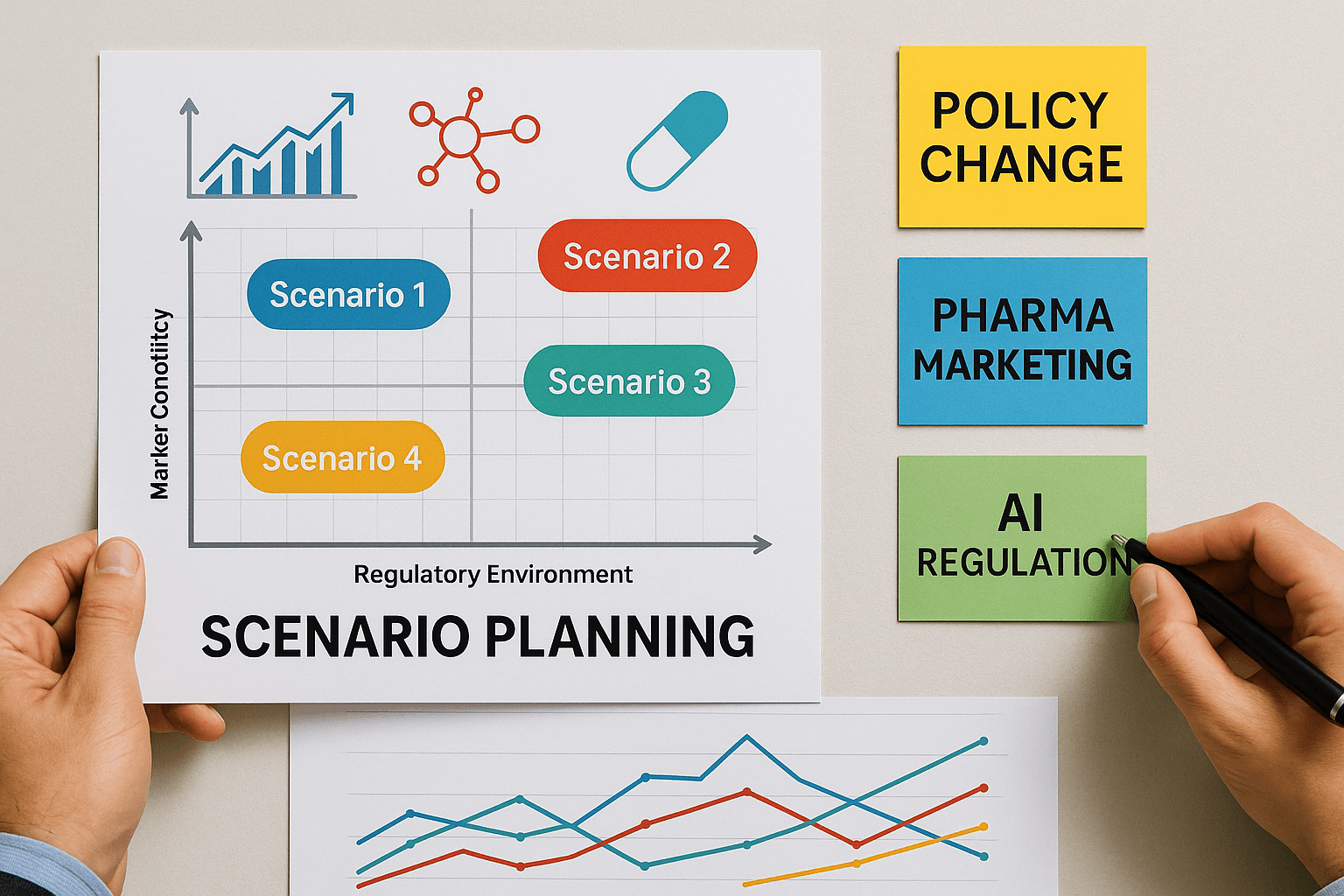
In today’s rapidly evolving healthcare landscape, traditional annual planning falls short. Especially in the world of scenario planning pharma marketing, teams face fast‑moving shifts in AI regulation, policy changes, and platform behavior that render static plans obsolete. This article explores how pharma marketers can embrace agile scenario planning as a living strategy to adapt to uncertainty without sacrificing strategic coherence or compliance readiness.
Table of Contents
- What Is Scenario Planning and Why It Matters to Pharma?
- Challenges with Traditional Annual Planning in Pharma Marketing
- Building an Agile Scenario Planning Framework
- Implementing Living Strategies in Pharma Marketing Teams
- Case Example: Navigating AI Regulation and Platform Shifts
- Conclusion
- Frequently Asked Questions
What Is Scenario Planning and Why It Matters to Pharma?
Scenario planning pharma marketing refers to a structured method that organizations use to anticipate multiple future environments and uncertainties. Rather than relying on a single forecast, scenario planning prepares teams to pivot quickly based on emerging trends, regulatory moves, or unexpected changes in technology. For the pharmaceutical industry, this is critical given ongoing shifts in digital marketing platforms, evolving healthcare policies, and new AI‑driven capabilities that influence how audiences engage with content.
This approach is not just about risk avoidance. Instead, it creates strategic flexibility that helps companies capture opportunities others may miss. For example, when a major social platform updates its algorithms, a team using scenario planning can rapidly adjust marketing tactics while still aligning with broader brand goals.
Scenario planning aligns teams across functions — including compliance, medical, legal, and commercial — ensuring that marketing decisions are both agile and compliant. This dual focus is especially important in pharma, where regulatory scrutiny is high and non‑compliant content can lead to serious issues.
Challenges with Traditional Annual Planning in Pharma Marketing
Traditional annual planning often involves setting goals, budgets, and campaigns months in advance. While this approach provides structure, it creates rigidity that fails under rapid change. For instance, policy shifts around AI tools or privacy on advertising platforms can occur mid‑year, rendering parts of a plan outdated.
Moreover, once plans are locked in, teams may be reluctant to revisit them frequently due to the perception that changes introduce compliance risks. This hesitation is understandable but problematic: waiting for the next annual cycle means missed opportunities and slower responses to competitors who adapt faster.
Annual plans also tend to assume a stable environment. In contrast, the business drivers affecting pharma marketing — from new product launches to shifts in patient behavior — are anything but static. This disparity highlights the need for a more dynamic strategic process.
Building an Agile Scenario Planning Framework
An effective scenario planning pharma marketing framework incorporates five key steps that keep strategies adaptive and aligned with regulatory and business realities.
1. Identify Key Drivers of Change
Start by identifying forces likely to shape your marketing landscape. Examples include regulatory updates (especially around AI usage), changes in data privacy laws, emerging ad formats, shifting platform policies, and evolving patient expectations. List these drivers and assess their potential impact on your goals.
2. Develop Multiple Scenarios
Next, create a set of plausible future scenarios. For example, one scenario may assume strict AI usage regulations, while another presumes relaxed guidelines and widespread AI adoption. The goal is not to predict the future but to explore a range of possibilities.
3. Define Strategic Responses
For each scenario, establish response strategies. These should outline how your team would adjust messaging, media plans, and compliance checks if that scenario unfolds. This is where collaboration with regulatory affairs and legal becomes invaluable.
4. Establish Monitoring Mechanisms
Scenario planning requires continuous monitoring. Set up triggers that signal which scenario may be emerging — such as regulatory announcements, platform updates, or AI capability advances. Regular check‑ins (monthly or quarterly) help teams stay informed and ready.
5. Integrate Into Daily Operations
Finally, make scenario planning part of your team’s routine. This may involve weekly huddles to review signals or adjusting dashboards to include key indicators tied to your scenarios. Over time, this institutionalizes agility.
Implementing Living Strategies in Pharma Marketing Teams
Adopting a living strategy requires changes in culture, process, and technology. Teams must be comfortable with uncertainty and equipped with tools that support rapid iteration. One practical approach is creating cross‑functional pods that include marketers, compliance specialists, and data analysts. These pods can act quickly when trigger events occur without waiting for executive sign‑offs.
Another vital component is investing in platforms that offer real‑time insights. Tools that monitor regulatory updates, AI policy changes, and audience behavior trends give teams the data needed to decide which scenario is emerging and how to react.
Training is equally important. Scenario planning and agile decision‑making are skills that teams must learn. Workshops, tabletop exercises, and simulations can help staff gain confidence in adapting strategies under varying conditions.
Case Example: Navigating AI Regulation and Platform Shifts
Consider a scenario where a leading social media platform announces new restrictions on AI‑generated content, just as your team plans to launch an AI‑driven campaign. An annual plan would struggle to accommodate this shift, but a scenario planning approach anticipates regulatory unpredictability as a key driver. Hence, your team already has prepared alternative tactics that adhere to the new rules while maintaining engagement goals.
In another instance, if privacy regulations change mid‑year, scenario planning allows your team to pivot media buying strategies without violating compliance. Instead of scrambling to rework your entire annual plan, you can implement pre‑approved variations tailored to the emerging context.
These examples illustrate how scenario planning pharma marketing transforms uncertainty into strategic advantage.
Conclusion
Moving from rigid annual plans to agile, living strategies prepares pharma marketing teams for the unpredictable nature of today’s digital landscape. Scenario planning helps organizations adapt to regulatory changes, AI policy shifts, and platform behavior in ways that preserve compliance and coherence. By embedding this approach into your marketing processes, you empower your team to act with confidence and foresight.
Frequently Asked Questions
What is scenario planning in pharma marketing?
Scenario planning in pharma marketing is the practice of developing multiple plausible future scenarios and preparing strategies for each, enabling teams to adapt quickly to regulatory and market changes.
Why is traditional annual planning insufficient?
Annual planning assumes stability and often fails to accommodate mid‑year changes in technology, policy, or market trends, making it less effective in dynamic environments.
How does scenario planning support compliance?
By involving regulatory, legal, and compliance teams in developing response strategies, scenario planning ensures adaptations remain within legal boundaries while enabling agility.
Can scenario planning improve campaign performance?
Yes, it allows marketers to anticipate changes and adjust tactics quickly, which can lead to better engagement and reduced risk of disruption.
What tools support scenario planning?
Real‑time monitoring tools for regulatory updates, data analytics platforms, and cross‑team communication technologies all support effective scenario planning.
This content is not medical advice. For any health issues, always consult a healthcare professional. In an emergency, call 911 or your local emergency services.