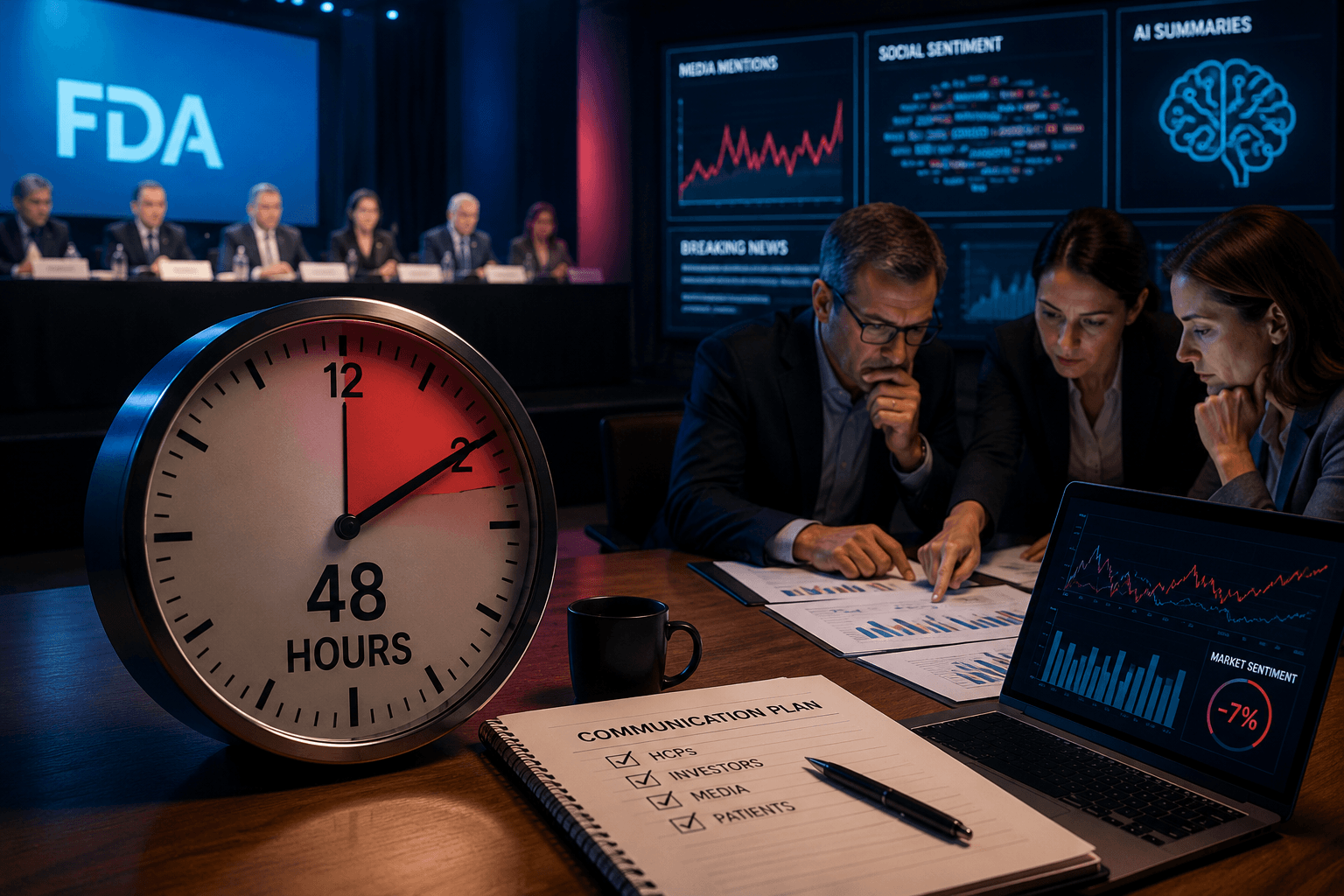
When an FDA Advisory Committee meeting ends, most pharmaceutical teams feel a sense of relief. The presentations are over, the experts have voted, and the media headlines begin to circulate. However, the most important work may only be starting. In today’s digital environment, the 48 hours after an FDA advisory vote can determine whether a brand gains trust or loses control of its narrative.
This period has become a defining moment for pharmaceutical regulatory strategy and stakeholder communications. Investors react within minutes, healthcare professionals search for clarity, and AI-powered platforms rapidly summarize and distribute information across the internet. As a result, even a positive vote can quickly become overshadowed by confusion, speculation, or misinformation if communication teams are not fully prepared.
For pharmaceutical marketers, medical affairs teams, and corporate communications leaders, the challenge is no longer limited to managing the Advisory Committee meeting itself. The real challenge is controlling the post-AdComm narrative before uncertainty shapes public perception.
Table of Contents
- Why the post-AdComm period matters
- The rise of the Post-AdComm Narrative Crisis
- How AI-driven misinformation impacts pharma brands
- Building a rapid-response communications framework
- Protecting HCP and investor confidence
- Frequently asked questions
Why the Post-AdComm Period Matters
FDA Advisory Committee votes influence more than regulatory outcomes. They shape market confidence, physician expectations, media narratives, and competitive positioning. Although the FDA is not legally bound by the committee’s recommendation, the vote often becomes the headline that defines public sentiment.
In many cases, companies invest heavily in preparing for the actual committee presentation. They rehearse executive statements, train spokespersons, and refine scientific messaging. Yet fewer organizations devote equal resources to the communication window immediately afterward.
This gap creates risk. Within hours of the vote, social media commentators, financial analysts, AI-generated summaries, and healthcare news platforms begin interpreting the outcome. Some reports may oversimplify complex clinical findings. Others may amplify uncertainty around safety concerns or approval timelines.
Consequently, brands that fail to respond quickly can lose control of the narrative. Strong regulatory communication strategies are now essential for maintaining credibility during this volatile period.
According to the FDA’s official guidance on advisory committees, these meetings are designed to provide independent expert advice on scientific and technical matters. However, public interpretation often extends far beyond the scientific discussion itself. Therefore, communications teams must be prepared to bridge the gap between regulatory complexity and public understanding.
The Rise of the Post-AdComm Narrative Crisis
The pharmaceutical industry is entering a new era where communication speed matters almost as much as clinical data quality. This shift has created what many marketers now describe as the “Post-AdComm Narrative Crisis.”
In the past, traditional media cycles gave companies time to craft thoughtful responses. Today, AI-generated search summaries and automated news aggregation tools can distribute incomplete or misleading interpretations within minutes.
For example, a narrowly positive advisory vote may still trigger negative online commentary if concerns raised during the discussion become amplified without context. Similarly, a split vote may create exaggerated perceptions of regulatory risk, even when approval remains likely.
This environment places enormous pressure on pharmaceutical communication teams. Brands must now anticipate multiple narrative scenarios before the meeting even begins.
Effective pharmaceutical communications require pre-approved response frameworks, aligned executive messaging, and coordinated stakeholder outreach plans. Without these systems in place, organizations risk reacting too slowly while misinformation gains momentum.
Companies that manage this phase effectively often treat post-AdComm planning as a dedicated operational discipline rather than a simple public relations exercise.
How AI-Driven Misinformation Impacts Pharma Brands
Artificial intelligence has transformed how healthcare information spreads online. Search engines, investor tools, and content platforms increasingly rely on AI-generated summaries that condense complex discussions into simplified narratives.
While this technology improves speed, it also creates new challenges for pharmaceutical brands.
AI systems may misinterpret nuanced regulatory language or highlight controversial moments without adequate scientific context. As a result, healthcare professionals and investors may encounter incomplete summaries before reading official company statements.
This problem becomes especially serious during high-profile FDA reviews. Market volatility can intensify rapidly when uncertainty spreads through digital channels.
For instance, investors monitoring biotechnology companies often rely on real-time AI-driven sentiment analysis tools. Negative framing can influence stock performance before companies have an opportunity to clarify the facts.
Healthcare professionals also face information overload. Physicians seeking quick updates may encounter fragmented reporting across social media, healthcare news sites, and AI-generated content feeds.
Because of this, pharmaceutical organizations must prioritize clear and authoritative messaging immediately after advisory votes occur. Brands that communicate early often reduce confusion while reinforcing trust among stakeholders.
A strong digital communications strategy should include rapid-response press materials, executive video statements, medical affairs FAQs, and search-optimized educational content. Many organizations are also expanding partnerships with Healthcare.pro to improve access to trusted healthcare information during critical regulatory moments.
In addition, companies focused on pharmaceutical visibility increasingly integrate digital communication strategies with broader healthcare marketing initiatives through partners like eHealthcare Solutions.
Building a Rapid-Response Communications Framework
The most successful pharmaceutical companies prepare for the post-AdComm period long before the FDA meeting begins. They understand that speed, consistency, and clarity are essential during the first 48 hours.
An effective framework typically includes several critical elements.
First, organizations should prepare multiple communication scenarios in advance. These scenarios may include positive votes, mixed outcomes, requests for additional data, or unexpected safety discussions.
Second, teams must establish cross-functional alignment. Regulatory affairs, investor relations, medical affairs, legal, and marketing departments should coordinate messaging before the event occurs.
Third, brands should develop response-ready digital assets. These assets may include FAQ documents, physician explainers, patient-facing resources, media statements, and executive talking points.
Search visibility is also critical. Companies should optimize online content using strategic healthcare SEO practices so accurate information appears quickly in search results. Strong regulatory messaging increasingly depends on digital discoverability.
Another important factor is media monitoring. Real-time tracking tools help organizations identify emerging misinformation trends before they escalate. This allows communications teams to address inaccuracies rapidly and maintain narrative control.
Finally, executive visibility matters. Stakeholders often look for leadership reassurance during uncertain regulatory moments. Timely interviews, analyst briefings, and transparent updates can stabilize confidence across both healthcare and financial audiences.
Protecting HCP and Investor Confidence
Healthcare professionals and investors evaluate regulatory events differently, yet both groups depend on trust and clarity.
Physicians want confidence that clinical evidence remains strong and patient safety remains central. Investors seek reassurance regarding regulatory pathways, commercial viability, and long-term growth potential.
Therefore, communication strategies should address both audiences simultaneously while tailoring language appropriately.
For healthcare professionals, companies should focus on scientific clarity. Medical affairs teams can provide balanced interpretations of the advisory discussion while emphasizing clinical relevance and patient outcomes.
For investors, transparency is essential. Clear timelines, regulatory expectations, and contextual explanations help reduce speculation and market anxiety.
Importantly, silence can create more uncertainty than imperfect news. Even when outcomes are mixed, proactive communication demonstrates organizational confidence and preparedness.
As pharmaceutical competition intensifies, companies that master post-FDA communications and regulatory messaging will likely gain a significant reputational advantage. In an era shaped by AI-driven information flow, narrative control has become a strategic business function rather than a secondary communications task.
Conclusion
FDA Advisory Committee meetings remain high-stakes moments for pharmaceutical companies. Yet the period immediately after the vote may now carry even greater reputational risk.
The first 48 hours shape how healthcare professionals, investors, media outlets, and AI-powered platforms interpret the outcome. Consequently, brands that fail to prepare for this window risk losing control of the narrative at a critical time.
Modern pharmaceutical communication strategies require rapid-response systems, aligned stakeholder messaging, and search-optimized educational content that can counter misinformation quickly and effectively.
Ultimately, the companies that succeed will be those that recognize communication readiness as a core part of regulatory strategy rather than an afterthought.
FAQ
Why are the 48 hours after an FDA advisory vote so important?
The post-vote period shapes public perception, investor sentiment, and healthcare professional confidence. Rapid communication helps prevent misinformation and uncertainty from dominating the narrative.
What is pharma regulatory communications?
Pharma regulatory communications refers to the strategic messaging pharmaceutical companies use during regulatory milestones, including FDA reviews, advisory committee meetings, and approval decisions.
How does AI affect pharmaceutical communications?
AI tools can rapidly distribute summaries and interpretations of regulatory events. However, these summaries may lack nuance, which increases the risk of misinformation or oversimplified reporting.
How can pharma companies prepare for post-AdComm communication challenges?
Companies should create pre-approved messaging frameworks, monitor digital sentiment in real time, align internal teams, and publish authoritative educational content immediately after the vote.
Why does investor confidence fluctuate after FDA advisory meetings?
Investors react to uncertainty surrounding approval likelihood, safety concerns, and commercial potential. Clear and transparent communication helps reduce speculation and stabilize market reactions.
This content is not medical advice. For any health issues, always consult a healthcare professional. In an emergency, call 911 or your local emergency services.