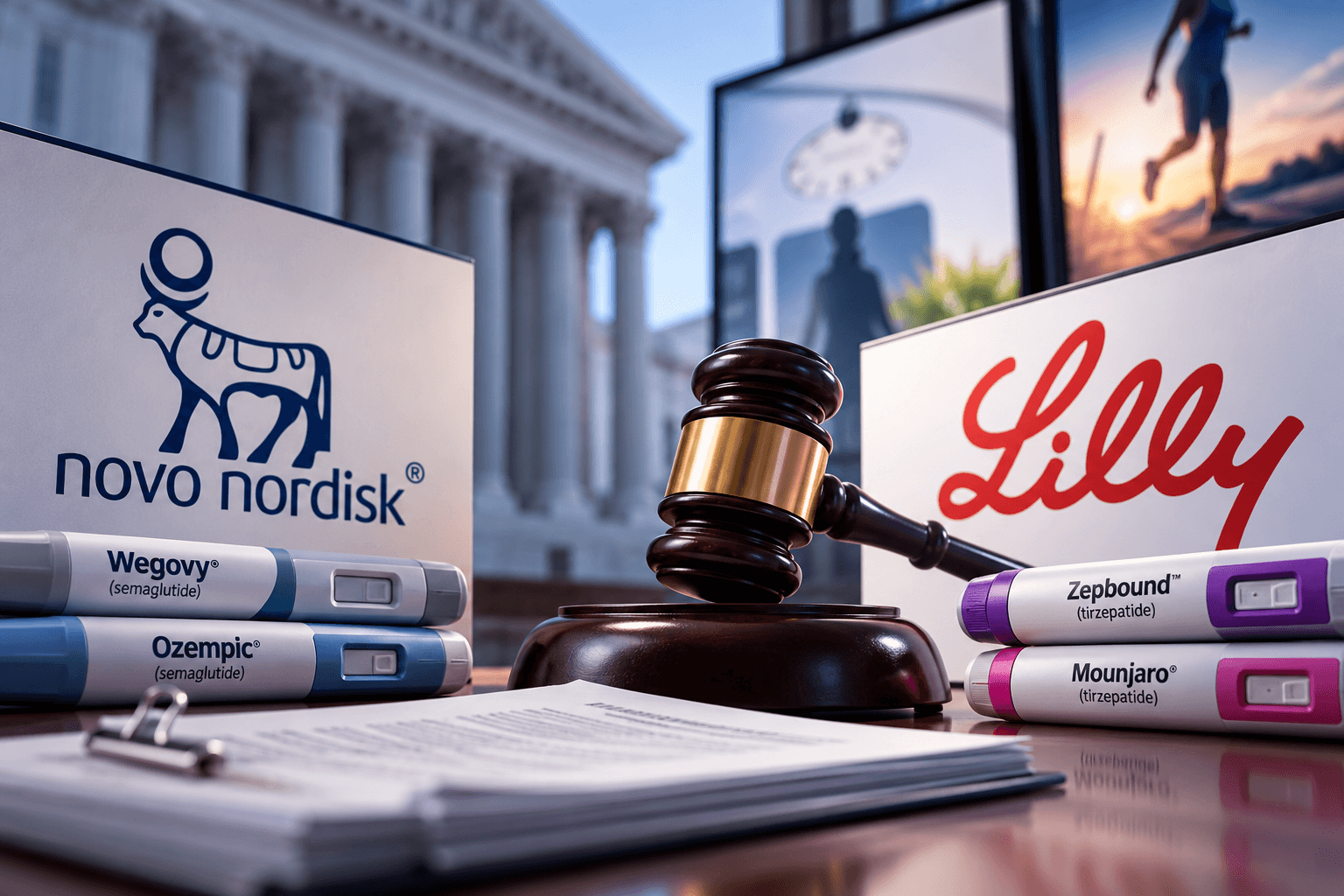
A legal fight over competitive pharma advertising has reached a federal courtroom, putting the claims drugmakers use to promote their products under new scrutiny. On October 26, 2026, a federal judge rejected Novo Nordisk’s request to temporarily stop Eli Lilly from running disputed advertisements for Zepbound and Mounjaro.
However, the decision did not establish that Lilly’s advertising was truthful or misleading. Instead, it exposed a bigger issue for drug marketers: What happens when competitors begin challenging the scientific evidence behind each other’s campaigns?
Table of Contents
- Why Novo Nordisk Challenged Lilly’s Advertising
- What the Federal Court Actually Decided
- Why Comparative Drug Claims Create Legal Risks
- What Pharmaceutical Marketing Teams Should Do Next
- Conclusion
- Frequently Asked Questions
Why Novo Nordisk Challenged Lilly’s Advertising
The dispute began on July 21, 2026, when Novo Nordisk filed a false-advertising lawsuit against Eli Lilly in New Jersey federal court.
Novo alleged that Lilly’s national campaigns presented misleading comparisons between popular obesity and diabetes medications.
Specifically, Lilly’s advertisements compared Zepbound (tirzepatide) with Wegovy (semaglutide), while other promotions compared Mounjaro (tirzepatide) with Ozempic (semaglutide).
One Zepbound advertisement highlighted average weight loss of approximately 50 pounds compared with 33 pounds for Wegovy. Those figures came from the SURMOUNT-5 clinical trial.
However, Novo argued that the comparison omitted important developments involving higher doses of its medications.
The study evaluated Wegovy doses of 1.7 mg and 2.4 mg but did not include the 7.2 mg dose approved in March 2026.
Similarly, Novo challenged Mounjaro advertising that compared the 15 mg dose against Ozempic 1 mg, despite an approved 2 mg Ozempic dose.
Novo maintained that these comparisons created an incomplete impression of the available treatments.
According to Novo Nordisk’s July announcement, the company wanted Lilly to withdraw the challenged advertisements and conduct corrective advertising.
Lilly disputed the allegations, making the controversy a significant test of how competing manufacturers defend comparative drug claims.
What the Federal Court Actually Decided
On October 26, U.S. District Judge Zahid Quraishi denied Novo Nordisk’s request for a preliminary injunction.
A preliminary injunction would have temporarily restricted Lilly’s challenged advertising while the lawsuit continued.
Importantly, the judge did not issue a final ruling on whether the advertisements violated false-advertising laws.
Instead, the court concluded that Novo had failed to demonstrate irreparable harm sufficient to justify immediate intervention.
Lilly presented prescription data showing that demand for Novo’s products remained stable during the period the disputed campaigns ran.
Furthermore, the judge questioned whether any measurable commercial damage could be addressed through financial compensation.
The court also examined Novo’s own advertising history. Lilly argued that Novo had previously used comparisons based on studies that excluded subsequently approved higher doses of competing medications.
The judge found this argument persuasive when considering whether Novo deserved emergency relief.
The October 26 federal court opinion provides the detailed reasoning.
For pharmaceutical marketers, the distinction matters. Lilly may continue the challenged advertising for now, but that permission is not a final judicial endorsement of its claims.
Why Comparative Drug Claims Create Legal Risks
When drugmakers compare their products with competing treatments, they must carefully review clinical studies, product labeling, and FDA advertising requirements.
However, the Novo-Lilly dispute illustrates another concern: competing manufacturers can challenge advertising directly through litigation.
Under the Lanham Act, businesses may pursue false-advertising claims when they believe a competitor’s commercial statements are misleading and harmful.
Therefore, regulatory compliance is not the only consideration when developing comparative campaigns.
Clinical Evidence Must Match the Advertising Message
A clinical trial can produce valid results while still raising questions about how those findings appear in promotional materials.
For example, a comparison involving specific doses does not automatically establish superiority over every approved dose of a competing medication.
New approvals can also change the context surrounding previously published research.
Consequently, marketing teams must consider whether an advertisement communicates a broader conclusion than its supporting study establishes.
The FDA identifies misleading drug comparisons, unsupported claims, and omitted material facts as potential promotional violations.
Its prescription drug advertising resources provide guidance on recognizing these concerns.
Competitors Are Watching More Than Campaign Performance
Rival pharmaceutical companies have strong incentives to monitor comparative claims, especially in valuable treatment categories.
A campaign that gains consumer attention may also attract scrutiny from a competitor’s legal and scientific teams.
Additionally, litigation can expose internal assumptions about evidence, consumer interpretation, and advertising strategy.
Even when a company successfully resists an injunction, defending its campaign can create legal costs and reputational concerns.
The Novo-Lilly dispute shows why comparative advertising cannot be treated as a routine creative exercise.
What Pharmaceutical Marketing Teams Should Do Next
For marketing leaders, this case offers practical lessons about protecting campaigns without weakening their competitive impact.
First, every comparative claim should connect directly to supporting clinical evidence. Teams should understand exactly which doses, populations, and outcomes the research evaluated.
Second, review procedures should account for new drug approvals and emerging clinical findings. Evidence supporting an earlier campaign may require updated context as treatment options change.
Third, disclaimers deserve careful attention. Small-print qualifications may not resolve concerns when the overall advertisement communicates a potentially misleading message.
Fourth, legal, medical, and marketing teams should evaluate how consumers are likely to interpret the complete advertisement, rather than reviewing isolated statements.
Finally, companies should maintain clear records explaining why a comparison was selected and how its presentation was supported.
These practices also connect with broader questions about boundaries in pharmaceutical promotion, a topic frequently explored by the Pharma Marketing Network.
For organizations developing complex digital campaigns, eHealthcare Solutions provides another perspective on healthcare advertising and audience engagement.
Ultimately, making persuasive claims about a drug’s advantages takes more than compelling clinical statistics. Those claims need evidence strong enough to withstand scrutiny from regulators, consumers, and competing drugmakers.
Conclusion
Novo Nordisk’s unsuccessful effort to temporarily block Eli Lilly’s advertisements marks an important development in pharmaceutical marketing litigation.
Although Lilly can continue the disputed campaigns for now, the underlying false-advertising allegations remain unresolved.
The case demonstrates that pharmaceutical brands must consider both regulatory requirements and potential competitor challenges when developing comparative claims.
For marketing teams, the lesson is straightforward: strong promotional messages need equally strong scientific support, current context, and careful review.
Frequently Asked Questions
1. Why did Novo Nordisk sue Eli Lilly over its advertising?
Novo alleged that Lilly’s Zepbound and Mounjaro advertisements used clinical comparisons that omitted relevant information about higher approved doses of Wegovy and Ozempic.
2. Did the court rule that Eli Lilly’s advertisements were accurate?
No. The court denied Novo’s request for a preliminary injunction, primarily because Novo failed to demonstrate irreparable harm. The underlying lawsuit remains unresolved.
3. What is competitive pharma advertising?
It involves promoting a pharmaceutical product by comparing its benefits, performance, or characteristics with competing treatments. Claims must be accurate, adequately supported, and not misleading.
4. Can pharmaceutical companies sue competitors over drug advertisements?
Yes. The Lanham Act allows companies to challenge allegedly false or misleading commercial advertising when legal requirements are met. Such disputes can proceed separately from FDA regulatory enforcement.
5. What should marketers learn from the Novo Nordisk and Eli Lilly dispute?
Marketers should verify comparative claims, monitor new clinical evidence, review dose-specific information, and ensure advertisements do not communicate conclusions broader than the available research supports.
This content is not medical advice. For any health issues, always consult a healthcare professional. In an emergency, call 911 or your local emergency services.