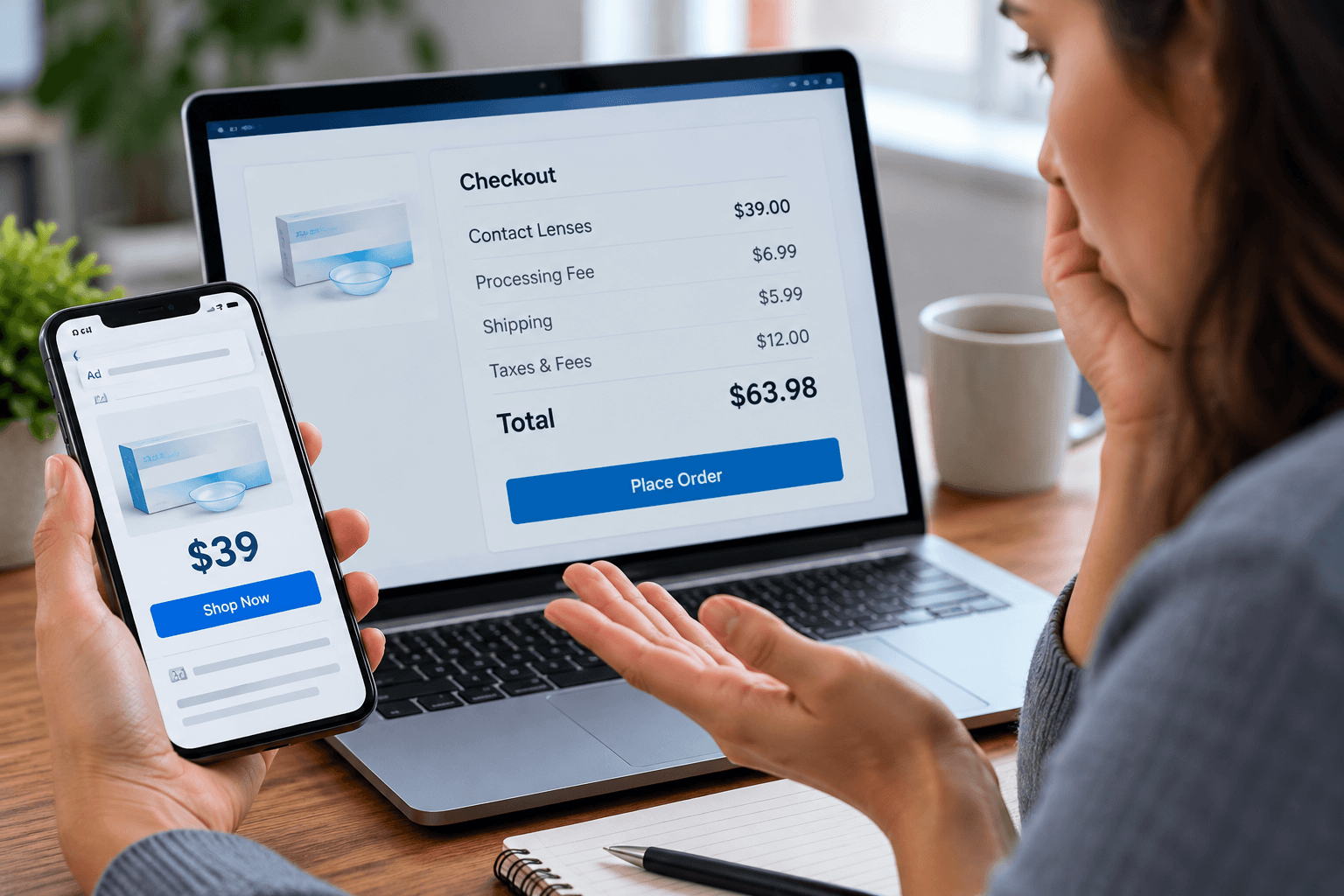
An online ad promises a $39 price. You click, compare options, and prepare to buy. However, the final bill tells a different story. That gap highlights a growing concern about healthcare pricing transparency and whether consumers can trust the prices they see in advertisements. A recent federal lawsuit involving Lens.com raises an important question: Does a price claim end when someone clicks an advertisement, or must that promise remain consistent through checkout?
For healthcare marketers, the answer could reshape how advertising, ecommerce, and compliance teams work together.
Table of Contents
- The Lens.com Case and the Price Promise
- Why Healthcare Pricing Transparency Matters Beyond the Ad
- The Risks of Disconnected Marketing and Checkout Teams
- Building a More Transparent Healthcare Customer Journey
- Conclusion
- Frequently Asked Questions
The Lens.com Case and the Price Promise
On October 2, 2026, the Federal Trade Commission joined Utah and Nevada authorities in filing a lawsuit against contact lens retailer Lens.com.
According to the FTC’s official announcement, the company allegedly advertised low contact lens prices while adding substantial mandatory charges during checkout.
Regulators claim these charges sometimes doubled the advertised price. Furthermore, they allege the additional amounts appeared under a misleading “Taxes & fees” label.
The complaint also challenges how those charges appeared on screen. According to regulators, some consumers could continue purchasing without seeing the additional fees.
Importantly, these are allegations in an ongoing case, not findings of liability.
Nevertheless, the dispute exposes a problem extending far beyond contact lenses.
Imagine an advertisement promoting a $39 product. The landing page repeats that price, but checkout adds an unavoidable charge. This is a hypothetical example illustrating the broader pricing issue, not a documented Lens.com advertisement.
From the customer’s perspective, the original price was not simply information. It was a promise.
Therefore, the central marketing question becomes whether every stage of the purchasing experience supports that initial claim.
Why Healthcare Pricing Transparency Matters Beyond the Ad
Traditional advertising reviews often focus on headlines, images, disclaimers, and promotional language.
However, digital healthcare purchases involve more than advertisements.
Consumers move through search results, landing pages, product selections, shopping carts, and payment screens. Each interaction influences how they understand the offer.
That’s why pricing transparency should be assessed throughout the customer journey, not just at individual points along the way.
A low advertised price may attract attention and improve click-through rates. Yet that advantage can disappear when unexpected charges emerge later.
Consumers may feel misled even when the final amount appears before payment.
This distinction matters because a disclosure at checkout cannot always repair a misleading impression created earlier.
The FTC’s approach to deceptive advertising generally examines the overall impression an advertisement creates, not simply whether technical disclosures exist.
Its Rule on Unfair or Deceptive Fees establishes additional upfront pricing requirements for live-event tickets and short-term lodging. That specific rule does not generally cover contact lens sales.
However, broader federal and state consumer protection laws still prohibit deceptive pricing practices.
For pharmaceutical brands, online pharmacies, telehealth providers, and medical retailers, the lesson is clear: pricing language needs careful review wherever consumers encounter it.
The Risks of Disconnected Marketing and Checkout Teams
One overlooked challenge is the way healthcare organizations divide responsibility for the customer experience.
Marketing teams manage paid search campaigns, promotional messaging, and customer acquisition.
Meanwhile, ecommerce teams control shopping carts, billing systems, subscriptions, and payment workflows.
Legal and compliance departments may review advertising materials without examining every checkout variation.
As a result, individually approved decisions can produce a confusing overall experience.
For example, a campaign might promote a prescription-related product at an attractive starting price. Later screens might introduce mandatory service charges or recurring payment terms.
Even if the teams followed separate internal procedures, consumers experience one transaction.
This disconnect can leave customers with a very different experience from the one the advertisement promised.
As Pharma Marketing Network explains in its article on healthcare brand strategy and consumer trust, brands need to create consistent experiences across digital interactions.
Advertised prices deserve that same level of attention.
Moreover, marketers should measure more than clicks and conversions. Unexpected charges can contribute to abandoned carts, complaints, refund requests, and reduced customer confidence.
A campaign that looks successful in an advertising dashboard may create problems elsewhere in the business.
Therefore, marketing performance and checkout integrity should be evaluated together.
Building a More Transparent Healthcare Customer Journey
Healthcare organizations can strengthen pricing integrity by treating the customer journey as one connected communication system.
First, teams should document every price presented in advertisements, search listings, emails, product pages, and checkout screens.
Next, they should identify mandatory charges and determine when consumers first learn about them.
If unavoidable fees are known beforehand, including them in a clearly presented total can reduce confusion.
In addition, organizations should distinguish required charges from optional services and accurately describe taxes.
Subscription offers need particular attention. Customers should understand recurring charges, renewal terms, and cancellation requirements before enrolling.
Marketing and ecommerce teams should also conduct joint reviews of promotional campaigns.
For example, a paid search advertisement can be tested against its destination page and completed checkout experience.
This process can uncover inconsistent prices, confusing terms, and important details that are hard to find on mobile devices.
Compliance teams can then assess the entire purchasing experience rather than reviewing individual screens separately.
Healthcare advertisers can also work with digital advertising specialists such as eHealthcare Solutions to strengthen campaign planning and messaging consistency.
However, responsibility for accurate pricing remains with the organizations making and delivering the offers.
Ultimately, transparent healthcare pricing depends on teams working together, sharing accurate information, and understanding what customers expect to pay.
Conclusion
The Lens.com lawsuit illustrates why clear, consistent pricing is becoming increasingly important in healthcare marketing.
Although the allegations remain unresolved, the case highlights the risks of advertising prices that do not clearly reflect the amounts consumers must pay.
For marketers, the essential lesson is that a price claim does not simply disappear after someone clicks.
Instead, every stage of the purchasing journey should support the promise that attracted the consumer.
Transparent pricing can strengthen trust, improve decision-making, and create a more reliable customer experience.
Frequently Asked Questions
1. What does price transparency mean in healthcare marketing?
Price transparency means giving consumers clear, accurate information about healthcare costs before they make a purchase. This includes advertised prices, mandatory fees, and important payment conditions.
2. Why is the Lens.com lawsuit important for healthcare marketers?
The case challenges alleged differences between advertised prices and checkout totals. Therefore, it highlights why marketing claims and ecommerce experiences should remain consistent.
3. Are unexpected checkout fees always illegal?
Not necessarily. Legal requirements depend on the product, applicable laws, how charges are presented, and whether the overall offer misleads consumers.
4. How can healthcare organizations improve pricing transparency?
Organizations can audit advertisements, disclose mandatory charges clearly, review subscription terms, and test the entire purchasing journey across devices.
5. Can transparent pricing improve healthcare marketing performance?
Clear pricing can help consumers make informed comparisons and reduce unpleasant surprises. Consequently, it may support customer confidence, engagement, and long-term brand trust.
This content is not medical advice. For any health issues, always consult a healthcare professional. In an emergency, call 911 or your local emergency services.