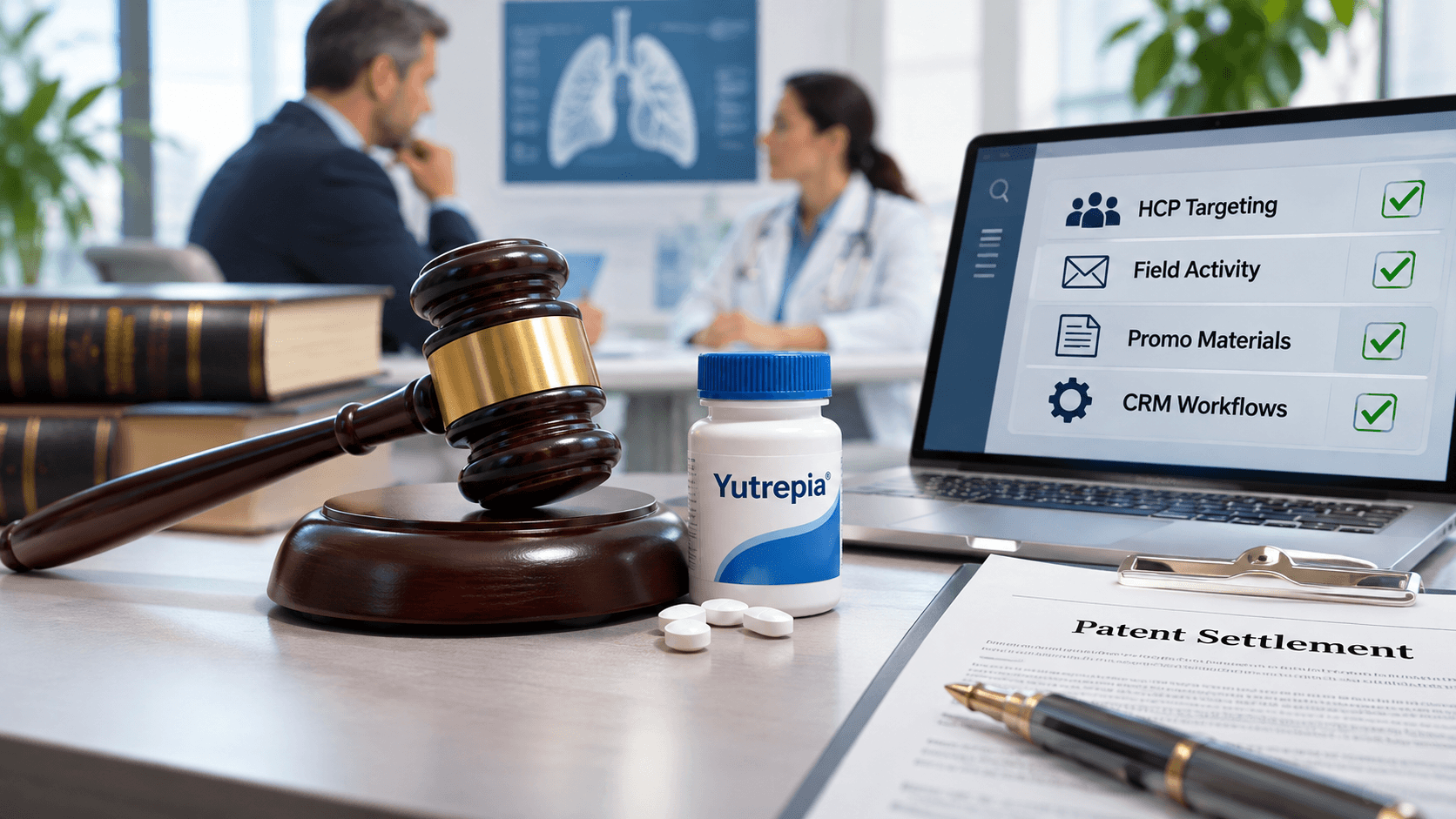
One patent settlement can make a pharmaceutical sales team’s target list obsolete almost overnight. That is the overlooked story behind Liquidia’s October 2026 agreement with United Therapeutics over Yutrepia. Beyond resolving legal disputes, the settlement introduced new restrictions on product promotion, healthcare professional outreach, and prescription support. For anyone managing pharma promotional operations, the settlement is more than a label change. It puts every sales and marketing system to the test.
Table of Contents
- How the Yutrepia Settlement Changed Promotion
- Why HCP Targeting and CRM Segmentation Must Change
- Why Sales Materials and Field Execution Need Controls
- How Referral Forms and Digital Workflows Are Affected
- Conclusion
- FAQ
How the Yutrepia Settlement Changed Promotion
On September 30, 2026, a federal court found that Yutrepia infringed two valid claims of a United Therapeutics patent related to treating pulmonary hypertension associated with interstitial lung disease (PH-ILD). Subsequently, the companies reached a settlement on October 13, resolving six pending lawsuits. Liquidia retained the ability to promote Yutrepia for pulmonary arterial hypertension (PAH), but agreed to stop promoting the drug for PH-ILD.
The agreement goes well beyond changing a product label. According to United Therapeutics’ SEC filing, Liquidia must stop PH-ILD advertising, detailing, and proactive medical education involving Yutrepia. The company also submitted a request to the FDA to remove PH-ILD references from the product’s approved labeling.
Once the FDA approves that amendment, sales of Yutrepia bearing the PH-ILD indication must cease. However, the settlement does not mean every patient must immediately stop treatment. In its November 2026 corporate update, Liquidia stated that patients are not required to discontinue therapy because of the agreement. Therefore, the promotional restrictions and individual treatment decisions must be understood separately.
For pharmaceutical marketers, this distinction matters. A legal settlement can change what representatives communicate, which audiences they contact, and how commercial systems support those interactions. As a result, operational changes may be needed long before every related regulatory process is complete.
Why HCP Targeting and CRM Segmentation Must Change
One settlement provision directly changes who Liquidia can target. The company may promote Yutrepia only to healthcare professionals who, to its knowledge, treat patients with PAH. Consequently, a broad pulmonology audience cannot automatically remain on a promotional list simply because its members work in respiratory medicine.
Instead, marketers need to establish whether each targeted clinician meets the agreed criteria. For example, a physician who treats both PAH and PH-ILD patients may still qualify for PAH-focused outreach. However, specialty alone may not provide enough information to establish eligibility.
In practice, commercial teams should review their CRM targeting rules, sales call plans, and vendor lists to ensure they meet this requirement. This could involve updating audience segments, identifying uncertain records, and preventing ineligible contacts from entering automated campaigns.
Additionally, targeting changes must reach every connected marketing channel. Email platforms, programmatic advertising vendors, territory planning systems, and field sales databases should operate from consistent eligibility rules. Otherwise, a clinician removed from one campaign could still receive promotional messages through another channel.
The importance of reliable audience data is also explored in our guide to HCP targeting in pharma marketing. Although better segmentation often improves campaign performance, this case shows how targeting accuracy can also become a contractual compliance requirement.
Why Sales Materials and Field Execution Need Controls
Even a carefully updated CRM cannot prevent compliance problems if sales representatives continue using outdated materials. The settlement requires Liquidia to instruct its sales force to stop using marketing and detailing information that references PH-ILD or the INCREASE study.
Consequently, field teams need clear guidance about which presentations, clinical discussions, and promotional resources remain appropriate. This makes content management just as important as audience selection.
A practical response begins with reviewing existing sales presentations, digital brochures, email templates, speaker program materials, and physician leave-behinds. Next, commercial teams can identify affected assets, withdraw outdated versions, and distribute approved replacements.
Medical, legal, and regulatory reviewers should also evaluate revised PAH-focused messages before they reach the field. Furthermore, training should explain the restrictions in plain language so representatives can recognize situations that require additional guidance.
These steps are recommended operational safeguards rather than confirmed descriptions of Liquidia’s internal processes. Nevertheless, they illustrate the broader challenge facing pharmaceutical companies after major legal decisions.
Separately, the agreement restricts the use of certain PH-ILD data from Liquidia’s ASCENT trial. This highlights why promotional content, scientific communications, and clinical information must be reviewed carefully within their applicable rules.
As our article on pharma press release compliance explains, commercial messaging can create regulatory risks beyond traditional advertisements. Ultimately, legal restrictions must translate into clear promotional guidelines that sales teams can understand and follow.
How Referral Forms and Digital Workflows Are Affected
Some of the settlement’s most revealing requirements fall outside advertising altogether. United Therapeutics disclosed that Liquidia must add a mandatory certification checkbox to Yutrepia referral forms, voucher applications, prescriptions, and similar documents.
Healthcare professionals must certify that the patient has Group 1 PAH or another indication that may receive future FDA approval. Additionally, pharmacies carrying Yutrepia must be instructed to include the certification on their own referral forms and obtain verbal attestations for certain pending referrals submitted without it.
These provisions create challenges that go far beyond revising a marketing campaign. For instance, an updated advertisement provides little protection against operational inconsistency if a referral system continues using outdated forms.
Therefore, commercial, patient support, pharmacy, technology, and compliance teams need coordinated procedures for implementing the changes. Digital platforms may require updated forms, revised validation rules, and additional checks before certain requests can proceed.
The agreement also calls for communications to healthcare professionals about transitioning PH-ILD patients to alternative treatment and requests to specified payers concerning PH-ILD prior authorizations. As a result, commercial execution must account for how information moves between prescribers, pharmacies, support programs, and payers.
Digital advertising partners may face similar coordination needs. For example, companies working with healthcare marketing providers such as eHealthcare Solutions should ensure that audience exclusions, approved creative materials, and campaign instructions remain aligned with applicable restrictions.
Importantly, the settlement does not establish that Liquidia uses any particular CRM platform or digital workflow. Rather, it demonstrates why pharmaceutical companies should examine every connected commercial system when legal obligations change.
The takeaway is simple: referral systems, patient support tools, and marketing messages must all follow the same compliance requirements.
Conclusion
Liquidia’s settlement with United Therapeutics demonstrates how patent litigation can reshape commercial execution without removing a medicine entirely from the market.
The implications extend beyond attorneys and regulatory specialists. Marketing teams must understand how legal restrictions affect audience selection, approved messaging, field activities, and prescription support.
Moreover, disconnected systems can create problems even when individual departments believe they have followed the rules. Effective coordination helps ensure that changes reach every relevant channel and commercial partner.
In short, major legal settlements should trigger a coordinated review of HCP targeting, promotional materials, and commercial workflows to ensure every activity stays compliant.
FAQ
What changed in Liquidia’s Yutrepia promotion?
The settlement allows Liquidia to continue promoting Yutrepia for PAH while prohibiting promotion for PH-ILD. It also restricts promotional outreach to healthcare professionals known by Liquidia to treat PAH patients.
Does the settlement require every PH-ILD patient to stop Yutrepia?
No. Liquidia has stated that patients are not required to discontinue treatment because of the settlement. However, the agreement includes restrictions on promotion and requirements involving communications and prescription support.
Why does the settlement affect HCP targeting?
Promotional eligibility now depends on whether Liquidia knows a clinician treats patients with PAH. Therefore, accurate physician data and appropriate audience segmentation are essential.
How can patent settlements affect pharmaceutical CRM systems?
When settlement terms restrict promotional audiences or activities, companies may need to revise CRM targeting rules, contact lists, campaign permissions, and field sales processes. The required changes depend on the specific agreement.
What should pharma marketing teams review first after a legal settlement?
Teams should begin by reviewing approved product claims, HCP targeting lists, sales materials, digital campaigns, and referral workflows. They should then coordinate changes with compliance teams and external partners.
This content is not medical advice. For any health issues, always consult a healthcare professional. In an emergency, call 911 or your local emergency services.