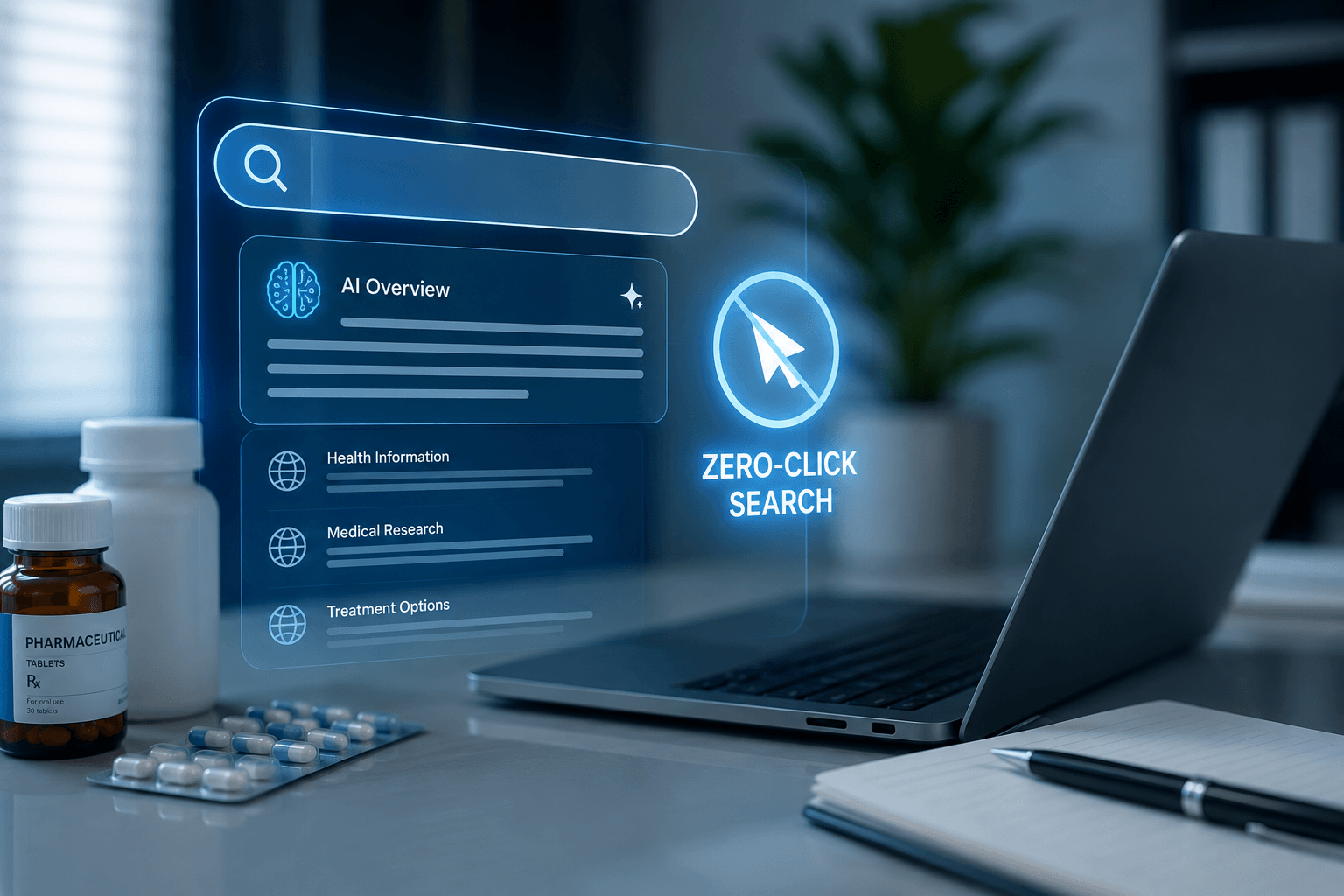
As AI-powered search engines continue to reshape how people access medical information, pharma marketers are facing a difficult reality. Traditional search traffic is shrinking fast. Instead of clicking through to websites, users now receive direct answers from AI-generated summaries, search overviews, and conversational assistants.
This shift has created what many healthcare marketers now describe as the “zero-click crisis” in search. For years, pharmaceutical brands invested heavily in SEO, paid search, and content marketing to attract healthcare professionals and patients through Google rankings. However, in 2026, the rules are changing. Search engines increasingly keep users on the results page rather than sending them to external websites.
As a result, companies are rethinking their entire digital strategy. A modern pharmaceutical search visibility strategy is no longer optional. It has become essential for maintaining visibility, trust, and audience engagement in the AI search era.
Table of Contents
- Why zero-click searches are growing
- How AI search impacts pharma websites
- Why marketers are shifting budgets in 2026
- The future of pharma visibility and trusted communities
- FAQs
Why Zero-Click Searches Are Growing
Zero-click searches happen when users get the information they need without visiting a website. AI-powered search tools now summarize medical conditions, drug information, symptoms, and treatment options directly within search results.
For example, a patient searching for “best biologic treatment for psoriasis” may now receive an AI-generated overview that combines information from multiple sources. Instead of clicking a pharmaceutical brand’s website, the user often stays within the search interface.
This trend is accelerating because generative AI tools prioritize convenience and speed. Patients want immediate answers. Healthcare professionals also prefer concise summaries during busy clinical workflows. Consequently, fewer users are clicking traditional search listings.
The rise of AI overviews has disrupted the traffic model that pharma companies relied on for years. Even highly ranked pages are seeing declining engagement. Paid ads are also becoming less effective because AI-generated answers push sponsored results further down the page.
As search behavior evolves, brands must adapt their approach. A strong AI-era pharma search strategy focuses less on website clicks and more on overall visibility across trusted digital ecosystems.
How AI Search Impacts Pharma Websites
AI search engines are fundamentally changing how pharmaceutical content gets discovered. Instead of rewarding websites with strong keyword density alone, AI systems now prioritize authority, credibility, and structured medical relevance.
This creates several challenges for pharma marketers.
First, website traffic becomes less predictable. Brands may continue producing educational content, yet AI systems often summarize that information without generating a visit. Consequently, content investment no longer guarantees traffic growth.
Second, attribution becomes harder to measure. Traditional SEO metrics such as impressions, click-through rates, and organic sessions lose value when users consume information directly within AI summaries.
Third, pharma companies face reduced message control. AI systems may combine information from multiple publishers, forums, and healthcare sites into a single response. As a result, brand messaging can become diluted or fragmented.
At the same time, regulatory concerns add another layer of complexity. Pharmaceutical marketing teams must ensure that content remains compliant while still optimized for AI discoverability. This balancing act is becoming increasingly difficult.
Because of these challenges, many organizations are moving away from outdated SEO tactics. Instead, they are investing in verified medical publishing platforms, physician-led communities, and patient engagement ecosystems that AI tools are more likely to reference.
For companies exploring healthcare-focused digital growth strategies, platforms like eHealthcare Solutions are becoming increasingly relevant as advertising channels evolve beyond traditional search.
Why 2026 Marketing Budgets Are Shifting
The decline in organic website traffic is forcing pharma executives to reevaluate marketing priorities. In 2026, more brands are allocating budgets toward trust-based distribution instead of relying exclusively on search engine rankings.
This shift is happening for several reasons.
AI search systems favor established authority sources. Clinical publishers, academic journals, healthcare networks, and verified patient communities are now more influential than standalone corporate websites. Therefore, pharma marketers want visibility within those trusted ecosystems.
Additionally, healthcare consumers increasingly seek peer validation. Patients often trust experiences shared within disease communities more than branded marketing pages. As a result, patient advocacy partnerships and physician-led discussions are becoming more valuable.
Another important factor is content syndication. Brands now recognize that distributing educational content across multiple high-authority healthcare platforms increases the likelihood of appearing in AI-generated summaries.
Instead of asking, “How do we rank number one on Google?” marketers are now asking, “How do we become part of the AI knowledge layer?”
That question now defines modern pharmaceutical search marketing.
Companies are also investing more heavily in structured medical data, schema optimization, expert-reviewed articles, and omnichannel publishing. These strategies help AI systems identify trustworthy content more effectively.
For pharmaceutical organizations seeking compliant digital communication strategies or professional healthcare guidance, Healthcare.pro offers useful healthcare resources and support.
The Future of Pharma Visibility and Trusted Communities
The future of pharmaceutical marketing will likely depend less on direct website traffic and more on distributed digital influence.
AI search is not eliminating content marketing entirely. However, it is changing where and how content creates value. Brands that continue relying solely on legacy SEO strategies may struggle to maintain visibility over the next few years.
Instead, successful pharma companies will focus on building authority across multiple trusted environments. This includes medical publishers, physician networks, healthcare podcasts, patient communities, and clinical education platforms.
Transparency will also become more important. AI systems increasingly favor expert-reviewed and evidence-backed content. Consequently, pharmaceutical companies must emphasize medical accuracy, credible sourcing, and authentic patient engagement.
Moreover, brands should optimize for AI retrieval rather than simple keyword rankings. Structured content, conversational language, and topic authority now matter more than traditional SEO tricks.
The organizations adapting fastest understand one key reality. In the AI era, visibility no longer belongs exclusively to the highest-ranking website. It belongs to the most trusted and widely referenced source.
That is why zero-click search optimization is becoming central to digital pharmaceutical marketing in 2026 and beyond.
Conclusion
The rise of AI-powered search has created a major turning point for pharmaceutical marketing. Traditional SEO models are losing effectiveness as users increasingly receive answers directly within search interfaces.
Because of this shift, pharma brands must rethink how they build visibility online. Success now depends on authority, trust, and presence within verified healthcare ecosystems rather than website clicks alone.
A strong AI search visibility strategy helps pharmaceutical companies adapt to this new environment by focusing on distributed influence, trusted publishing networks, and meaningful patient engagement. As AI search continues evolving, the brands that embrace these changes early will likely gain the strongest competitive advantage.
FAQs
What does zero-click search mean for pharma marketers?
It focuses on maintaining visibility in AI-driven search environments where users often get answers without visiting websites.
Why are pharma websites losing organic traffic?
Pharma websites are losing traffic because AI search engines increasingly summarize medical information directly on search result pages.
How does AI search affect pharmaceutical marketing?
AI search changes how users discover information, reducing website clicks while increasing the importance of authority, credibility, and structured medical content.
What platforms are becoming more important for pharma brands?
Trusted healthcare publishers, physician communities, patient advocacy groups, and verified clinical networks are becoming increasingly valuable.
Is traditional SEO still important for pharma companies?
Yes, but traditional SEO alone is no longer enough. Pharma brands must also optimize content for AI discoverability and trusted digital ecosystems.
This content is not medical advice. For any health issues, always consult a healthcare professional. In an emergency, call 911 or your local emergency services.