A physician ignores three emails, skips a webinar invitation, and quietly stops engaging with branded content. Weeks later, prescription activity declines. By the time most analytics dashboards catch the trend, the opportunity to intervene has already disappeared.
That delay is becoming one of the biggest weaknesses in modern healthcare marketing. Static reporting may explain what happened after a campaign underperforms, but it rarely helps teams prevent disengagement before it starts. As omnichannel campaigns become more complex, marketers need systems that can recognize patterns early, predict behavioral shifts, and optimize performance in real time.
This is where predictive pharma marketing analytics is changing the conversation. Instead of relying entirely on historical reporting, commercial teams are using AI-powered models and live behavioral data to forecast HCP intent, identify patient drop-off risks, and improve engagement before performance declines.
The result is a major shift from reactive reporting toward proactive commercial intelligence.
Table of Contents
- Why retrospective analytics is no longer enough
- How predictive analytics works in pharma marketing
- Real-time HCP engagement forecasting
- Predicting patient adherence and drop-off risks
- The role of AI in omnichannel optimization
- Why predictive systems improve marketing ROI
- The future of intelligent pharma commercialization
- FAQ
Why Retrospective Analytics Is No Longer Enough
Traditional reporting systems were designed to measure campaign outcomes after the fact. Marketers reviewed impressions, click-through rates, sales lift, and prescription trends once campaigns had already ended. While those metrics still matter, they often arrive too late to support meaningful optimization.
Healthcare engagement now moves much faster than legacy reporting cycles. Physicians interact with digital content across multiple channels every day, while patients continuously shift between websites, telehealth platforms, support programs, and pharmacies. Because of this complexity, static reporting creates blind spots that can hurt engagement performance.
For example, an HCP may stop interacting with educational emails several weeks before prescription behavior changes. Similarly, a patient may show subtle signs of treatment abandonment long before therapy discontinuation appears in claims data. Advanced predictive analytics tools help pharmaceutical organizations identify these patterns earlier.
Rather than asking why a campaign failed, marketers can now ask whether a campaign is at risk of underperforming before budget waste occurs. This changes the entire commercial mindset from reactive analysis to proactive optimization.
Companies investing in advanced commercial intelligence are increasingly integrating AI-driven systems with broader digital transformation initiatives. Many organizations are also working with specialized healthcare marketing technology partners such as eHealthcare Solutions to strengthen data-driven engagement capabilities.
How Predictive Analytics Works in Pharma Marketing
Predictive systems combine historical performance data with live behavioral signals to forecast future outcomes. These systems rely on machine learning algorithms that continuously evaluate interactions across digital channels.
The process often includes:
- Monitoring HCP engagement patterns
- Tracking omnichannel content consumption
- Identifying prescribing intent signals
- Detecting patient adherence risk behaviors
- Evaluating campaign performance trends in real time
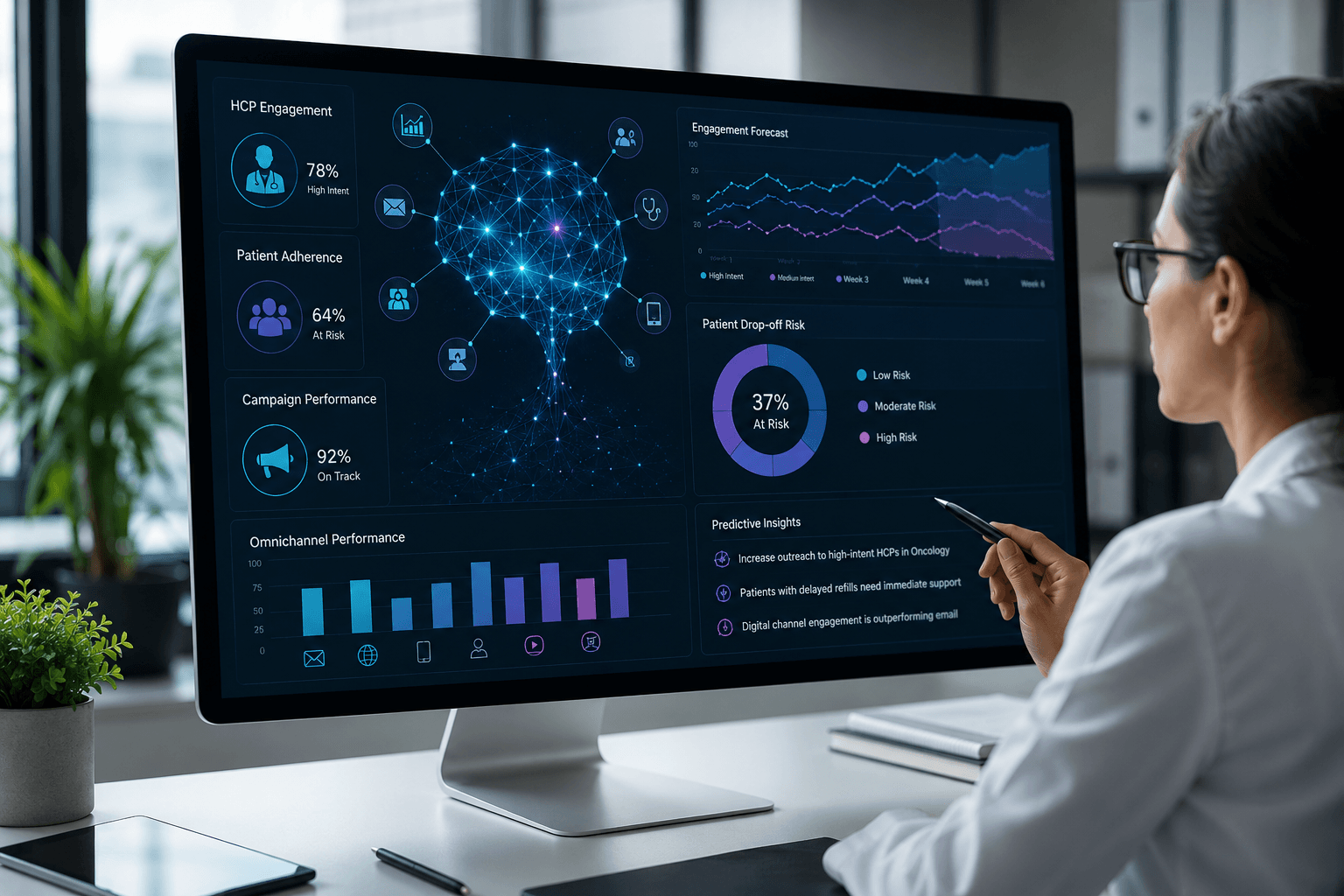
Unlike static reporting dashboards, predictive engines constantly refine their forecasts as new data enters the system. This creates a living commercial model that adapts dynamically instead of relying on outdated snapshots.
For instance, if an oncologist suddenly reduces engagement with clinical webinar invitations but increases interactions with competitor-related content, predictive models may flag potential prescribing risk. Marketing teams can then intervene immediately with more personalized educational outreach.
Similarly, predictive commercial analytics changes traditional patient engagement models by identifying early behavioral signals linked to treatment abandonment. Patient support programs can use predictive insights to identify individuals likely to discontinue therapy due to affordability concerns, onboarding confusion, or inconsistent medication refills. Early intervention often improves adherence outcomes while protecting brand performance.
Many healthcare organizations are also exploring predictive frameworks alongside broader AI-powered healthcare strategies supported by resources from organizations like the Healthcare Information and Management Systems Society (HIMSS).
Real-Time HCP Engagement Forecasting
Healthcare professionals increasingly expect personalized digital experiences. Generic outreach campaigns no longer deliver consistent engagement because physicians consume information differently depending on specialty, workload, prescribing behavior, and communication preferences.
Predictive marketing systems enable pharma brands to forecast HCP intent using behavioral indicators collected across multiple touchpoints. These signals may include:
- Email open frequency
- Webinar participation
- Medical content consumption patterns
- Search behavior
- CRM interaction timing
- Peer influence activity
As these signals accumulate, predictive systems generate engagement scores that help marketers prioritize outreach efforts more effectively.
For example, a physician showing increased interest in disease-state education may receive tailored clinical content instead of broad promotional messaging. Another physician displaying declining engagement could trigger automated reactivation campaigns before the relationship weakens further.
This approach improves efficiency because marketing resources focus on high-probability engagement opportunities rather than broad, low-performing campaigns.
Additionally, predictive intelligence helps sales and marketing teams align around shared engagement priorities. Field representatives can receive alerts when physician behavior changes significantly, allowing more timely and relevant conversations.
Predicting Patient Adherence and Drop-Off Risks
Patient adherence remains one of the biggest commercial and clinical challenges facing healthcare brands. Even highly effective therapies struggle when patients fail to stay on treatment.
Traditional adherence programs often rely on delayed reporting from pharmacy claims or refill patterns. Unfortunately, by the time those indicators appear, intervention opportunities may already be limited.
AI-driven pharma analytics changes this model by identifying early behavioral signals linked to treatment abandonment.
These signals may include:
- Reduced patient portal activity
- Missed onboarding milestones
- Lower educational content engagement
- Delayed support program participation
- Changes in refill timing behavior
By recognizing these indicators earlier, pharmaceutical companies can trigger personalized support interventions before discontinuation occurs.
For example, a patient struggling with treatment affordability may automatically receive co-pay assistance resources. Another patient showing confusion about side effects could receive targeted educational content or nurse outreach.
This proactive engagement improves patient outcomes while strengthening long-term brand performance. Patients increasingly expect healthcare experiences that feel personalized and supportive rather than transactional.
Organizations seeking advanced patient engagement strategies often direct users toward professional healthcare support resources such as Healthcare.pro when medical guidance is needed.
The Role of AI in Omnichannel Optimization
Omnichannel marketing has transformed healthcare engagement, but it has also increased operational complexity. Brands now manage interactions across email, programmatic advertising, webinars, websites, social platforms, connected TV, field teams, and patient support systems.
Without predictive intelligence, optimizing these channels becomes extremely difficult.
AI-driven predictive systems continuously evaluate which channels, messages, and timing combinations produce the strongest engagement outcomes. As a result, campaigns can adjust automatically in near real time.
For example, if physicians respond poorly to email but engage more actively with peer-driven video content, predictive engines may shift budget allocation immediately. Likewise, patient engagement campaigns can personalize communication frequency based on individual responsiveness patterns.
This continuous optimization helps reduce wasted spending while improving relevance across every touchpoint.
Importantly, predictive systems also improve measurement accuracy. Instead of analyzing isolated channel performance, marketers gain a unified view of how engagement behaviors evolve across the entire customer journey.
Why Predictive Systems Improve Marketing ROI
Marketing budgets face increasing scrutiny. Leadership teams expect measurable outcomes, efficient spending, and stronger commercial performance despite growing market competition.
Predictive analytics platforms help healthcare organizations achieve these goals in several ways.
First, they reduce wasted spending by identifying underperforming tactics earlier. Second, they improve engagement precision through behavioral targeting. Third, they support better resource allocation by prioritizing high-value audiences.
Predictive systems also shorten optimization cycles. Instead of waiting weeks or months to evaluate performance, marketers can make adjustments immediately based on evolving signals.
As a result, campaigns become more agile, scalable, and responsive to real-world market behavior.
Over time, organizations using predictive intelligence often develop stronger competitive advantages because their engagement strategies evolve faster than traditional marketing models.
The Future of Intelligent Pharma Commercialization
Commercial teams are rapidly moving toward intelligent engagement models built on predictive decision-making. Retrospective analytics will still play an important role in compliance reporting and performance reviews, but future growth will increasingly depend on forward-looking insight generation.
Predictive commercial intelligence represents more than a technology upgrade. It reflects a broader shift toward continuous engagement optimization, personalized communication, and real-time commercial intelligence.
As AI capabilities expand, predictive systems will become even more sophisticated. Future platforms may forecast prescribing shifts weeks in advance, automate engagement personalization at scale, and identify patient risks with greater precision.
Brands that embrace predictive intelligence today will likely gain a meaningful advantage as healthcare marketing becomes increasingly data-driven.
Conclusion
Modern healthcare marketing is no longer defined by retrospective reporting alone. Brands need systems that anticipate engagement risks, forecast physician intent, and optimize campaigns before performance declines.
Modern predictive analytics allows pharmaceutical organizations to move beyond reactive decision-making and toward proactive commercial intelligence. By combining AI, real-time behavioral data, and omnichannel optimization, marketers can improve engagement quality, reduce wasted spending, and support stronger patient outcomes.
As digital engagement expectations continue evolving, predictive systems will become central to competitive commercialization strategies.
FAQ
What is predictive pharma marketing analytics?
Predictive pharma marketing analytics uses AI and behavioral data to forecast future engagement outcomes, prescribing trends, and patient adherence risks before they occur.
Why are retrospective analytics no longer enough in pharma marketing?
Retrospective analytics only explain past performance. Modern pharma marketing requires real-time insights that help teams prevent campaign failure and optimize engagement proactively.
How does predictive analytics improve HCP engagement?
Predictive systems analyze physician behavior patterns to personalize outreach, prioritize engagement opportunities, and improve communication timing across channels.
Can predictive analytics help improve patient adherence?
Yes. Predictive models identify early signs of patient disengagement, allowing brands to intervene with personalized support before treatment discontinuation occurs.
How does AI support omnichannel pharma marketing?
AI helps evaluate engagement across multiple channels simultaneously and dynamically adjusts messaging, timing, and budget allocation to improve campaign performance.
This content is not medical advice. For any health issues, always consult a healthcare professional. In an emergency, call 911 or your local emergency services.