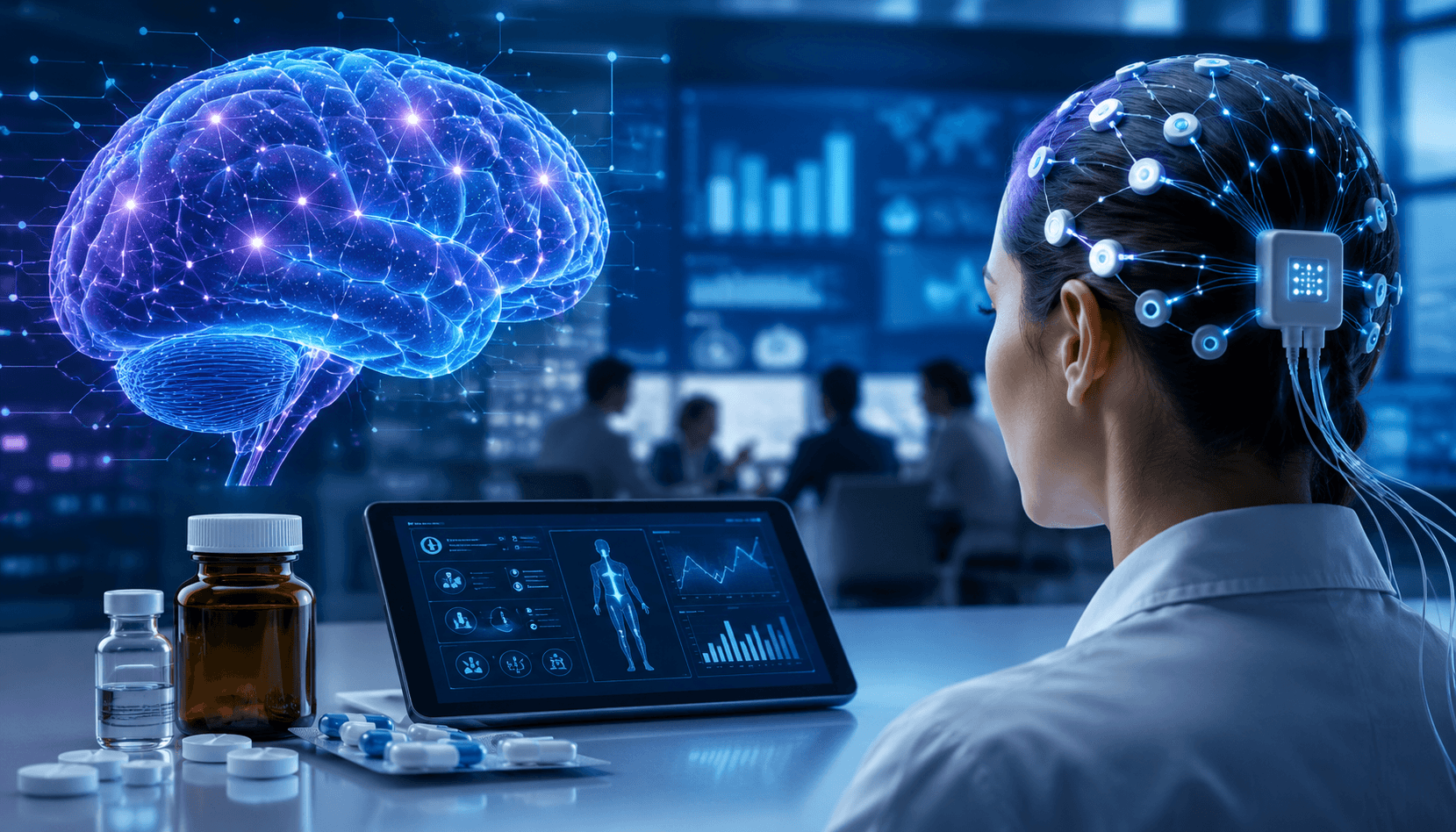
Marketing for brain-computer interfaces is emerging as one of the most important strategic considerations for pharmaceutical companies entering the age of intelligent neurotechnology. As brain-computer interfaces (BCIs), adaptive neurostimulation systems, and AI-powered neurological devices become part of everyday clinical practice, pharmaceutical marketers face an entirely new challenge. They are no longer promoting a medication alone. Instead, they are communicating the value of an integrated treatment ecosystem that combines drugs, software, connected medical devices, cloud analytics, and continuous patient support.
This shift is already taking shape in therapeutic areas such as Parkinson’s disease, epilepsy, spinal cord injury, severe depression, chronic pain, and paralysis. Consequently, pharmaceutical companies must rethink traditional marketing strategies to address healthcare professionals, patients, caregivers, and payers who increasingly evaluate complete treatment experiences rather than individual products.
Table of Contents
- The rise of intelligent neurotechnology
- Why marketing brain-computer interfaces changes everything
- Building trust in connected neurotechnology
- Preparing for the future of neurotechnology marketing
- Conclusion
- FAQs
Brain-Computer Interfaces Are Expanding Beyond Research
Brain-computer interfaces have evolved rapidly over the past decade. What once existed primarily in academic laboratories is steadily moving toward commercial healthcare applications. Companies including Neuralink, Synchron, Precision Neuroscience, and Blackrock Neurotech are advancing implantable and minimally invasive systems that allow communication between the human brain and external devices. Meanwhile, adaptive neurostimulation technologies are becoming increasingly sophisticated for managing neurological disorders.
Unlike conventional pharmaceuticals, these therapies often involve multiple components working together. A patient may receive medication alongside implanted electrodes, wearable sensors, AI-powered software, smartphone applications, and remote physician monitoring.
As a result, treatment success depends on the performance of the entire ecosystem rather than a single therapy. Pharmaceutical companies partnering with device manufacturers must therefore communicate how each component contributes to improved patient outcomes.
According to the U.S. Food and Drug Administration, digital health technologies and medical devices are becoming an increasingly important part of personalized healthcare, requiring greater collaboration between pharmaceutical and technology companies. Learn more from the FDA’s Digital Health Center of Excellence.
Why Marketing Brain-Computer Interfaces Requires a New Mindset
Traditional pharmaceutical marketing has historically emphasized clinical efficacy, safety profiles, dosing convenience, and comparative trial data. While these factors remain essential, marketing brain-computer interface therapies introduces entirely new value propositions.
Healthcare providers now evaluate software reliability, cybersecurity protections, interoperability with hospital systems, firmware updates, artificial intelligence performance, and real-world patient engagement. These considerations extend well beyond pharmacology.
Furthermore, patients increasingly expect intuitive digital experiences similar to those offered by consumer technology companies. A therapy supported by an easy-to-use mobile application, responsive technical support, and seamless remote monitoring may deliver higher patient satisfaction than medication alone.
Consequently, marketers must explain how integrated solutions improve quality of life while reducing treatment burden. This requires messaging that balances scientific credibility with technology usability.
In addition, purchasing decisions increasingly involve multidisciplinary teams that include neurologists, neurosurgeons, rehabilitation specialists, IT professionals, hospital administrators, and procurement departments. Marketing materials must therefore address multiple stakeholder priorities simultaneously.
Companies seeking innovative digital engagement strategies can also benefit from the resources available at eHealthcare Solutions, which focuses on healthcare digital marketing, medical advertising, and audience engagement.
Building Trust in Connected Neurotechnology
Trust will become one of the most valuable assets when marketing brain-computer interface technologies. Unlike conventional medications, connected neurotechnologies continuously collect, analyze, and transmit sensitive neurological data.
Patients naturally want reassurance that their information remains secure and private. Physicians need confidence that software updates will not disrupt therapy. Healthcare systems require evidence that connected devices integrate safely into existing clinical workflows.
Therefore, pharmaceutical marketers should emphasize transparency alongside clinical evidence.
Successful messaging should highlight:
- Long-term clinical outcomes
- Device reliability and uptime
- Data privacy protections
- Regulatory compliance
- AI transparency
- Remote monitoring capabilities
- Patient support services
- Cross-platform interoperability
Rather than focusing exclusively on product features, marketers should demonstrate how these elements work together to improve treatment continuity, patient confidence, and measurable clinical outcomes.
The journal Nature Reviews Neurology continues to highlight the importance of integrating neurotechnology into routine clinical care while addressing ethical, regulatory, and patient-centered considerations. Read more.
From Product Marketing to Ecosystem Marketing
Perhaps the biggest transformation is that pharmaceutical companies are gradually becoming ecosystem companies.
Many future neurological therapies will involve partnerships between pharmaceutical manufacturers, software developers, AI companies, cloud computing providers, medical device manufacturers, and digital health platforms.
Instead of marketing a single branded medication, organizations may market a complete neurological care platform.
This creates opportunities to demonstrate value throughout the patient journey. Educational content can extend beyond disease awareness to include digital onboarding, remote monitoring, technical support, patient communities, rehabilitation resources, and outcome tracking.
Similarly, commercial teams must collaborate more closely with medical affairs, digital health specialists, software engineers, cybersecurity experts, and customer experience teams.
For marketers, this means success will increasingly depend on storytelling that connects every element of the therapeutic ecosystem into one cohesive narrative.
Healthcare professionals and patients seeking expert medical guidance can also use Healthcare.pro to connect with qualified healthcare providers.
Preparing Pharma Marketing Teams for Intelligent Neurotechnology
Marketing strategies for brain-computer interfaces are still evolving, but their influence will grow rapidly as neurotechnology becomes more widely adopted. Pharmaceutical companies that begin adapting today will be better positioned to compete tomorrow.
Several priorities stand out.
First, marketers should develop a deeper understanding of digital therapeutics, AI-powered medical devices, connected healthcare ecosystems, and software-enabled therapies.
Second, cross-functional collaboration will become essential. Marketing teams should work closely with engineering, regulatory, medical affairs, cybersecurity, and customer success departments to build consistent messaging.
Third, real-world evidence will become increasingly valuable. Long-term patient outcomes, device performance metrics, adherence data, digital biomarkers, and patient-reported experiences will strengthen marketing claims far beyond traditional clinical trial endpoints.
Finally, organizations should embrace continuous education. As technologies evolve, both healthcare professionals and patients will require ongoing support to fully understand the benefits and limitations of intelligent neurotechnology.
Companies that position themselves as trusted educators rather than simply product promoters will be better equipped to build lasting relationships across the healthcare ecosystem.
Conclusion
Marketing for brain-computer interfaces represents a fundamental evolution in pharmaceutical communications. As drugs become integrated with intelligent neurotechnology, successful marketing will depend on demonstrating the value of complete therapeutic ecosystems rather than individual products alone.
Companies that effectively communicate software performance, patient experience, device reliability, clinical evidence, and seamless integration will be better positioned to earn the trust of physicians, patients, healthcare systems, and payers. The future of pharmaceutical marketing is no longer centered solely on molecules. Instead, it is increasingly defined by connected care, intelligent technology, and measurable patient outcomes.
Frequently Asked Questions
What is brain-computer interface marketing?
Brain-computer interface marketing refers to the strategies used to promote integrated therapies that combine pharmaceuticals, connected neurotechnology, software, and intelligent medical devices.
Why is brain-computer interface marketing important for pharmaceutical companies?
As neurological therapies become more technology-driven, pharmaceutical companies must communicate the value of complete treatment ecosystems rather than individual drugs.
Which diseases may benefit from brain-computer interfaces?
Current and emerging applications include Parkinson’s disease, epilepsy, paralysis, spinal cord injury, severe depression, chronic pain, and other neurological disorders.
How does connected neurotechnology change pharmaceutical messaging?
Marketing increasingly emphasizes patient experience, software functionality, interoperability, cybersecurity, remote monitoring, and long-term treatment outcomes alongside clinical efficacy.
Will pharmaceutical companies work more closely with technology firms?
Yes. Future neurological therapies will increasingly involve collaborations between pharmaceutical companies, medical device manufacturers, AI developers, digital health providers, and software companies to deliver integrated patient care.
Disclaimer: This content is not medical advice. For any health issues, always consult a healthcare professional. In an emergency, call 911 or your local emergency services.