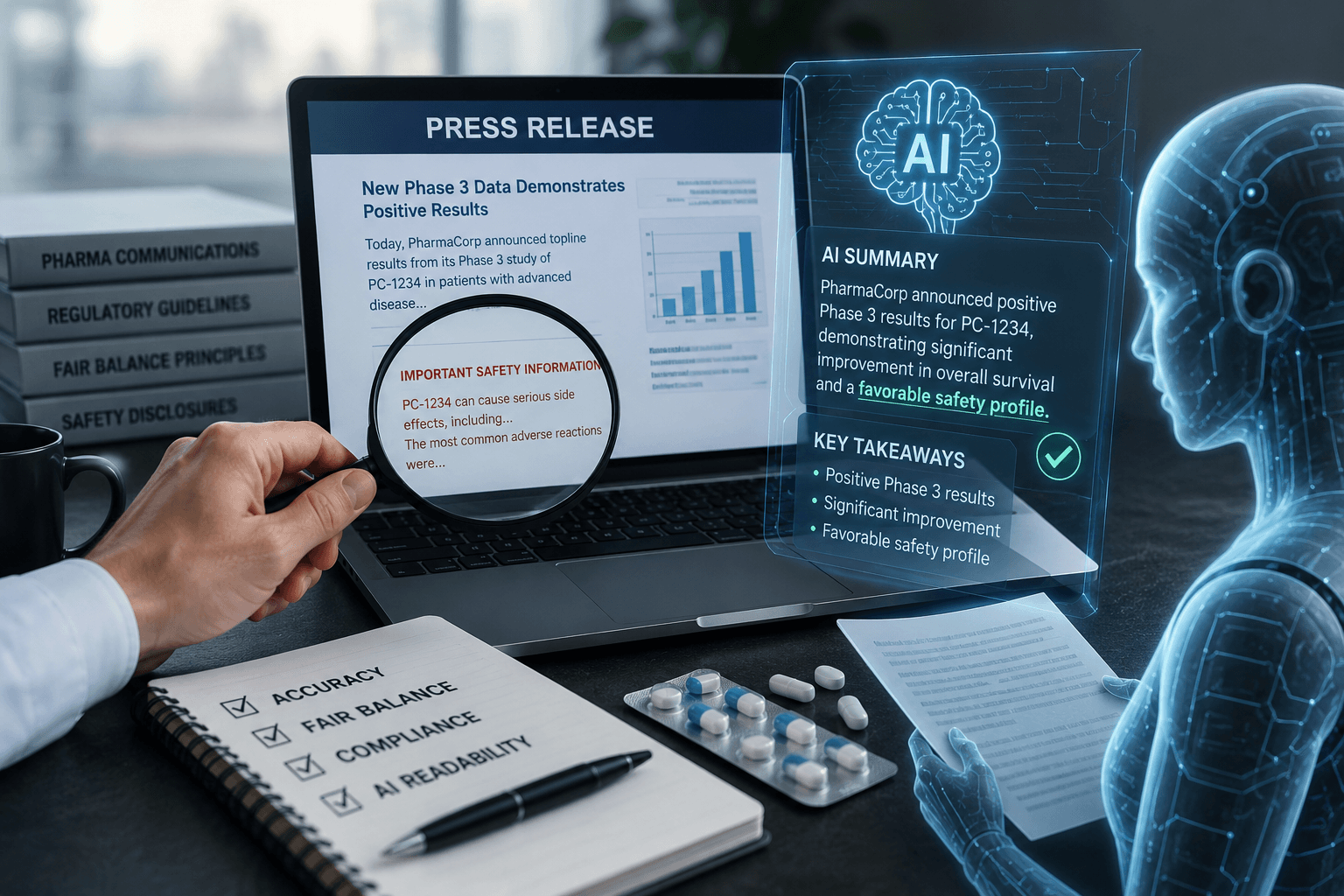
AI tools are now reading pharmaceutical press releases faster than most humans. Large language models, medical AI assistants, and automated summarization systems scan earnings calls, pipeline announcements, and clinical trial updates within seconds. However, speed comes with a serious risk. If these systems misinterpret safety language, omit fair balance, or exaggerate efficacy claims, the resulting summaries may spread incomplete or misleading information to healthcare professionals and investors.
This is where an AI-ingestion audit for pharma companies becomes essential. Pharma brands already review communications for regulatory compliance before publication. Yet many teams still fail to test how AI systems actually interpret their content after release. As AI-generated summaries increasingly shape online visibility and medical discovery, communications teams must optimize content not only for human readers but also for machine interpretation.
Table of Contents
- Why AI systems struggle with pharma communications
- What an AI-ingestion audit includes
- Risks of inaccurate AI-generated summaries
- How pharma teams can structure AI-friendly content
- Future-proofing medical communications
Why AI Systems Struggle With Pharma Communications
Pharmaceutical communication is heavily regulated for a reason. Clinical data requires context, limitations, safety disclosures, and fair balance. Human reviewers understand nuance. AI systems often do not.
For example, an oncology press release may highlight progression-free survival improvements in a headline. However, the detailed safety profile may appear much later in the release. A language model summarizing the document could prioritize efficacy claims while minimizing adverse event information. As a result, the summary may unintentionally create promotional imbalance.
This challenge becomes more serious when AI systems aggregate information from multiple sources. Medical AI agents increasingly pull snippets from press releases, investor presentations, conference transcripts, and social posts simultaneously. If one source lacks sufficient context, the model may generate conclusions that no regulatory reviewer would approve.
Additionally, AI systems favor concise and prominent language. That means headlines, bullet points, executive quotes, and early paragraphs carry disproportionate influence. If important risk language lacks visibility or clarity, AI models may underweight it entirely.
According to the U.S. Food and Drug Administration, pharmaceutical promotional communications must present benefits and risks with fair balance and accuracy. AI-generated summaries that distort this balance can create compliance concerns even when the original release technically meets regulatory standards. External healthcare guidance from the FDA Drug Safety Communications reinforces the importance of clear safety presentation.
As AI search and generative engines become more influential, communications teams must assume that machines are now a secondary audience.
What an AI-Ingestion Audit Includes
An AI-ingestion audit helps pharma companies evaluate how AI systems interpret corporate communications after publication. Instead of reviewing only the approved source document, the audit tests what downstream AI tools actually produce.
The process typically begins with ingestion testing. Teams input press releases, earnings call transcripts, and clinical announcements into multiple AI platforms to observe how summaries differ. Some models prioritize optimistic language. Others simplify complex medical terminology too aggressively. These differences reveal vulnerabilities in communication structure.
An effective audit also examines semantic hierarchy. AI systems rely heavily on document structure to determine importance. Headings, subheadings, quote placement, metadata, and repetition all influence interpretation. If safety language lacks visibility, the AI may downgrade its significance.
Furthermore, audits analyze contextual integrity. Clinical claims should remain linked to study limitations, endpoints, and patient populations. When AI systems separate these elements, summaries can become misleading despite technically accurate wording.
Another important area involves retrieval optimization. Generative AI tools increasingly use retrieval-augmented generation methods, meaning they extract and summarize specific text fragments. Communications teams should therefore ensure that high-risk statements include immediate contextual qualifiers.
Many organizations now partner with specialized firms offering AI communication testing and digital compliance support. Companies exploring advanced digital visibility strategies can also benefit from resources available through eHealthcare Solutions, especially when evaluating AI-driven content discovery.
A successful AI-ingestion review process does not replace legal or medical review. Instead, it extends compliance thinking into the AI interpretation layer.
Risks of Inaccurate AI-Generated Summaries
The risks associated with AI misinterpretation extend beyond simple misinformation. In healthcare, incomplete summaries may influence prescribing decisions, investor sentiment, media coverage, and patient perceptions.
One major concern involves fair balance erosion. AI systems naturally compress information for readability. Unfortunately, compression often removes nuance. Safety disclosures, contraindications, and study limitations tend to receive less attention because they are linguistically complex and less emotionally engaging than efficacy claims.
Another issue involves hallucinated context. AI systems sometimes infer conclusions not explicitly stated in the source material. For instance, a model may imply comparative superiority despite the absence of head-to-head data. Even subtle wording shifts can create regulatory exposure.
There is also reputational risk. Journalists, analysts, and healthcare professionals increasingly use AI-generated summaries as starting points for research. If those summaries misrepresent clinical findings, trust in the sponsoring organization may suffer.
Additionally, search visibility is changing rapidly. AI-generated answers increasingly appear above traditional search results. This means distorted summaries may become more visible than the original press release itself. Pharma brands that ignore AI interpretability could lose control over how their data is represented online.
Communications teams should also consider downstream syndication. Once inaccurate summaries spread through secondary channels, correcting them becomes difficult. AI systems may repeatedly train on flawed interpretations, amplifying misinformation over time.
Because of these risks, organizations should involve cross-functional stakeholders in AI-ingestion planning. Medical affairs, regulatory, legal, investor relations, and digital strategy teams all have valuable perspectives during audit development.
How Pharma Teams Can Structure AI-Friendly Content
Fortunately, pharma companies can reduce AI misinterpretation risk through smarter content design. The goal is not to oversimplify science. Instead, teams should structure information so AI systems preserve context more reliably.
First, safety information should appear earlier in documents. If adverse events or limitations only appear near the end, AI summaries may omit them. Integrating balanced context within opening sections improves retention during summarization.
Second, headlines should avoid ambiguity or exaggerated framing. AI models place substantial weight on titles and introductory statements. Clear and precise wording reduces distortion risk.
Third, communications teams should use consistent terminology across channels. If clinical endpoints are described differently in press releases, earnings calls, and social content, AI systems may merge concepts inaccurately.
Structured formatting also matters. Clear subheadings, concise paragraphs, and explicit contextual qualifiers improve machine readability. Additionally, placing efficacy claims directly alongside supporting limitations helps preserve fair balance.
Organizations should also test multiple AI systems regularly. Different models behave differently, and outputs evolve rapidly over time. Quarterly or campaign-specific testing can identify new vulnerabilities before issues escalate.
Finally, teams should establish governance processes for AI-era communications. A modern review workflow should include not only approval of source content but also validation of likely AI-generated interpretations.
For companies developing broader AI communication strategies, consulting qualified experts through platforms like Healthcare.pro may help align medical accuracy, compliance, and digital discoverability.
Future-Proofing Medical Communications
The pharmaceutical industry has always adapted to new communication channels. Websites, social media, and search optimization all transformed how healthcare information spreads. AI-driven summarization is simply the next evolution.
However, the stakes are uniquely high in healthcare. A missing sentence or distorted summary can change how scientific information is understood. Therefore, pharma companies cannot assume that approved messaging will remain intact once processed by AI systems.
An AI-ingestion audit gives pharma organizations a more proactive way to reduce risk. By testing how AI models interpret corporate communications, organizations gain visibility into emerging compliance and reputation risks. More importantly, they can redesign content structures to improve accuracy before misinformation spreads.
The future of compliant pharma communications will depend not only on what companies publish, but also on how AI systems interpret and distribute that information.
Conclusion
AI systems are rapidly becoming gatekeepers for healthcare information. While pharmaceutical communications already undergo rigorous review, AI-generated summaries introduce a new layer of interpretive risk. AI-ingestion audits help organizations identify how AI models process, summarize, and potentially distort regulated content. By improving structure, context placement, and semantic clarity, pharma teams can reduce compliance concerns and protect the integrity of scientific communication in the AI era.
FAQs
What is an AI-ingestion audit in pharma communications?
An AI-ingestion audit evaluates how AI systems interpret and summarize pharmaceutical communications such as press releases, earnings calls, and clinical announcements.
Why are AI-generated summaries risky for pharma companies?
AI-generated summaries may omit safety details, distort fair balance, or exaggerate efficacy claims, potentially creating compliance and reputational risks.
Which pharma materials should undergo AI-ingestion testing?
Press releases, investor communications, conference presentations, medical updates, and clinical trial announcements should all be tested for AI interpretability.
Can AI systems misunderstand FDA-compliant content?
Yes. Even if source content meets regulatory requirements, AI systems may summarize it inaccurately by removing context or emphasizing selective information.
How often should companies perform AI-ingestion audits?
Many organizations benefit from quarterly reviews or audits tied to major communication campaigns, especially for high-profile clinical or commercial announcements.
This content is not medical advice. For any health issues, always consult a healthcare professional. In an emergency, call 911 or your local emergency services.