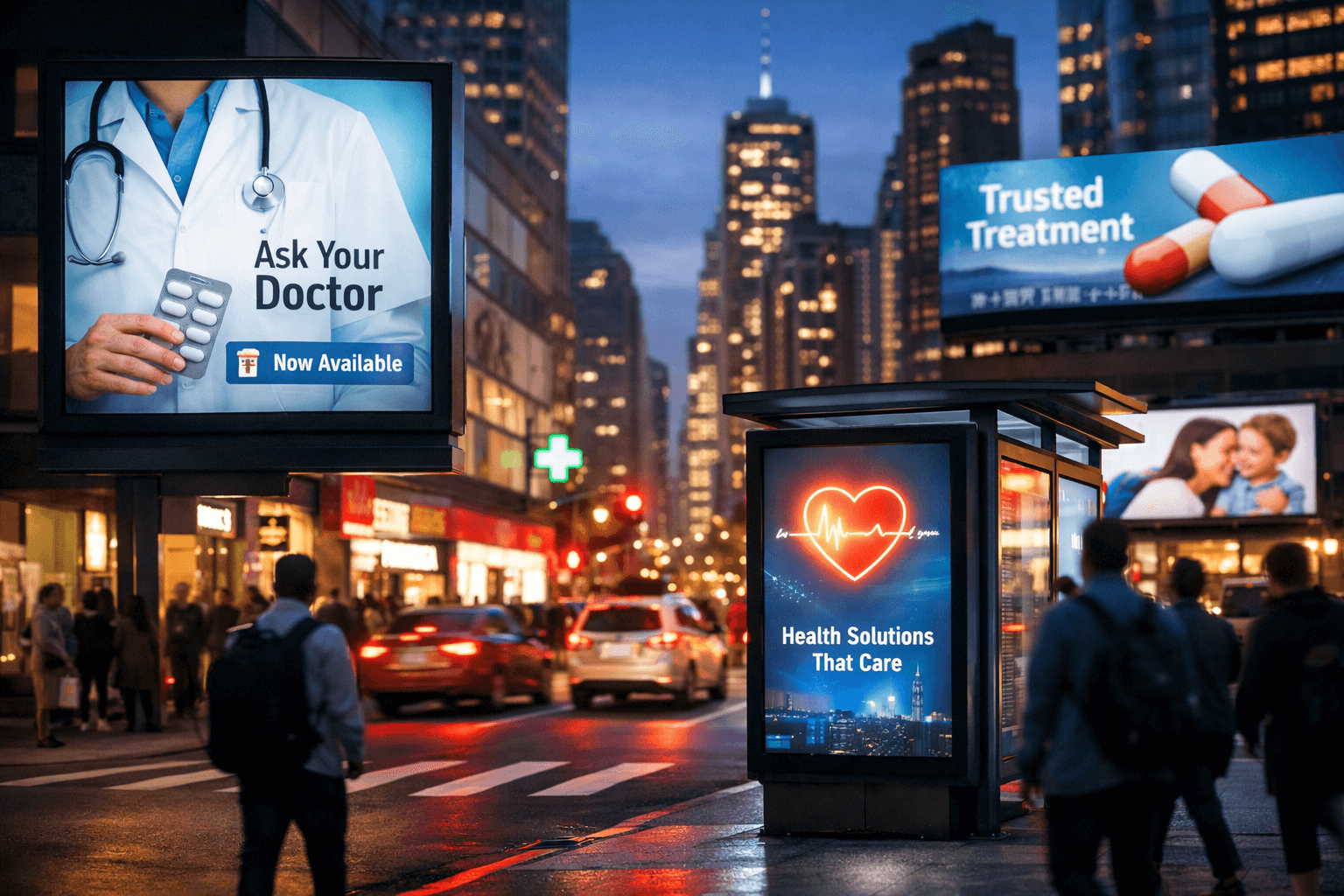
What happens when cookies disappear, targeting gets restricted, and trust becomes the real currency of healthcare marketing? For many brands, this shift feels limiting. However, for pharma marketers, it also opens the door to smarter, more resilient media planning. A well-planned out-of-home strategy for pharma brands offers scale, credibility, and stability at a time when digital signals are shrinking.
Rather than acting as filler spend, modern out-of-home and digital out-of-home media can become a strategic layer that supports access, education, and public confidence. When used intentionally, OOH helps pharma brands show up in trusted public spaces without relying on personal data.
Table of Contents
Why Privacy Changes Are Reshaping Pharma Media
The Strategic Role of OOH in Modern Pharma Marketing
Designing a Privacy-First OOH Approach for Pharma
Measuring Impact Without Personal Data
Integrating OOH With Digital and Retail Health
Why Privacy Changes Are Reshaping Pharma Media
The decline of third-party cookies and the expansion of health data regulations have reshaped how pharma brands reach audiences. Digital channels still matter, yet hyper-targeting now carries more risk and less reach. As a result, marketers are being pushed to rethink how awareness and education are delivered.
Out-of-home media thrives in this environment because it does not depend on individual identifiers. Messages are delivered based on location and context rather than personal tracking. Consequently, compliance concerns are reduced while reach remains strong. For regulated healthcare communications, this balance is increasingly valuable.
At the same time, consumer expectations around privacy have shifted. People are more receptive to health messages when they appear in trusted, real-world environments. This is one reason out-of-home marketing plays such a natural role in pharma when transparency and respect matter most.
The Strategic Role of OOH in Modern Pharma Marketing
OOH works best when it is treated as a core channel rather than a supporting tactic. Unlike fleeting digital impressions, out-of-home builds mental availability through repeated, high-visibility exposure. Over time, this consistency supports brand recall and credibility.
For pharma brands, OOH can serve several strategic purposes. It supports disease awareness without targeting individuals. It reinforces digital messaging by creating real-world touchpoints. It also aligns naturally with retail health environments such as pharmacies, clinics, and testing centers.
When paired with broader healthcare marketing efforts, OOH strengthens omnichannel performance. Increased search activity and site visits often follow strong out-of-home exposure. This is why many teams now view OOH as a strategic layer within pharma marketing, rather than a standalone buy. Agencies such as eHealthCare Solutions often position OOH as a catalyst that improves the effectiveness of other compliant channels.
Designing a Privacy-First OOH Approach for Pharma
A successful out-of-home approach for pharma brands starts with clarity. Marketers must decide whether the primary goal is awareness, education, or access. Each objective influences placement, creative, and timing.
Context has become more important than precision targeting. Messaging placed near hospitals, pharmacies, or commuter routes tied to healthcare professionals delivers relevance without personal data. Digital out-of-home screens also allow for location-based and time-based messaging while remaining privacy safe.
Creative execution matters just as much as placement. Simple language, compliant claims, and clear calls to action help messages land quickly. Because audiences only have a few seconds, clarity builds trust. When appropriate, brands can guide viewers toward safe next steps such as visiting a website, speaking with a healthcare professional, or exploring trusted resources like Healthcare.pro.
Measuring Impact Without Personal Data
Measurement is often the biggest concern when cookies are no longer available. However, OOH offers several privacy-first ways to demonstrate value. Reach and frequency can be modeled using traffic and mobility data, while brand lift studies help measure changes in awareness or perception.
OOH also contributes to indirect performance signals. Increases in branded search, website traffic, or pharmacy inquiries often correlate with strong out-of-home exposure. While attribution may not be one-to-one, the combined insights provide a reliable and compliant view of impact.
Importantly, expectations must match the role of the channel. OOH is not designed for immediate conversion. Instead, it builds the foundation that allows other marketing efforts to perform better. When measurement frameworks reflect this reality, ROI discussions become clearer and more productive.
Integrating OOH With Digital and Retail Health
The true power of OOH in pharma marketing appears when it is integrated across channels. Out-of-home primes awareness, while privacy-safe digital channels capture intent later. For example, a commuter may see an educational message during the day and search for more information at home.
Retail health integration strengthens this effect. OOH placements near pharmacies or clinics support access initiatives and patient support programs. This proximity helps shorten the gap between awareness and action without crossing privacy boundaries.
Consistency across touchpoints is essential. Visual identity, tone, and messaging should align across OOH, digital, and point-of-care materials. When everything feels connected, trust grows. In a regulated environment, that trust often becomes the most valuable outcome.
Conclusion
As privacy regulations tighten and digital targeting evolves, pharma brands need channels built for durability. A modern OOH approach for pharma marketers delivers scale, compliance, and credibility without relying on personal data. When designed with context, creativity, and integration in mind, out-of-home becomes more than a fallback option. It becomes a strategic pillar that supports access, education, and public trust.
FAQ
What makes OOH a privacy-first channel for pharma?
OOH does not rely on personal identifiers or individual tracking. Messages are delivered based on context and location, which aligns well with healthcare privacy regulations.
How does out-of-home support digital pharma campaigns?
OOH builds awareness and recall, which often leads to higher search activity and stronger performance from compliant digital channels.
Is digital out-of-home compliant with healthcare regulations?
Yes, when used correctly. DOOH relies on aggregated and contextual data rather than personal health information.
Can OOH help with patient access and education?
Absolutely. Placements near pharmacies, clinics, and transit routes can effectively support access initiatives and educational efforts.
How should pharma brands measure OOH success?
Brands typically use reach modeling, brand lift studies, and indirect indicators such as search lift or website traffic.
This content is not medical advice. For any health issues, always consult a healthcare professional. In an emergency, call 911 or your local emergency services.