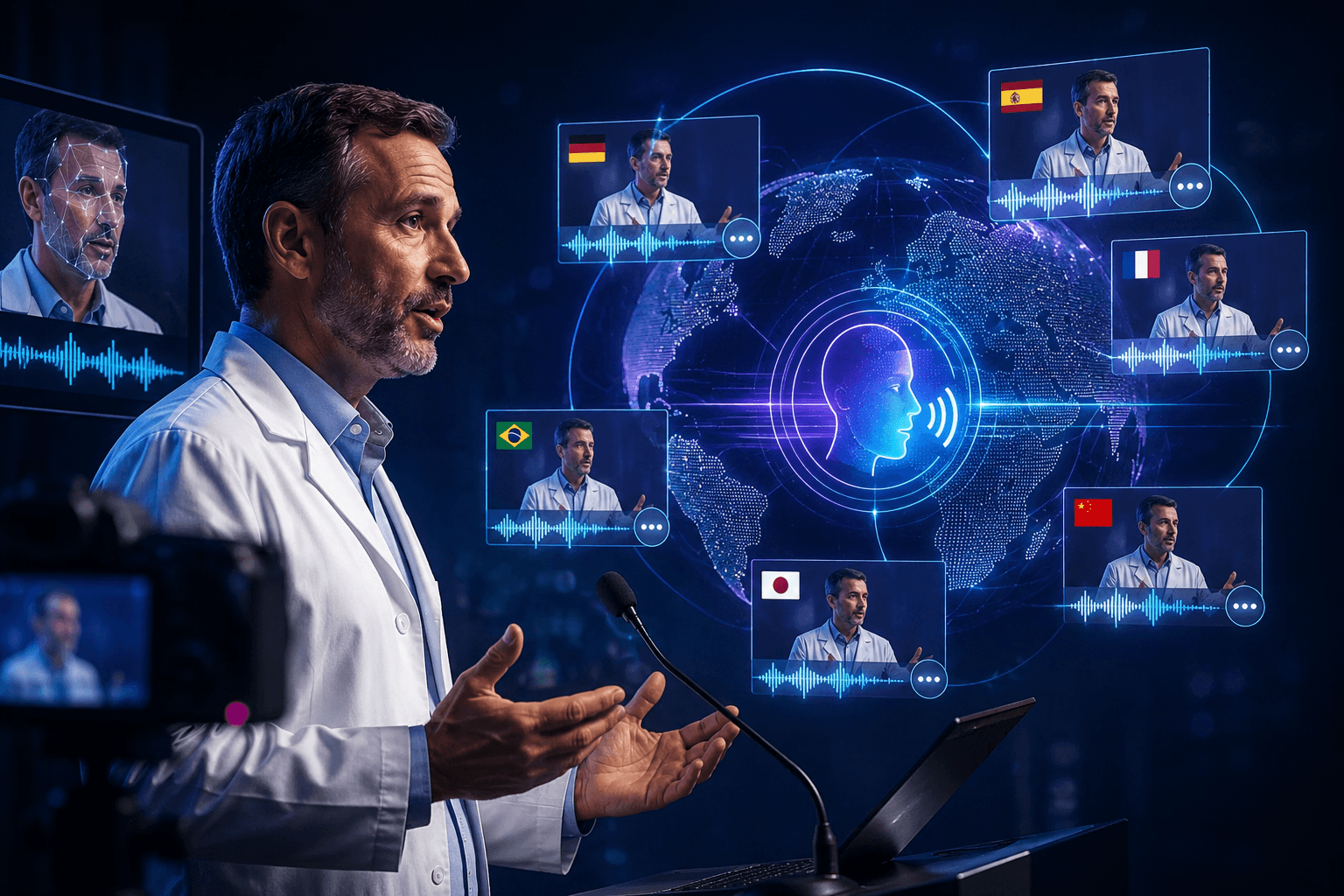
A respected key opinion leader delivers a compelling medical presentation in English. Now imagine that same expert appearing to deliver it naturally in Spanish, Japanese, French, German, and dozens of other languages. The voice sounds familiar, the delivery feels authentic, and even the speaker’s lip movements can match the translated words. AI voice localization in pharma is turning that scenario into a practical option for global medical education.
For pharmaceutical marketers, this shift could dramatically change how expert content travels across markets. Instead of recreating the same presentation with multiple speakers and production teams, companies can adapt one approved source into localized versions. However, healthcare communication demands more than technical accuracy. Consent, scientific integrity, transparency, and regulatory review must travel with the content too.
Table of Contents
- How AI voice localization is changing medical education
- Why one KOL can reach a larger global audience
- Consent, transparency, and regulatory considerations
- Building a responsible AI voice localization workflow
- Conclusion
- FAQs
How AI Voice Localization Is Changing Medical Education
Traditional medical video localization can be slow and expensive. Teams may need translators, voice actors, recording studios, editors, medical reviewers, and local regulatory approval. As a result, expanding one educational asset across many markets can become a major production project.
AI-powered voice localization can streamline several of those steps. Modern systems can translate speech, reproduce characteristics of an authorized speaker’s voice, and synchronize translated audio with video. Consequently, one master presentation can become the foundation for multiple localized assets.
The technology also creates a different experience from subtitles alone. Healthcare professionals can listen to information in a familiar language while maintaining the visual connection with the original expert. Therefore, complex clinical discussions may feel more accessible and natural.
However, localization should never mean simple word-for-word translation. Drug terminology, indications, safety language, clinical claims, and prescribing information can differ between countries. Human medical and legal review remains essential before publication.
This approach fits into the industry’s wider adoption of AI in pharma marketing. AI is already supporting personalization, content workflows, analytics, and customer engagement. Voice localization adds another possibility: scaling expert knowledge without repeatedly rebuilding the original experience.
One KOL Can Reach a Much Larger Global Audience
KOL programs have traditionally faced a basic limitation. An expert may have international credibility but speak only one or two languages fluently. Consequently, local teams often choose between subtitles, conventional dubbing, or recreating content with another presenter.
Synthetic voice technology changes that equation. With appropriate permission, an approved recording could potentially become educational content for audiences across numerous languages. Meanwhile, AI-assisted lip synchronization can make translated video appear more natural than conventional dubbing.
The efficiency opportunity is significant. Teams can start with one scientifically reviewed master asset and create controlled local versions. Moreover, updates may become easier because approved changes can be incorporated without arranging another international filming schedule.
Consistency is another advantage. Traditional localization creates opportunities for differences in emphasis, terminology, or interpretation. A governed AI workflow can help teams maintain closer alignment with approved source material.
Still, efficiency cannot replace local expertise. Medical terminology that sounds natural in the United States may not work in Germany, Japan, or Brazil. Furthermore, local product labels and promotional requirements may differ. Native-speaking medical reviewers should therefore evaluate meaning, tone, pronunciation, and scientific accuracy.
Pharma marketers already exploring AI-generated marketing campaigns should view localization through the same lens. Scale is valuable only when governance scales with it.
Consent, Transparency, and Regulatory Considerations
A cloned voice is not simply another production asset. It represents an identifiable person. Therefore, pharmaceutical companies should obtain clear permission defining how a KOL’s voice and likeness may be generated, translated, edited, distributed, and reused.
Consent should also address practical boundaries. For example, can the synthetic voice be used for future updates? Which languages and markets are permitted? Can sentences be changed after recording? Who approves the final versions? Clear answers can prevent ethical and contractual problems later.
Transparency is equally important because audiences may reasonably assume they are hearing the expert’s actual recording. A simple disclosure explaining that a presentation was translated or localized using AI can help preserve trust.
That principle has become especially relevant in Europe. EU AI Act transparency requirements applying from August 2, 2026 address certain AI-generated and manipulated content, including synthetic audio. Providers of generative AI systems also face requirements concerning machine-readable marking of synthetic content. Pharma organizations operating internationally should therefore assess how these requirements apply to their specific technology and use case.
Regulatory review remains critical as well. AI localization does not change the underlying expectation that pharmaceutical communications be accurate, balanced, and appropriately reviewed. In fact, synthetic media can increase the need for oversight because errors can be reproduced across many markets almost instantly.
Trust should ultimately be treated as part of the product. As Pharma Marketing Network has explored in its coverage of trust in AI-powered pharma experiences, automation works best when human expertise remains visible.
Building a Responsible AI Voice Localization Workflow
Successful pharma voice localization programs should begin with governance rather than software. First, teams should establish documented consent from the KOL and define exactly how synthetic versions of the person’s voice and likeness can be used.
Next, companies need an approved source-of-truth presentation. Claims, references, safety statements, graphics, and spoken content should be finalized before large-scale localization begins. Otherwise, an error in the master version can quickly multiply across markets.
Local medical reviewers should then assess each translated version. They should examine clinical terminology, pronunciation, cultural meaning, and consistency with local labeling. Additionally, legal and regulatory teams should determine whether disclosures or other safeguards are required.
Teams should also maintain records showing which AI tools were used, what source material entered the system, who reviewed each version, and which version received approval. This creates an audit trail and makes future updates easier to manage.
Finally, marketers should consider how localized content will reach healthcare professionals. Digital media partners such as eHealthcare Solutions can support strategies for reaching professional healthcare audiences once compliant content is ready for distribution.
The goal is not to make AI invisible. Instead, organizations can use automation to remove production barriers while keeping human accountability highly visible.
Conclusion
AI voice localization could turn one expert presentation into a global medical education platform. Voice synthesis, translation, and lip synchronization can reduce production barriers while creating more natural experiences for international audiences.
However, the strongest programs will not measure success by the number of languages generated. They will measure scientific accuracy, transparency, consent, regulatory compliance, and audience trust.
The technology may allow one KOL to speak fifty languages. Pharma’s responsibility is making sure every version still communicates the right message.
FAQs
What is AI voice localization in pharma?
AI voice localization uses artificial intelligence to translate spoken pharmaceutical or medical content and generate localized audio, sometimes using an authorized synthetic version of the original speaker’s voice.
Can pharma companies clone a KOL’s voice?
Technology can reproduce voice characteristics, but companies should establish explicit permission and clear contractual boundaries before using a person’s synthetic voice or likeness. Legal requirements can also vary by jurisdiction.
Does AI localization replace medical translators?
No. AI can accelerate production, but qualified human reviewers remain important for medical terminology, scientific meaning, local labeling, cultural context, and regulatory compliance.
Should AI-localized medical videos be disclosed?
Transparency is a strong practice and may also be legally required in some circumstances. In the EU, AI Act transparency rules address certain AI-generated or manipulated content, including synthetic audio.
What is the biggest benefit of AI voice localization for pharma?
Scale is the primary advantage. Companies can potentially adapt one approved educational presentation for many markets while reducing repeated recording and production work. However, governance and human review should scale alongside the technology.
This content is not medical advice. For any health issues, always consult a healthcare professional. In an emergency, call 911 or your local emergency services.