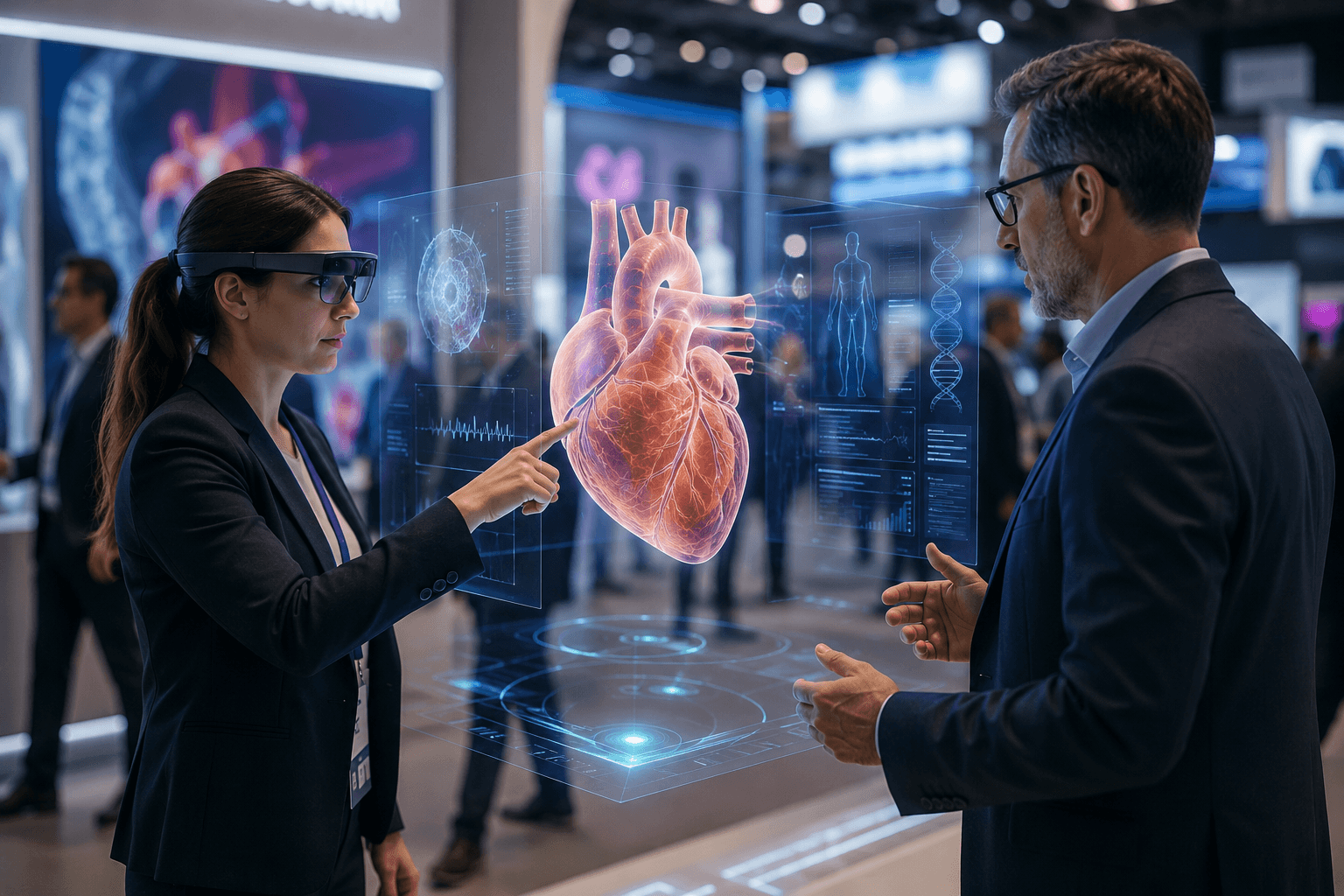
The VR booth was once an easy way to draw a crowd at a medical congress. Put on a headset, enter a virtual environment, and experience something memorable. However, the novelty is wearing off. For many healthcare professionals, simply entering a virtual world is no longer enough.
Spatial computing offers pharma marketing teams a more useful direction. Instead of isolating an attendee inside a VR demonstration, spatial experiences can place interactive anatomy, clinical evidence, and scientific stories within the physical environment. As a result, medical affairs and marketing teams can focus less on the headset and more on helping healthcare professionals understand complex information.
Table of Contents
- Why spatial computing goes beyond traditional pharma VR
- How immersive anatomy can improve HCP engagement
- Turning clinical data into interactive scientific stories
- Building better spatial experiences at medical congresses
- Conclusion
- Frequently Asked Questions
Why Spatial Computing in Pharma Marketing Goes Beyond VR
Virtual reality and spatial computing are related, but they are not the same thing. Extended reality includes VR, augmented reality, and mixed reality, while spatial computing allows digital content to interact more naturally with physical surroundings. Weill Cornell Medicine, for example, describes XR as a form of spatial computing with applications in medical education and clinical practice.
For pharma marketers, that distinction matters. A traditional VR booth often asks an HCP to leave the congress floor mentally, even while standing in the middle of it. Spatial computing can take the opposite approach by bringing digital information into the attendee’s existing environment.
Imagine a cardiologist walking around an interactive 3D heart rather than watching an animation on a flat display. The physician could examine a disease pathway from several angles, reveal anatomical layers, or explore where a therapy acts.
Likewise, an oncologist could interact with a three-dimensional tumor model while relevant clinical information appears alongside it. Instead of clicking through slides, the user explores the information spatially.
Consequently, the technology becomes a tool for understanding rather than the attraction itself. That shift could be especially important as healthcare audiences become more familiar with immersive technology.
Immersive Anatomy Can Make Complex Science Easier to Explore
Medical science is inherently three-dimensional. Organs have depth, disease progresses through physical systems, and mechanisms of action often involve relationships that are difficult to communicate on a flat screen.
Spatial computing in pharma marketing can make those scientific relationships easier to explore. For example, an HCP could enlarge a virtual organ, remove anatomical layers, highlight a receptor, and then examine how a therapeutic mechanism interacts with the disease pathway.
Importantly, these ideas are moving beyond science fiction. Peer-reviewed research and clinical programs are actively exploring extended reality and spatial computing across medical education and healthcare. JMIR XR and Spatial Computing, for example, publishes peer-reviewed research focused on extended reality and spatial computing in health and healthcare.
Healthcare institutions are also testing immersive environments for procedural education, pre-procedural planning, and collaborative learning. The Weill Cornell Medicine Extended Reality Anesthesiology Immersion Lab, for instance, develops XR programs designed to support training and clinical planning.
For pharma teams, however, the goal should not be to imitate clinical applications. Instead, these developments demonstrate how spatial interfaces can support scientific visualization.
The strongest congress experience may therefore be the one where an HCP forgets about the technology. What remains memorable is the scientific idea they were able to see, manipulate, and understand.
Interactive Clinical Data Creates Three-Dimensional Stories
Clinical data presents another opportunity. Congress booths still rely heavily on posters, touchscreens, videos, and presentation decks. Those formats remain useful, but spatial computing can add another layer to scientific storytelling.
Consider a large clinical trial dataset. Rather than presenting every result as another chart, designers could build an interactive evidence environment. An HCP might select patient populations, compare endpoints, explore treatment pathways, or move between different layers of approved clinical information.
The concept is similar to turning a map into a place you can explore. Researchers have already proposed spatial approaches for navigating complex biomedical information, including anatomical and patient-history data.
However, pharma marketers should resist the temptation to make everything three-dimensional. A bar chart does not automatically become more useful because it floats in midair.
Instead, spatial computing works best for pharma marketers when three-dimensional relationships add meaning. Anatomy, molecular interactions, disease progression, device operation, and treatment pathways are natural candidates.
Moreover, spatial experiences can create opportunities for guided conversations between HCPs and medical teams. Rather than placing a physician alone inside a headset, both people could potentially explore the same scientific model.
That shared experience changes the role of immersive technology. It becomes a conversation interface rather than a digital amusement ride.
Building Better Pharma Congress Experiences
The next generation of congress engagement should begin with an educational objective, not a device. Teams should first ask what an HCP needs to understand, remember, compare, or discuss. Only then should they decide whether spatial computing is the right format.
Usability matters as well. Research into virtual and extended reality in health professions education points to the potential of immersive technology for visualization and active learning. However, practical barriers can include cost, technical complexity, accessibility, and poor alignment between the technology and the educational goal.
Therefore, a five-minute experience that clearly explains one difficult concept may deliver more value than a 20-minute technological showcase. Fast onboarding is particularly important on crowded congress floors.
Pharma teams should also think beyond booth traffic as their primary measure of success. Useful metrics could include completion rates, interactions with scientific content, dwell time, requested follow-up materials, and post-experience knowledge assessments.
Compliance must remain central throughout development. Every claim, visualization, data point, and interaction needs the same medical, legal, and regulatory scrutiny applied to other promotional or medical communications.
Finally, marketers should design for reuse. A strong spatial asset could potentially support congress engagement, medical education, field-team conversations, or remote experiences when appropriately developed and approved.
For teams exploring broader digital engagement strategies, Pharma Marketing Network provides additional perspectives on pharmaceutical marketing, advertising, healthcare technology, and emerging digital channels.
Conclusion
The VR booth may not disappear overnight. However, putting an HCP in a headset simply because the technology attracts attention is becoming a weak strategy.
For pharma marketers, spatial computing points toward something more valuable: making complicated science easier to see and explore. Interactive anatomy, three-dimensional disease pathways, shared clinical models, and immersive evidence experiences can turn passive viewing into active learning.
The opportunity is not to build a more impressive virtual world. Instead, it is to build a clearer scientific story.
For pharma marketers, that distinction could determine whether spatial computing becomes another short-lived congress gimmick or a genuinely useful platform for HCP engagement.
Frequently Asked Questions
What is spatial computing in pharma marketing?
Spatial computing combines physical and digital environments so users can interact with three-dimensional information. In pharma marketing, it can support scientific visualization, HCP education, interactive clinical data, and immersive congress experiences.
How is spatial computing different from virtual reality?
VR generally places users inside a fully digital environment. Spatial computing is broader and can blend digital objects and information with the user’s physical surroundings through augmented, mixed, and extended reality technologies.
Can spatial computing improve medical congress engagement?
It can create more interactive experiences when the technology supports a clear educational goal. For example, HCPs could explore anatomy, mechanisms of action, disease pathways, or appropriate clinical information in three dimensions.
Will spatial computing replace traditional pharma booths?
Probably not entirely. Screens, conversations, presentations, and printed materials will continue to have roles. However, spatial experiences can complement these formats when three-dimensional interaction makes complex scientific information easier to understand.
What should pharma marketers consider before investing in spatial computing?
Start with the scientific or educational objective. Then consider usability, HCP relevance, accessibility, measurement, cost, technical support, and medical, legal, and regulatory review before selecting a platform or device.
This content is not medical advice. For any health issues, always consult a healthcare professional. In an emergency, call 911 or your local emergency services.