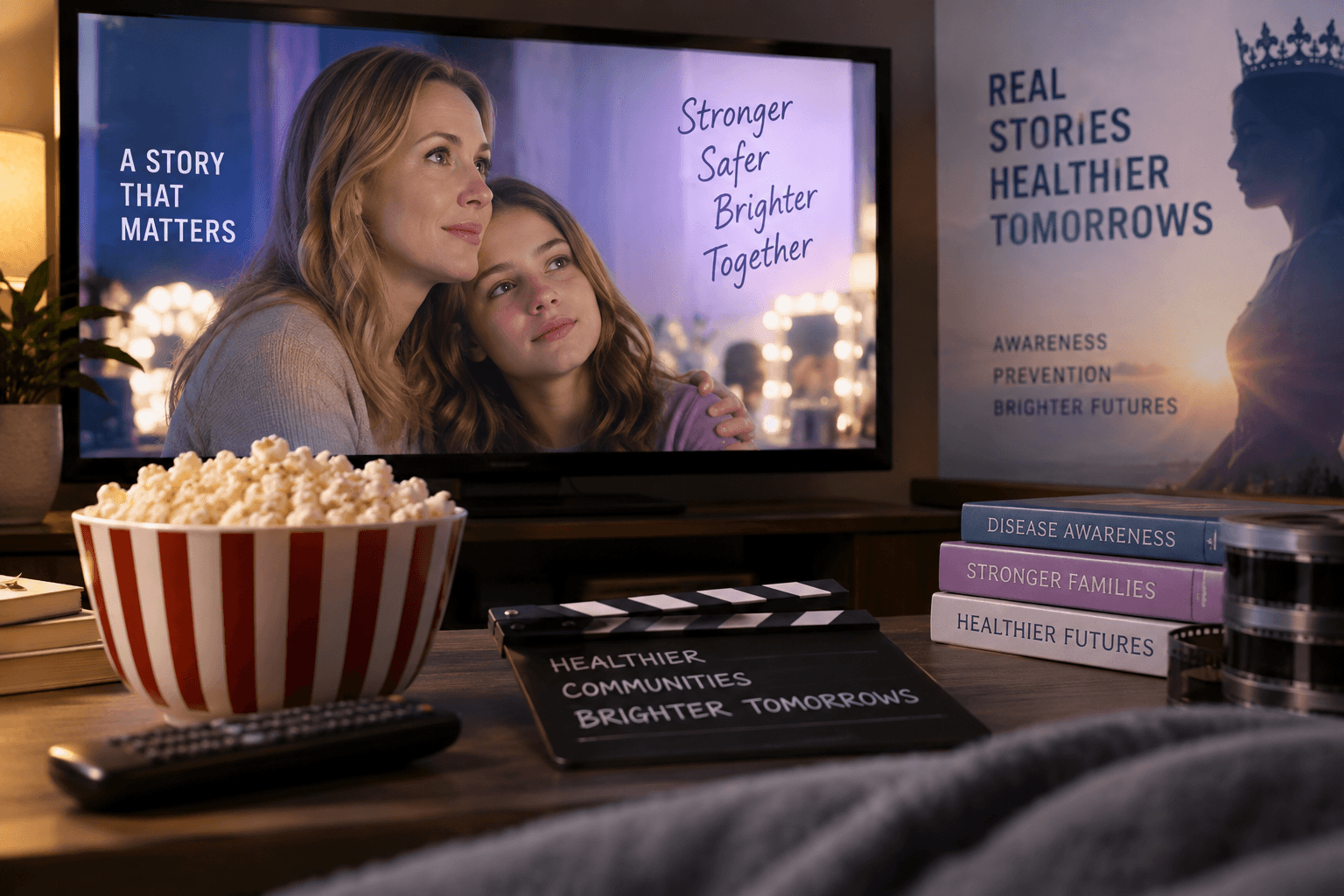
GSK did something unusual for pharmaceutical marketing. Instead of buying another commercial break, the company helped create the entertainment around it. Its sponsored Lifetime original movie, Pretty Hurts, brought meningitis awareness into a feature-length story designed for an audience already accustomed to emotional, family-centered programming.
The experiment has now gained industry recognition. Pretty Hurts won the Pharma TV category at the 2026 Fierce Pharma Marketing Awards, where judges recognized the GSK and Chandler Chicco Agency campaign. Fierce Pharma described the movie as the first pharma-sponsored original film to air on Lifetime and an extension of GSK’s Ask2BSure meningitis awareness campaign.
That makes the project more than an interesting campaign. It offers a useful case study in pharma marketing through entertainment and what happens when a healthcare brand stops interrupting stories and starts helping create them.
Table of Contents
- How Pretty Hurts changed the traditional pharma TV model
- Why pharma entertainment marketing could matter
- The regulatory and trust questions marketers cannot ignore
- Where entertainment-led pharma marketing could go next
- Conclusion
- Frequently Asked Questions
How GSK Turned Meningitis Education Into Entertainment
Pretty Hurts premiered on Lifetime in June 2025 as part of GSK’s Ask2BSure campaign. According to GSK, the company provided financial and content support for the film, which was created to raise awareness of meningococcal disease among parents of teens and young adults.
The plot follows a mother, played by Haylie Duff, whose teenage daughter enters a beauty pageant before meningitis suddenly affects their community. Rather than stopping the story for a conventional health message, the disease becomes part of the narrative.
That distinction matters. Traditional pharmaceutical television advertising generally rents a small piece of someone else’s entertainment. Entertainment-led pharma marketing reverses that relationship. The health topic becomes part of the content viewers came to watch.
For GSK, Pretty Hurts was not a completely isolated experiment. In 2023, the company worked with Lifetime on I Never Thought to Ask: A Mom’s Quest for Answers, a shorter meningitis B awareness film featuring Soleil Moon Frye and Melissa Joan Hart.
Pretty Hurts expanded that idea into a full Lifetime original movie. In other words, the brand moved from sponsored educational content toward something much closer to mainstream entertainment.
There are indications that viewers responded. A+E Global Media reports increases in Ask2BSure awareness and favorability from the campaign, alongside extensive earned-media exposure. The REGGIE Awards case study also reports a sharp increase in meningitis-related search activity associated with the campaign. These are campaign and award-entry figures rather than independent measures, but they suggest that entertainment can generate behavior beyond passive viewing.
Why Pharma Entertainment Marketing Could Matter
Pharmaceutical marketers have spent years trying to make advertising feel less like advertising. Native content, patient stories, influencer partnerships, podcasts and short-form video have all pushed healthcare communications in that direction.
Long-form entertainment takes the idea further. A 30-second commercial has to establish a problem, communicate a message and create recall almost immediately. A movie has time to establish characters, relationships and consequences before asking viewers to think about the underlying health issue.
Consequently, storytelling can provide context that conventional paid media struggles to deliver. For a disease-awareness campaign, that context may be particularly valuable. A condition that sounds abstract in an informational advertisement can become easier to understand when audiences see how it affects a family, school or community.
However, long-form content does not need to replace paid media. Instead, it could become the center of a broader communications system.
A film can generate trailers, social clips, interviews, influencer content, earned media and search interest. Those assets can then direct interested viewers toward deeper disease education or conversations with healthcare professionals.
For pharmaceutical marketers, the opportunity is therefore bigger than producing a movie. The real value may come from building an entertainment property that gives every other channel more material to work with.
The Regulatory Challenge Does Not Disappear
There is an important reason pharma brands cannot simply copy the branded entertainment playbook used by consumer packaged goods companies. Healthcare communications operate within a much more complicated regulatory environment.
The U.S. Food and Drug Administration defines disease-awareness communications as communications discussing a disease or health condition without mentioning a specific drug or device or suggesting a particular product. Once a communication becomes product promotion, different requirements can apply.
For example, FDA rules require certain direct-to-consumer television and radio prescription drug advertisements that name a drug and its conditions of use to communicate major risks clearly, conspicuously and neutrally.
There is also a subtler communications problem. FDA research has examined “conflation,” where consumers may confuse disease-awareness communications with nearby prescription drug advertising. Similar visuals, close timing and repeated exposure can affect how consumers interpret drug benefits and risks.
Therefore, entertainment does not remove the need for careful separation between education and promotion. If anything, deeper audience engagement makes clarity even more important.
Marketers will need to consider sponsorship transparency, medical accuracy and the relationship between unbranded storytelling and any branded campaign surrounding it. That does not make entertainment impossible. It simply means the creative concept and regulatory strategy need to develop together rather than meeting during final review.
Where Entertainment-Led Pharma Marketing Goes Next
Pretty Hurts does not mean every pharmaceutical company needs to commission a television movie. The more important lesson is the shift in mindset.
For decades, pharma advertising has largely focused on reaching audiences inside existing media environments. Entertainment-led campaigns ask whether healthcare companies can create content people actively choose to consume.
That could take many forms. Documentary series, podcasts, scripted streaming content, creator collaborations and patient-led programs can all combine education with storytelling without requiring a feature-film budget.
Indeed, other healthcare marketers are already experimenting with unconventional formats. At the 2026 Fierce Pharma Marketing Awards, argenx and Avalere Health won the Online Video or Film category for CIDP Unscripted, which used improv concepts to explore communication and unpredictability for people affected by chronic inflammatory demyelinating polyneuropathy.
The challenge will be maintaining the reason people watch entertainment in the first place. If a movie feels like a 90-minute commercial, audiences will recognize it. Conversely, if the health message becomes so subtle that viewers miss the intended education, the campaign may fail strategically.
Successful healthcare entertainment campaigns therefore have to serve two audiences at once. They need to respect the viewer as an entertainment consumer while delivering useful, responsible healthcare information.
That balance may ultimately be Pretty Hurts’ most interesting contribution to pharmaceutical marketing.
Conclusion
GSK’s Pretty Hurts represents a notable evolution in healthcare storytelling. Its 2026 Fierce Pharma Marketing Award adds industry recognition to an experiment that had already moved disease awareness beyond conventional advertising.
Still, the larger opportunity is not simply “pharma makes movies.” It is the possibility of designing healthcare communications around stories audiences voluntarily spend time with, then connecting those stories to paid media, social content, search, education and other campaign channels.
Pretty Hurts may not replace the 30-second pharma commercial. However, it suggests that the commercial no longer has to be where the story begins.
Frequently Asked Questions
What is pharma entertainment marketing?
Pharma entertainment marketing brings healthcare or disease-awareness messages into entertainment-oriented content such as films, video series, podcasts and other storytelling formats. The approach aims to create content audiences actively choose to consume rather than relying only on advertising interruptions.
What is GSK’s Pretty Hurts?
Pretty Hurts is a Lifetime original movie sponsored by GSK as part of its Ask2BSure meningitis awareness campaign. It premiered in June 2025 and uses a fictional family story to raise awareness of meningococcal disease.
Did Pretty Hurts win a Fierce Pharma Marketing Award?
Yes. GSK and Chandler Chicco Agency’s Pretty Hurts: Meningitis Awareness Through Entertainment won the Pharma TV category at the 2026 Fierce Pharma Marketing Awards.
Could entertainment replace traditional pharma advertising?
Entertainment is more likely to complement traditional channels than replace them. Long-form storytelling can build attention and context, while paid media, search, social campaigns and educational resources can extend the message and provide next steps.
What should pharma marketers consider before using entertainment content?
Marketers should consider audience value, medical accuracy, sponsorship transparency and regulatory requirements from the beginning. They should also clearly distinguish disease education from product promotion and evaluate how entertainment content connects with the wider campaign.
This content is not medical advice. For any health issues, always consult a healthcare professional. In an emergency, call 911 or your local emergency services.