Direct-to-patient pharma is evolving from an access experiment into a broader commercial strategy. Manufacturer-led platforms such as LillyDirect and PfizerForAll are creating more connected paths between patients, healthcare providers, pricing support, pharmacies, and fulfillment. As a result, pharmaceutical marketers can no longer think only about generating awareness and prescription intent. Increasingly, what happens after a prescription is written can influence whether commercial demand becomes an actual patient.
Table of Contents
- From prescription demand to patient conversion
- Why post-prescription UX becomes a commercial issue
- What direct models mean for pharma marketing teams
- Building a long-term patient relationship
- Conclusion
- Frequently Asked Questions
Direct-to-Patient Models Move Beyond Prescription Demand
For decades, pharmaceutical commercial strategy largely focused on influencing two critical decisions. First, marketers sought to build awareness and demand among patients. Second, field teams and professional campaigns worked to support informed treatment decisions among healthcare professionals.
However, a prescription does not automatically translate into a filled prescription.
Cost, prior authorization, pharmacy availability, confusing enrollment processes, and fulfillment delays can all create friction after the physician makes a prescribing decision. Consequently, those steps represent potential points of commercial leakage.
Direct-to-patient models give manufacturers a larger role in closing that gap.
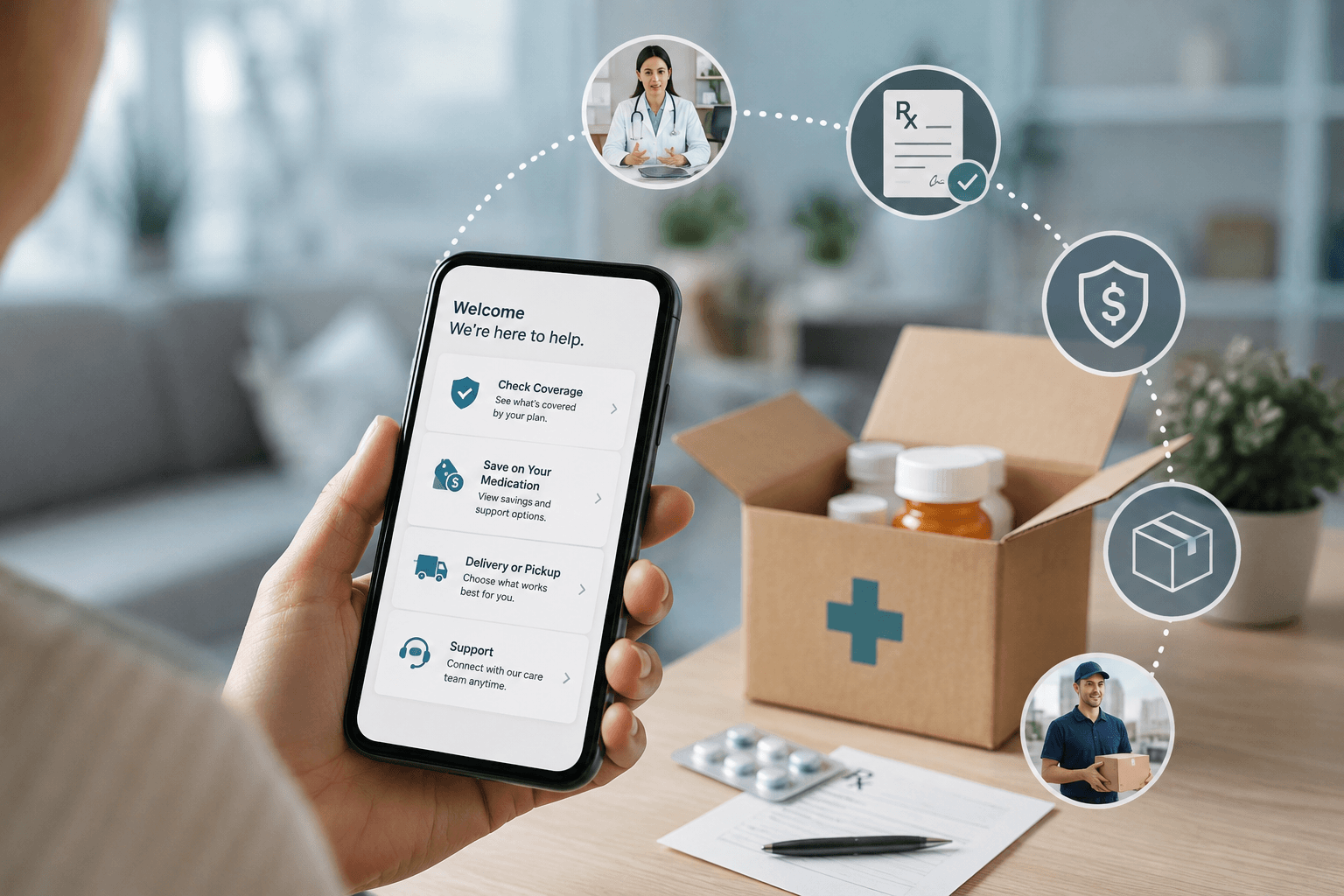
LillyDirect, for example, connects eligible patients with pharmacy services, savings and coverage guidance, prescription support, and delivery or pickup options. Lilly says its model works with licensed third-party dispensing pharmacies rather than simply replacing pharmacies altogether.
Similarly, PfizerForAll was introduced as an end-to-end digital platform connecting consumers with healthcare professionals, vaccine scheduling, testing, medications, savings, and support. Pfizer has continued to describe PfizerForAll as part of its direct-to-consumer strategy.
Therefore, the competitive question is changing. It is no longer only, “Can we generate a prescription?” It is increasingly, “Can we help the patient successfully move from prescription to treatment?”
Post-Prescription UX Becomes Part of Commercial Strategy
This shift gives pharmaceutical marketers a new conversion funnel to consider.
Imagine a patient who sees an ad, researches a condition, speaks with a physician, and receives a prescription. Traditional campaign measurement might treat that sequence as a success. Yet the patient could still encounter a high out-of-pocket price, an insurance issue, a delayed prior authorization, or uncertainty about where to obtain the medicine.
Each additional obstacle creates another opportunity for abandonment.
That makes the post-prescription user experience increasingly relevant to commercial performance. In practice, marketers may need to understand metrics that once sat primarily with patient services, market access, pharmacy operations, or other teams.
For example, prescription-to-fill conversion, time to therapy, checkout abandonment, fulfillment completion, refill behavior, and support interactions can provide important signals about the patient journey.
LillyDirect illustrates how extensive that journey can become. Its patient experience can include insurance checks for select medicines, savings support, prior authorization assistance, checkout, home delivery or pickup, refill support, and shipment tracking through participating partners.
As a result, the direct-to-patient model starts looking less like a media channel and more like a service design challenge.
Pharma Marketing Must Connect Media, Access and Fulfillment
The change also has implications for how pharmaceutical organizations structure commercial teams.
Brand marketing, media, market access, patient services, analytics, technology, and fulfillment have traditionally operated with different objectives and data streams. However, direct models make those boundaries harder for patients to see.
A consumer does not care which department owns a broken checkout experience. Likewise, a patient waiting for medication may not distinguish between a brand promise, pharmacy partner, benefits investigation vendor, or delivery provider.
The experience feels like one journey.
That means pharma marketers may need a broader definition of omnichannel strategy. Omnichannel cannot stop when a patient clicks “find a doctor” or downloads a savings card. Instead, marketing strategy should account for the handoffs that determine whether motivated patients actually begin treatment.
The industry is already moving in this direction. L.E.K. Consulting has identified LillyDirect, NovoCare, PfizerForAll, AmgenNow, AstraZeneca Direct, and other manufacturer initiatives as evidence of expanding direct pharmaceutical platforms. The broader trend suggests that biopharma companies increasingly see these platforms as part of commercialization rather than simply a temporary access tactic.
Still, going direct does not necessarily mean eliminating traditional distribution. Pharmacies, distributors, healthcare professionals, and other partners continue to perform essential roles throughout the prescription journey.
Therefore, the likely future is not purely direct. Instead, it is a more connected hybrid commercial ecosystem.
Direct-to-Patient Strategies Create an Ongoing Patient Relationship
Perhaps the biggest strategic change comes after fulfillment.
Historically, pharmaceutical brands have had limited direct visibility into what happens between one prescription and the next. Direct platforms can create more opportunities for patients to interact with support services throughout treatment.
That relationship can include refill reminders, affordability support, coverage guidance, shipment information, educational resources, and access to pharmacists or other appropriate services.
For commercial teams, however, this opportunity comes with significant responsibility. Healthcare is not conventional ecommerce, and prescription medicines cannot be marketed like ordinary consumer products. Privacy, regulatory requirements, clinical independence, pharmacovigilance, and appropriate use must remain central to the experience.
Moreover, success should not be defined simply by making it easier to “buy” a medicine. A stronger measure is whether the model reduces unnecessary friction after an appropriate prescribing decision.
That distinction matters for both patients and brands.
As manufacturer-led patient platforms evolve, the strongest models may be those that combine convenience with trust. Clear pricing information, transparent handoffs, reliable support, and straightforward fulfillment can become part of the brand experience itself.
In turn, commercial strategy becomes less about isolated moments of persuasion and more about managing a connected patient journey.
Conclusion
The “pharma-as-a-pharmacy” idea does not mean manufacturers will literally replace pharmacies. Rather, it describes a broader commercial shift in which manufacturers take greater responsibility for connecting the pieces surrounding prescription access and fulfillment.
For brand teams, that changes the job. Generating prescription intent remains important, but reducing conversion friction, improving post-prescription UX, and supporting continuity can matter too.
This direct-to-patient approach therefore brings marketing closer to market access, patient services, technology, and operations. Companies that manage those connections well may gain more than another distribution option. They may create a more measurable, useful, and lasting relationship with patients.
Frequently Asked Questions
What is direct-to-patient pharma?
Direct-to-patient pharma refers to models in which drug manufacturers play a more direct role in connecting patients with services such as care navigation, prescription support, pricing, pharmacy fulfillment, and delivery.
Is direct-to-patient pharma the same as direct-to-consumer advertising?
No. Direct-to-consumer advertising primarily generates awareness and demand. Direct-to-patient models can extend further into access, affordability support, prescription processing, fulfillment, and ongoing patient services.
Are LillyDirect and PfizerForAll online pharmacies?
Not exactly. Both rely on partnerships and existing healthcare infrastructure. LillyDirect works with licensed third-party dispensing pharmacies, while PfizerForAll connects consumers with healthcare and pharmacy services through participating partners.
What should pharma marketers measure in a direct-to-patient model?
In addition to traditional reach and engagement metrics, teams can examine prescription-to-fill conversion, time to therapy, abandonment points, fulfillment completion, support engagement, and refill behavior where appropriate and compliant.
Will direct-to-patient platforms replace traditional pharmacies?
That appears unlikely in the near term. Instead, current models point toward a hybrid approach in which manufacturers create a more coordinated patient experience while pharmacies, distributors, healthcare professionals, and other partners continue to perform essential roles.
This content is not medical advice. For any health issues, always consult a healthcare professional. In an emergency, call 911 or your local emergency services.