Every pharmaceutical marketer has faced the same challenge: how do you create a campaign that people remember without crossing regulatory boundaries? While compliance is essential, many Medical, Legal, and Regulatory (MLR) review processes unintentionally remove the emotional elements that make healthcare communications meaningful. As a result, campaigns often become informative but forgettable.
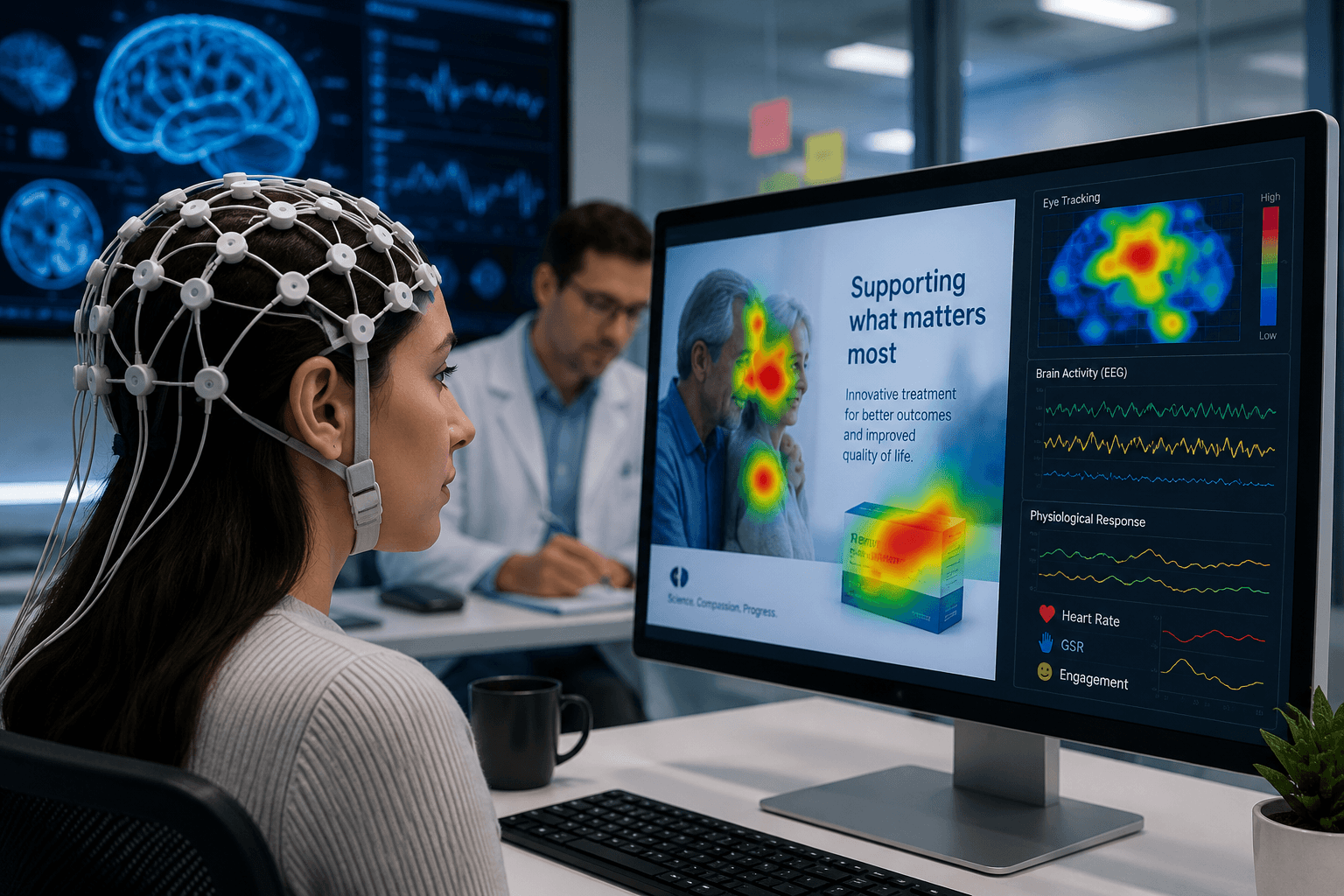
This is where neuromarketing is beginning to reshape pharmaceutical marketing by giving teams objective ways to measure emotional engagement. Rather than relying solely on surveys or focus groups, pharmaceutical companies can now evaluate subconscious emotional responses through biometric research. Technologies such as eye tracking, electroencephalography (EEG), facial coding, and physiological response testing provide objective insights into how healthcare professionals and patients actually experience marketing materials before they are launched.
The goal is not to replace creativity or regulatory oversight. Instead, it is to provide evidence that helps creative teams develop campaigns that are both compliant and emotionally engaging.
Table of Contents
- Why emotion matters in pharmaceutical marketing
- Understanding neuromarketing in the pharmaceutical industry
- The role of biometric research
- Balancing compliance with emotional engagement
- The future of evidence-based marketing
- Frequently Asked Questions
Why Emotional Engagement Still Matters in Pharmaceutical Marketing
Healthcare decisions are grounded in science, yet they are rarely free from emotion. Physicians remember compelling educational content more easily than repetitive product claims. Likewise, patients often respond better to messages that acknowledge their fears, hopes, and daily challenges.
However, pharmaceutical marketers operate within one of the world’s most highly regulated industries. Every advertisement, digital campaign, sales aid, and patient education piece must satisfy strict regulatory standards. Consequently, many creative concepts become increasingly conservative throughout the MLR review process.
Although this approach reduces compliance risk, it can also weaken audience engagement. When every campaign follows the same predictable structure, brands struggle to differentiate themselves in crowded therapeutic markets.
Research in behavioral science consistently demonstrates that emotional engagement improves attention, memory formation, and decision-making. According to the Nielsen Norman Group, visual attention and cognitive processing significantly influence how users absorb information across digital experiences.
For pharmaceutical companies, the challenge is finding measurable ways to assess emotional resonance without introducing unnecessary regulatory risk.
What Is Neuromarketing in the Pharmaceutical Industry?
Neuromarketing in pharma applies neuroscience and behavioral research techniques to pharmaceutical communications. Instead of asking participants how they feel, researchers observe physiological and neurological responses that occur during exposure to marketing materials.
Several technologies are becoming increasingly valuable.
Eye tracking identifies exactly where viewers focus their attention, revealing whether important safety information, claims, or calls to action are actually being noticed.
EEG measures electrical brain activity associated with attention, cognitive workload, and emotional engagement. While it does not read thoughts, it helps researchers understand which content generates stronger mental processing.
Facial expression analysis evaluates subtle emotional reactions that may occur too quickly for participants to consciously report.
Physiological measurements such as galvanic skin response, heart rate variability, and pupil dilation can indicate levels of excitement, stress, or engagement during message exposure.
Together, these tools offer marketers objective data that complements traditional qualitative research.
Rather than replacing focus groups, neuromarketing research adds another layer of evidence that supports creative decision-making.
Using Biometrics Before MLR Review
One of the greatest advantages of biometric testing is its ability to evaluate campaign effectiveness before expensive production and lengthy review cycles.
Creative concepts can be tested using low-fidelity prototypes, digital mockups, videos, or website designs. Researchers then measure which elements naturally attract attention and which messages generate stronger emotional responses.
For example, eye tracking may reveal that physicians consistently overlook important efficacy data because imagery unintentionally draws attention elsewhere.
Similarly, EEG analysis might demonstrate that one patient story produces greater cognitive engagement than another, even though both meet identical regulatory requirements.
These insights allow creative teams to refine layouts, messaging hierarchy, visuals, and storytelling before submitting materials for formal MLR approval.
As a result, companies may reduce costly revisions while improving campaign performance.
Organizations looking to modernize commercial strategy can also benefit from working with specialized healthcare marketing partners. Agencies focused on pharmaceutical communications, such as the Pharma Marketing Network, regularly explore emerging technologies that support evidence-based marketing innovation.
Can Neuromarketing Improve Emotional Engagement Without Compromising Compliance?
Many marketers assume compliance and emotional storytelling are fundamentally incompatible. Fortunately, that assumption is increasingly being challenged.
Emotion does not require exaggerated claims or promotional language. Instead, it often comes from authenticity, empathy, clarity, and patient-centered communication.
Biometric testing provides objective evidence showing whether creative concepts successfully connect with audiences while maintaining regulatory integrity.
Rather than debating subjective opinions during creative reviews, teams can reference measurable engagement data.
This approach encourages more productive conversations among marketers, medical reviewers, regulatory specialists, and legal teams.
Importantly, neuromarketing should never be viewed as a substitute for ethical marketing practices. Patient privacy, informed consent, scientific accuracy, and transparent research methods remain essential.
When applied responsibly, biometric research simply helps teams better understand how audiences experience healthcare communications.
The Future of Neuromarketing in Pharmaceutical Marketing
Artificial intelligence, predictive analytics, and neuroscience are rapidly changing healthcare marketing. As these technologies mature, pharmaceutical organizations will have greater opportunities to evaluate campaign effectiveness before launch.
Instead of relying exclusively on post-campaign performance metrics, marketers may increasingly optimize communications during development using objective behavioral evidence.
This evolution supports a more scientific creative process that aligns naturally with the evidence-driven culture of the pharmaceutical industry.
The future of neuromarketing in pharmaceutical marketing is unlikely to replace traditional market research. Instead, it will complement existing methods by providing deeper insights into attention, engagement, and emotional resonance.
Ultimately, the brands that successfully combine compliance with meaningful storytelling will be better positioned to educate healthcare professionals, support patients, and build lasting trust.
Conclusion
Pharmaceutical marketing has always balanced scientific accuracy with effective communication. Today, advances in biometric research offer a promising way to strengthen that balance. Eye tracking, EEG analysis, facial coding, and physiological response testing provide objective insights into how audiences experience marketing materials long before campaigns reach the market.
While regulatory compliance will always remain essential, it no longer has to come at the expense of emotional engagement. By incorporating neuromarketing research into pharmaceutical campaign development, organizations can make more informed creative decisions, improve audience attention, and develop communications that are both compliant and memorable.
Frequently Asked Questions
What is pharma neuromarketing?
Pharma neuromarketing refers to the application of neuroscience and biometric research techniques to pharmaceutical marketing. It helps organizations measure attention, emotional engagement, and message effectiveness before campaigns launch.
Is neuromarketing compliant with pharmaceutical regulations?
Yes. When conducted ethically and with informed participant consent, neuromarketing research supports creative optimization while complementing MLR review and regulatory approval processes.
How does eye tracking improve pharmaceutical campaigns?
Eye tracking reveals where healthcare professionals or patients focus their attention, allowing marketers to improve layouts, safety information placement, and messaging hierarchy.
Can EEG predict whether a campaign will succeed?
No. EEG cannot predict commercial success by itself, but it provides valuable insights into cognitive engagement and emotional processing that complement traditional market research.
Will neuromarketing replace focus groups?
No. Most experts consider neuromarketing research a complementary tool that enhances traditional qualitative and quantitative research rather than replacing it.
This content is not medical advice. For any health issues, always consult a healthcare professional. In an emergency, call 911 or your local emergency services.