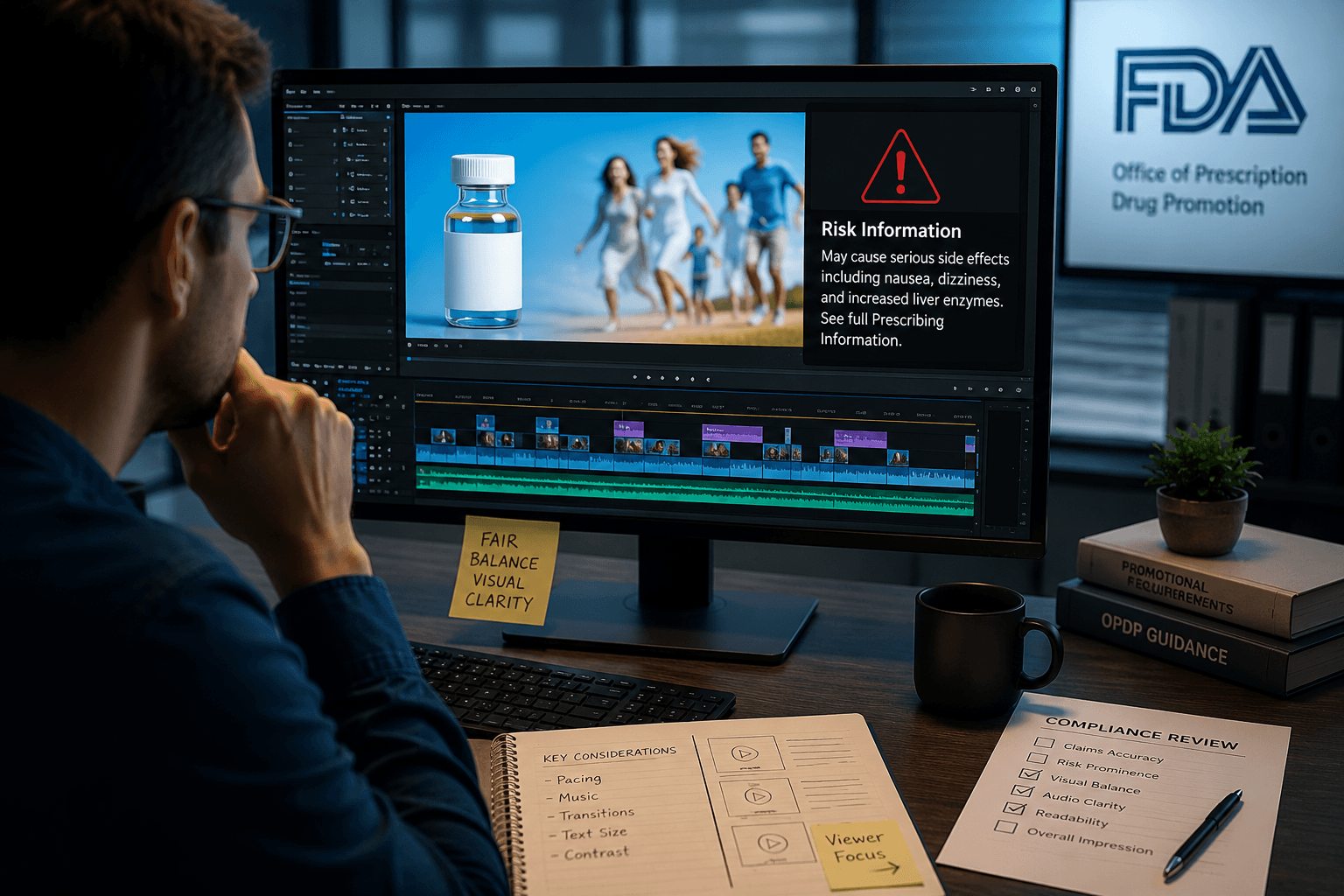
A patient watches a branded drug commercial on their phone while scrolling through social media. Bright visuals flash across the screen. A hopeful soundtrack plays underneath smiling families and fast-moving transitions. Somewhere in the background, a voice quickly lists side effects.
But what does the viewer actually remember?
That question is becoming increasingly important for pharmaceutical marketers, creative agencies, and compliance teams. The FDA’s Office of Prescription Drug Promotion (OPDP) is paying closer attention not only to what pharma ads say, but also to how video content presents risk information visually and emotionally.
This shift has created a growing compliance challenge for brands investing heavily in video-first campaigns. A modern pharmaceutical video compliance framework must now evaluate visual pacing, emotional tone, audio layering, screen movement, and audience attention patterns alongside traditional regulatory review.
As branded video becomes central to omnichannel marketing, companies that ignore visual balance may face greater regulatory scrutiny.
Table of Contents
- Why FDA scrutiny of video design is increasing
- How visual distraction affects fair balance
- The hidden compliance risks in branded video assets
- Building FDA-safe pharmaceutical video campaigns
- FAQs
Why FDA Scrutiny of Video Design Is Increasing
Historically, pharmaceutical advertising reviews focused heavily on claims language, disclosure accuracy, and omission of material facts. Yet digital media has transformed how audiences consume healthcare information. Modern viewers process short-form content quickly, often on mobile devices with limited attention spans.
As a result, OPDP has signaled increasing concern about whether risk information remains noticeable and understandable within visually dynamic environments.
A growing number of warning and untitled letters have referenced presentation issues tied to readability, prominence, and audience distraction. While many pharma marketers assume compliance simply means including risk language somewhere in the video, regulators are examining whether consumers can realistically absorb that information.
This distinction matters.
For example, a rapid montage of smiling patients, scenic imagery, energetic transitions, and emotionally uplifting music may unintentionally overpower spoken side effect disclosures. Similarly, small-font supers, fleeting risk text, or crowded visuals can reduce audience comprehension even when the required information technically appears onscreen.
In other words, the FDA increasingly evaluates the consumer experience, not just the existence of disclosures.
This evolving environment means pharma marketers must rethink how creative execution affects regulatory perception.
How Visual Distraction Affects Fair Balance
Fair balance remains one of the foundational principles of pharmaceutical advertising regulation. Drug benefits and risks must receive reasonably comparable treatment. Yet visual storytelling can unintentionally shift that balance.
Several design elements commonly create compliance concerns in branded video campaigns.
Fast-Paced Editing and Motion Graphics
Quick cuts and animated visuals can make risk information harder to process. When important disclosures compete against moving graphics or rapid transitions, viewers may focus on emotional stimulation rather than medical context.
This issue becomes especially important in social media video formats where attention spans are already compressed.
Even subtle motion behind supers can reduce readability. For this reason, many regulatory reviewers now encourage calmer visual environments during risk presentation sequences.
Music and Emotional Framing
Audio also shapes consumer perception.
Upbeat music layered beneath risk narration may soften the perceived seriousness of adverse events. Emotional storytelling can create positive associations that unintentionally minimize cautionary information.
This does not mean pharma brands must eliminate music entirely. However, a thoughtful pharma video review process should consider whether the emotional tone of the soundtrack aligns with the seriousness of the disclosures being communicated.
In some cases, lowering music intensity or simplifying visuals during risk narration can significantly improve fair balance.
Visual Priority and Attention Competition
Modern pharmaceutical videos often contain multiple simultaneous stimuli. Logos, patient scenes, captions, transitions, animations, and product imagery may all appear while risk information is delivered.
The problem is cognitive overload.
Research consistently shows that audiences cannot fully absorb competing information streams at the same time. When visually engaging content dominates the screen, risk communication may become secondary in practice even if it remains technically visible.
For compliance teams, the key question becomes simple: what is the viewer most likely to remember?
The Hidden Compliance Risks in Branded Video Assets
Many pharmaceutical organizations still treat compliance review as a final checkpoint rather than an integrated creative process. Unfortunately, that approach can create hidden vulnerabilities.
A strong compliance strategy for pharma video campaigns starts early in concept development, not after production is complete.
Social Media Compression Risks
Video content designed for platforms like LinkedIn, Instagram, YouTube, or connected TV often undergoes aggressive compression. Smaller screens and autoplay environments can reduce readability and audio clarity.
What appears compliant in an editing suite may become problematic in real-world viewing conditions.
Therefore, review teams should evaluate content across multiple devices and playback scenarios before approval.
International Adaptation Challenges
Global campaigns also introduce complexity. Subtitle formatting, translation length, and regional disclosure requirements may affect visual pacing and readability.
A compliance-friendly U.S. video may require substantial adaptation for other regulatory environments.
Pharma marketers working across markets should coordinate closely with medical, legal, and regulatory teams to avoid inconsistent presentation standards.
According to FDA OPDP guidance, promotional materials must communicate information truthfully and without misleading impressions. Visual execution increasingly influences how regulators interpret that standard.
Building FDA-Safe Pharmaceutical Video Campaigns
Effective compliance does not require sacrificing creativity. In fact, the most successful pharmaceutical campaigns often combine emotional storytelling with disciplined visual clarity.
The goal is balance.
Create Risk-Focused Design Standards
Pharma companies should develop standardized rules for:
- Minimum supers duration
- Font size and contrast
- Motion limitations during disclosures
- Audio mixing standards
- Transition pacing during risk narration
These standards help reduce subjectivity during review cycles while improving consistency across campaigns.
Organizations seeking broader digital compliance alignment may also benefit from integrated healthcare marketing governance frameworks such as those discussed at Pharma Marketing Network.
Involve Regulatory Teams Earlier
Compliance review should begin during storyboarding and scripting phases rather than post-production.
Early collaboration allows creative teams to design around fair balance requirements instead of retrofitting compliance changes later. This approach often reduces revision costs while preserving storytelling quality.
Many organizations now include medical-legal-regulatory reviewers in creative concept workshops for this reason.
Test for Audience Comprehension
Some advanced marketers conduct user testing to evaluate whether audiences actually understand disclosed risks.
This practice can identify hidden distraction problems before launch. Eye-tracking studies, readability testing, and comprehension surveys may provide valuable insights for high-profile campaigns.
Importantly, these evaluations support both regulatory protection and stronger patient communication outcomes.
Align Compliance With Patient Trust
Ultimately, visually balanced communication is not only about avoiding FDA scrutiny. It also supports long-term brand credibility.
Patients expect healthcare companies to communicate transparently. When disclosures appear rushed, obscured, or visually minimized, trust can erode even if regulators never intervene.
A modern pharmaceutical marketing compliance approach therefore serves two purposes simultaneously: regulatory protection and audience confidence.
Conclusion
Video has become one of the most persuasive tools in healthcare marketing. However, the same creative techniques that capture audience attention can also create regulatory risk when they overpower or distract from important safety information.
Fast edits, emotional music, layered graphics, and overloaded visuals may unintentionally weaken fair balance even when disclosures technically appear onscreen. As a result, pharmaceutical brands must think beyond simple disclosure placement and focus on the full viewer experience.
The most effective pharma marketing compliance approach combines creative engagement with disciplined presentation standards. By integrating compliance considerations early in production, simplifying distraction-heavy sequences, and prioritizing audience comprehension, marketers can create branded video assets that remain both compelling and regulator-ready.
FAQs
Why is the FDA focusing on pharma video design?
The FDA is increasingly concerned that visual elements like fast editing, music, and motion graphics may distract viewers from important risk information in pharmaceutical advertising.
What does compliance mean in pharmaceutical video marketing?
A strong pharmaceutical video compliance process helps brands communicate benefits and risks fairly while staying aligned with FDA promotional standards.
Can music create compliance issues in pharma ads?
Yes. Upbeat or emotionally persuasive music can unintentionally minimize the seriousness of side effect disclosures if not balanced appropriately.
How can pharma marketers improve fair balance in video ads?
Marketers can improve fair balance by simplifying visuals during risk narration, increasing supers readability, reducing competing stimuli, and involving compliance teams earlier.
Does OPDP review visual presentation or only claims language?
OPDP evaluates both. Regulators increasingly examine how visual design affects audience understanding and whether disclosures remain noticeable and understandable.
This content is not medical advice. For any health issues, always consult a healthcare professional. In an emergency, call 911 or your local emergency services.