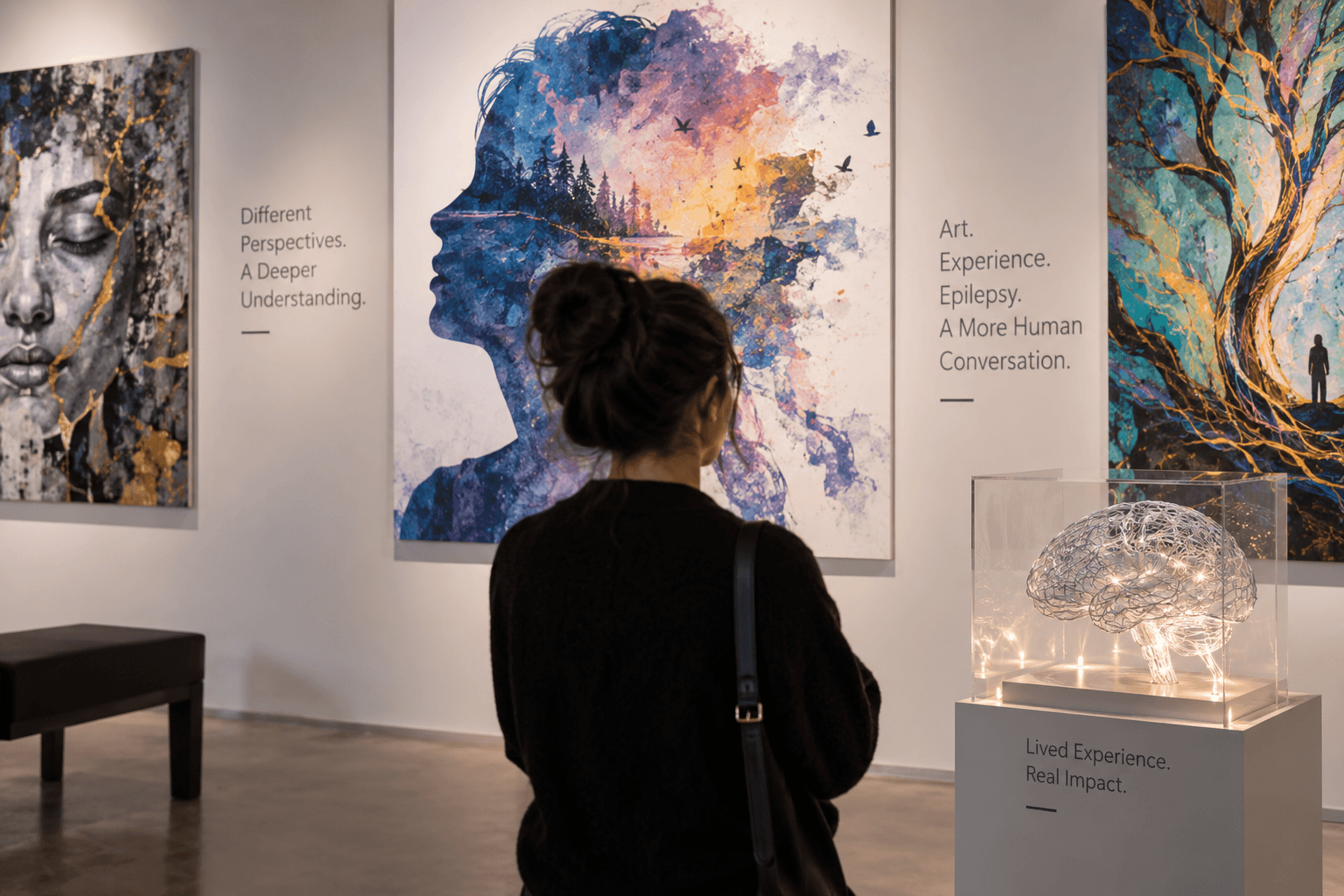
What does epilepsy feel like when no seizure is visible? That is a much harder question to answer than explaining symptoms, prevalence, or treatment options. UCB is approaching that challenge through experiential disease education, using art created by people living with epilepsy to communicate parts of the condition that conventional health information can struggle to capture.
The biopharma company launched Expressing Epilepsy, a global initiative built around art, storytelling, and lived experience. The project debuted at the 2026 European Epilepsy Congress in Athens and features original work from three artists living with epilepsy.
For pharma marketers, the campaign raises a bigger question. When audiences already know the basic facts about a disease, could helping them experience its emotional reality be the more powerful form of education?
Table of Contents
- Why epilepsy creates a different communication challenge
- How UCB turns lived experience into disease education
- What experiential storytelling changes for pharma marketers
- Lessons for future disease awareness campaigns
- Conclusion
- FAQs
Why Epilepsy Needs More Than Traditional Disease Education
Traditional disease education is good at answering factual questions. What are the symptoms? How common is the condition? When should someone seek medical attention? Those questions matter, but they do not always explain what living with a condition actually feels like.
Epilepsy illustrates that gap particularly well. The World Health Organization estimates that around 50 million people worldwide live with epilepsy, making it one of the world’s most common neurological diseases. Yet stigma and misunderstanding remain significant challenges.
Moreover, epilepsy can carry emotional, psychological, and social effects that are harder to place on an infographic. UCB describes experiences involving uncertainty, relationships, isolation, identity, and the wider impact on families.
That difference matters to marketers. Awareness of a condition is not the same as understanding it.
As Pharma Marketing Network has explored in its coverage of year-round disease awareness strategy, effective education increasingly requires ongoing engagement rather than isolated awareness moments. More experiential approaches to disease education can add another dimension, moving audiences beyond knowing the facts toward understanding what those facts mean in everyday life.
UCB Makes Art the Medium for Epilepsy Storytelling
Expressing Epilepsy features artists Noëmi Manser, Anastasia Egonyan, and Stephanie Gowdy. Each uses a different creative medium to interpret experiences shaped by epilepsy.
Their work includes painting, textiles, photography, sketches, and mixed media. Rather than illustrating a clinical definition of epilepsy, the pieces explore ideas such as identity, uncertainty, resilience, family impact, fear, and control.
That distinction makes the initiative interesting from a marketing perspective.
A conventional testimonial generally asks someone to describe an experience. Here, artistic expression becomes part of the experience itself. Audiences must interpret what they see and connect emotionally with another person’s perspective.
For example, Manser paints with both hands simultaneously, a technique UCB says developed from her experience of living with epilepsy. Gowdy’s work considers how epilepsy can affect families and support networks, while Egonyan uses her art to reflect experiences that can be difficult to express verbally.
UCB also extended the physical exhibition into a virtual experience, allowing people beyond the congress to explore the artwork and stories. Consequently, experiential patient education does not have to depend on an elaborate live event. Digital experiences can extend that same emotional connection to a much broader audience.
When Disease Education Becomes an Experience
There is a subtle but important shift happening here. Traditional awareness campaigns often measure whether audiences received or remembered information. Experiential campaigns may need to ask whether audiences understood something differently afterward.
That changes the creative brief.
Instead of asking, “What facts should people remember?” marketers can also ask, “What perspective should people leave with?”
For invisible or misunderstood conditions, that can be especially important. Statistics can communicate scale, while symptom lists can improve recognition. However, neither automatically communicates fear, isolation, unpredictability, stigma, or the effect a condition has on someone’s identity.
Experience-led disease education offers marketers another way to close that gap. Art, interactive environments, audio, virtual experiences, patient-created content, and other sensory formats can make audiences active participants rather than passive recipients.
Still, emotional communication requires discipline. Pharma Marketing Network’s examination of emotional storytelling in pharma highlights the need to balance compelling narratives with accuracy, consent, privacy, and compliance. Emotional power should deepen understanding rather than manipulate audiences.
For marketers building digital extensions of these experiences, eHealthcare Solutions provides healthcare-focused digital advertising opportunities that can help educational content reach relevant professional audiences.
What Pharma Marketers Can Learn From Expressing Epilepsy
The first lesson is simple: patient experience can be the creative idea rather than supporting material added after the campaign is designed.
That requires involving people living with the condition early enough to influence how the story takes shape. Otherwise, experiential marketing risks becoming a polished interpretation of patients rather than an authentic expression created with them.
Second, marketers should identify the specific communication gap they are trying to solve. If the problem is low symptom recognition, clear informational content may remain the best approach. However, if the problem is stigma, emotional distance, or misunderstanding of invisible disease burden, another fact sheet may accomplish little.
Third, experiential disease education should still lead somewhere. Emotional engagement can open the door, but audiences need credible information, patient resources, advocacy connections, or other useful next steps.
Finally, measurement should reflect the objective. Impressions and exhibition visits provide reach metrics, but they reveal little about whether perceptions changed. Marketers may also need qualitative research, sentiment measurement, content engagement, message recall, and pre-and-post exposure studies.
The larger opportunity is not to replace clinical education with emotion. Instead, it is to recognize that understanding a disease can require both.
Conclusion
UCB’s Expressing Epilepsy initiative suggests a different direction for disease communication. Rather than asking artists to decorate an educational message, the company has made their lived experiences central to the message itself.
That approach will not fit every condition or campaign. However, it highlights an important distinction for pharma marketers: awareness tells people that a disease exists, while understanding helps them appreciate what living with it can mean.
When the challenge involves stigma, invisible disease burden, identity, or experiences that resist simple explanation, immersive and patient-led storytelling may communicate something conventional educational materials cannot. Sometimes the next step in patient education is not finding better words. It is finding a different language.
FAQs
What is experiential disease education?
It uses interactive, sensory, creative, or patient-led storytelling to help audiences understand what living with a health condition can feel like, rather than relying only on clinical facts.
What is UCB’s Expressing Epilepsy initiative?
Expressing Epilepsy is a global UCB awareness initiative using artwork and personal perspectives from artists living with epilepsy to encourage understanding, conversation, and greater recognition of the condition’s often-hidden impact.
Why can art work in pharmaceutical disease education?
Art can communicate emotions and experiences that are difficult to reduce to statistics or symptom lists. Therefore, it may be particularly useful when campaigns need to address stigma, empathy, identity, or invisible disease burden.
Should experiential storytelling replace traditional patient education?
No. Clinical information remains essential. Experiential approaches can complement factual education by adding emotional and human context to disease understanding.
How should pharma marketers measure experiential disease education?
In addition to reach and engagement, marketers can examine changes in understanding, sentiment, message recall, resource use, and willingness to discuss the condition. Those measures can provide a clearer picture of whether an experience actually changed perceptions.
This content is not medical advice. For any health issues, always consult a healthcare professional. In an emergency, call 911 or your local emergency services.